2026 Toyota Camry Hybrid: MPG, AWD, Trims, Price, Features, and Buyer Guide
This buyer guide focuses on practical decisions: LE, SE, SE Nightshade, XLE, and XSE trim context, FWD vs available Electronic On-Demand AWD, real-world fuel economy factors, commuting, small-family use, road trips, financing, leasing, resale value, and whether a new 2026 Camry Hybrid makes more sense than a used Camry Hybrid. If you are also comparing Toyota models beyond the Camry, start with our 2026 Toyota Models USA guide for the broader lineup.
Quick Answer
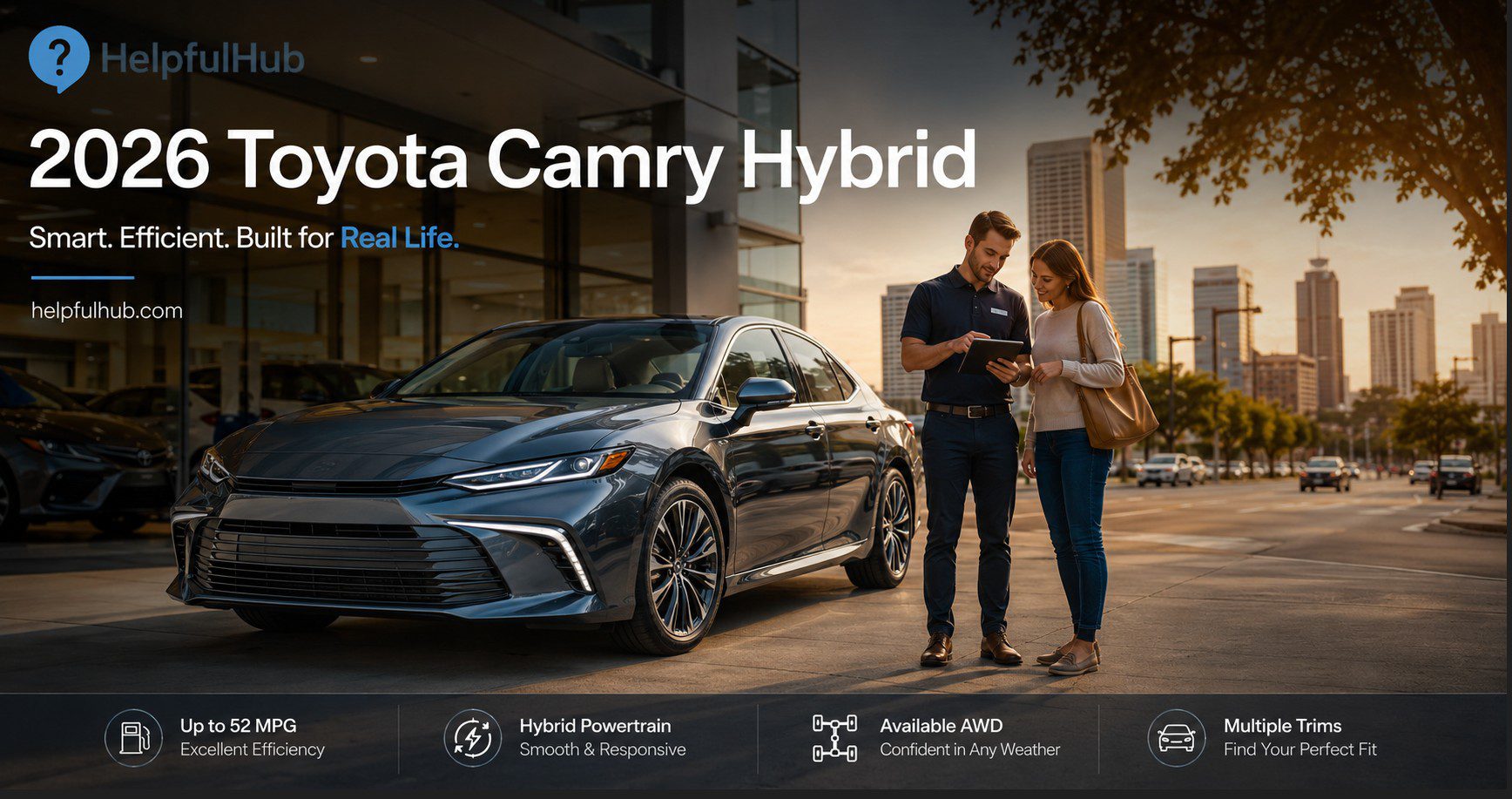
The 2026 Toyota Camry Hybrid is a midsize sedan built around an all-hybrid lineup. It is a strong fit for commuters, small families, students, young professionals, and fuel-conscious drivers who want hybrid efficiency without stepping up to an SUV. Toyota lists up to a 51 combined EPA-estimated mpg rating, up to 232 net combined horsepower, available Electronic On-Demand AWD, and Toyota Safety Sense 3.0. FWD may make the most sense for buyers focused on maximum fuel economy and lower complexity, while available AWD may matter for snowbelt states, hilly areas, or poor-weather confidence. The best trim depends on your priorities: value, comfort, sportier styling, tech, or premium features. Before purchasing, compare current trim pricing, MPG ratings, comfort, technology, insurance quotes, financing or lease offers, dealer fees, incentives, destination charge, accessories, and local availability with Toyota or a nearby dealer.
2026 Toyota Camry Hybrid: What US Buyers Should Know
The 2026 Toyota Camry Hybrid is designed for buyers who still want the low seating position, easy highway manners, and fuel efficiency of a midsize sedan. It is not a plug-in hybrid and it is not a full EV. Instead, it uses Toyota’s hybrid system to blend gasoline and electric power without requiring the driver to plug in.
That point matters for everyday US buyers. You do not need home charging, public charging, or an EV route plan. You drive it like a regular sedan, but the hybrid system helps improve fuel use in city traffic, suburban errands, and daily commuting.
The 2026 Camry Hybrid also sits in an important middle ground. It is larger than a compact sedan, easier to park than many SUVs, and more fuel-focused than many non-hybrid midsize cars. For drivers who spend time on American highways, school routes, office commutes, and weekend trips, that balance is the main reason to consider it.
2026 Toyota Camry Hybrid Key Buyer Details at a Glance
| Buyer Topic | What to Know | What to Verify Before Buying |
|---|---|---|
| Powertrain | All-hybrid Camry lineup for 2026 | Confirm exact trim and drivetrain details with Toyota or your dealer |
| Fuel Economy | Toyota lists up to 51 combined EPA-estimated mpg | Check MPG by trim, wheel size, and drivetrain |
| Drivetrain | FWD and available Electronic On-Demand AWD | Confirm AWD availability on the exact trim you want |
| Performance | Toyota lists up to 232 net combined horsepower | Compare FWD and AWD output if performance matters |
| Trims | LE, SE, SE Nightshade, XLE, and XSE context | Compare standard features, packages, and dealer inventory |
| Best Fit | Commuters, small families, fuel-conscious sedan buyers | Test drive your preferred trim before choosing |
| Price | Varies by trim, options, destination, fees, and location | Verify current MSRP, dealer fees, incentives, and final out-the-door price |
Why the Camry Hybrid Matters in Toyota’s USA Lineup
The Camry has long been one of Toyota’s best-known nameplates in the United States. The 2026 Camry Hybrid matters because it turns the mainstream midsize sedan into a hybrid-first choice rather than treating the hybrid as a separate niche model.
That makes the Camry different from many older sedan shopping patterns. In the past, some buyers compared a gas Camry against a Camry Hybrid. For 2026, the all-hybrid approach makes the main decision less about gas vs hybrid and more about trim, drivetrain, features, and monthly cost.
In Toyota’s broader electrified lineup, the Camry Hybrid is the practical sedan option. It sits beside compact choices like the 2026 Toyota Corolla and Corolla Hybrid, SUV choices like the 2026 Toyota RAV4 Hybrid and Plug-in Hybrid, and full EV directions such as the 2026 Toyota C-HR EV and 2026 Toyota bZ Woodland.
For many buyers, the Camry Hybrid may be the simplest electrified Toyota to live with. It gives you hybrid efficiency without the cargo height of an SUV and without the charging questions that come with battery-electric vehicles. That is why it deserves its own supporting guide instead of being treated as just one line in a broad Toyota lineup article.
Quick Comparison: Camry Hybrid Trims, FWD, and AWD
The trim decision should start with how you actually drive. A commuter who wants maximum efficiency may look at the LE first. A buyer who wants sportier styling may prefer SE, SE Nightshade, or XSE. A small-family buyer who values a quieter cabin, comfort upgrades, and technology may compare XLE and XSE more closely.
AWD should be treated as a functional choice, not just a feature to check off. If you live in a state with heavy rain, snow, steep roads, or frequent winter travel, available AWD may be worth comparing. If you live in a warmer climate and care most about fuel economy, FWD may be the smarter value.
2026 Camry Hybrid Trim Buyer Guide
| Trim | Likely Buyer Fit | Why It May Make Sense | What to Compare |
|---|---|---|---|
| LE | Efficiency-focused commuters | Typically the value and MPG-focused starting point | Standard features, seat comfort, and FWD vs AWD availability |
| SE | Drivers who want a sportier look | Adds a more athletic design direction without moving to the highest trim | Ride feel, wheel size, MPG rating, and price difference vs LE |
| SE Nightshade | Style-focused buyers | Black exterior accents and a more distinctive appearance | Whether the appearance upgrade is worth the added cost |
| XLE | Comfort and technology shoppers | More premium interior and available upscale features | Packages, infotainment, seating, and final monthly payment |
| XSE | Sport-premium sedan shoppers | Combines sporty design with higher-end features | Ride comfort, tire cost, MPG rating, and insurance quote |
All-Hybrid Camry Lineup Explained
The all-hybrid Camry lineup means every 2026 Camry is built around hybrid power. That is good news for buyers who want a simpler shopping process. You no longer need to ask whether the hybrid is a special version of the Camry. Instead, the Camry itself is the hybrid sedan.
A hybrid sedan uses a gasoline engine, electric motors, a hybrid battery, and electronic controls to manage power. In normal driving, the system can blend electric assistance and gasoline power automatically. The driver does not need to select a special charging routine.
This setup is especially useful in stop-and-go traffic. City driving, school drop-off lines, suburban errands, and slow commute traffic often give hybrid systems more chances to save fuel compared with traditional gas-only vehicles. However, real-world MPG still depends on speed, weather, terrain, tire pressure, cargo load, driving habits, trim, and drivetrain.
Buyers should also understand what the 2026 Camry Hybrid is not. It is not a plug-in hybrid, so it does not offer a plug-in electric-only range like some PHEVs. It is not a battery EV, so it does not rely on charging stations. This makes it a practical bridge for shoppers who want electrified efficiency but still prefer a familiar gasoline-refueling routine.
Trim Overview: LE, SE, SE Nightshade, XLE, and XSE
The best 2026 Toyota Camry Hybrid trim depends on how you define value. For some drivers, value means the lowest practical payment and strong MPG. For others, it means a quieter interior, larger screen, upgraded seating, or sportier styling that makes the car feel more enjoyable every day.
The LE is the natural starting point for buyers who want a practical Toyota hybrid sedan. The SE adds a sportier look and feel. The SE Nightshade builds on that with blacked-out design elements for buyers who want a stronger visual presence.
The XLE moves the Camry toward a comfort-focused experience. It may appeal to shoppers who spend more time on highways or want a more upscale cabin. The XSE is the sport-premium direction, giving buyers a more aggressive design while keeping the hybrid sedan foundation.
Do not choose a trim only from photos. Sit in the exact model, check the seat fabric or trim, test the infotainment screen, compare visibility, and drive on roads similar to your daily commute. A trim that looks better online may not feel better during a long commute.
FWD vs Available AWD: Which Camry Setup Makes Sense?
Front-wheel drive is often the simplest choice for Camry Hybrid buyers. It may be the better fit if you live in a mild climate, drive mostly on paved roads, and want to prioritize fuel economy, lower purchase price, and a straightforward ownership experience.
Available Electronic On-Demand AWD may be worth considering if you live in the snowbelt, drive through frequent rain, travel hilly roads, or want more traction confidence in poor weather. Toyota’s AWD approach uses electric assistance at the rear when conditions call for it, but buyers should still remember that AWD does not replace winter tires, safe speed, or careful driving.
The most practical way to decide is to compare your real driving environment. A buyer in Florida, Texas, Arizona, or Southern California may not need AWD. A buyer in Michigan, Minnesota, Colorado, Pennsylvania, upstate New York, or northern New England may value it more.
FWD vs AWD Camry Hybrid Decision Table
| Driving Situation | FWD May Be Better If | AWD May Be Better If |
|---|---|---|
| Daily commute | You drive mostly dry city and suburban roads | You face wet, icy, or snowy commutes often |
| Fuel economy priority | You want the highest possible MPG rating by configuration | You accept a possible MPG difference for traction confidence |
| Budget | You want to keep the purchase price and payment lower | You can justify the added cost for your climate and use |
| Road trips | You travel mostly in mild weather | You often drive mountains, winter roads, or variable weather |
| Long-term ownership | You prefer the simplest setup for your needs | You plan to keep the car in a region where AWD helps resale appeal |
MPG and Real-World Fuel Economy Considerations
Toyota lists the 2026 Camry Hybrid with up to a 51 combined EPA-estimated mpg rating. That makes MPG one of the biggest reasons to shop this sedan. However, buyers should not assume every trim and drivetrain gets the same fuel economy.
Wheel size, tire type, drivetrain, trim, traffic conditions, speed, air conditioning use, winter temperatures, and driving habits can all affect real-world MPG. A highway-heavy driver moving at high speeds may see different results than a city commuter using gentle acceleration.
The best MPG strategy is simple. Compare the official rating for the exact trim and drivetrain you plan to buy. Then think about your actual route. A commuter who drives 45 minutes through stop-and-go traffic may benefit differently than a driver who spends most of the time at 75 mph on open interstate roads.
Also compare fuel economy with total cost. If a higher trim adds features you want but slightly changes MPG, the right answer depends on how long you will keep the car, how many miles you drive, and how much the monthly payment changes.
Exterior Design and Midsize Sedan Practicality
The 2026 Camry Hybrid keeps the core shape of a midsize sedan. That gives it a lower ride height than most crossovers, a more traditional trunk layout, and a footprint that works well in city parking, office garages, and suburban driveways.
Exterior styling varies by trim. Sportier trims may use more aggressive design cues and larger wheels, while comfort-oriented trims may feel more understated. The SE Nightshade is especially focused on appearance, so shoppers should decide whether the blacked-out look matters enough to affect the final price.
Practicality is not just about dimensions. It is about how the car fits your life. Before buying, check how easy it is to park, how the doors open in tight spaces, whether the trunk opening works for your luggage, and whether rear-seat access is comfortable for children, adults, or older family members.
Interior Technology, Comfort, and Everyday Usability
Interior usability can matter more than exterior styling over a five-year ownership period. In the 2026 Toyota Camry Hybrid, shoppers should compare seat comfort, screen size, phone integration, climate controls, storage space, charging ports, rear-seat comfort, and visibility.
Some features vary by trim or package. Higher trims may offer larger displays, more premium seating materials, upgraded audio, additional comfort features, or available driver assistance upgrades. However, a lower trim may still be the smarter buy if it gives you the features you use every day without raising the payment too much.
During a test drive, pair your phone, check the steering wheel controls, adjust the driver’s seat, test rear visibility, and sit in the back seat. If multiple people will drive the car, make sure each driver can find a comfortable position. Small details can become daily annoyances after purchase.
Daily Commuting and City Driving
The 2026 Camry Hybrid is likely to be most attractive to commuters. A midsize hybrid sedan can make sense for drivers who want strong MPG, a quiet cabin, comfortable seating, and predictable highway behavior without buying a larger SUV.
City and suburban driving also suit the Camry Hybrid’s purpose. Stoplights, traffic waves, school routes, grocery runs, and mixed-speed errands are the kind of driving where many hybrid buyers expect better fuel use than a comparable non-hybrid vehicle. Still, your results will vary.
If you commute daily, focus on seat comfort, visibility, steering feel, brake feel, infotainment ease, and safety features. A trim with the best appearance may not be the best commuting trim. The right commuter car is the one that feels calm, efficient, and easy to live with every day.
Commuter, Small-Family, and Road-Trip Use Case Table
| Use Case | What Matters Most | Camry Hybrid Buying Tip |
|---|---|---|
| Daily commuter | MPG, seat comfort, easy controls, insurance cost | Compare LE, SE, and XLE before moving to higher-cost packages |
| Student or young professional | Payment, fuel cost, reliability expectations, safety features | Get insurance quotes before choosing a sportier trim |
| Small family | Rear-seat access, trunk space, safety tech, comfort | Bring child seats, stroller, or luggage during the dealership visit |
| Highway driver | Cabin quietness, adaptive cruise, seating, fuel range | Test drive at highway speeds if possible |
| Road-trip buyer | Comfort, trunk loading, rear vents, driver assistance | Compare XLE and XSE features with your budget |
Small-Family Use, Trunk Space, and Road Trips
A Camry Hybrid can work well for small families that do not need SUV ride height or three rows. It may be enough for daily school runs, daycare drop-offs, weekend errands, and family road trips if the trunk and rear seat fit your needs.
However, sedan practicality is different from SUV practicality. A trunk can be secure and useful, but it is not as flexible as a tall cargo area. If you carry large strollers, sports gear, pets, or bulky road-trip items, compare the Camry Hybrid with a compact SUV before buying.
Road-trip shoppers should pay attention to seat comfort and cabin noise. Higher trims may offer comfort upgrades that matter on long drives. However, they may also cost more to insure or replace tires on, depending on wheel and tire choices.
Safety and Driver Assistance Considerations
Toyota lists Toyota Safety Sense 3.0 for the 2026 Camry. This is an important part of the Camry Hybrid’s appeal because many buyers want driver assistance features for commuting, highways, and family use.
Driver assistance systems can help reduce stress, but they do not make the car self-driving. Buyers should understand how features work, when they operate, and what warnings appear on the dashboard. During the test drive, ask the dealer to explain the systems on the exact trim you are considering.
Also compare standard and available safety features by trim. Blind spot monitoring, rear cross-traffic alerts, parking assistance, camera systems, and traffic assist features may vary by trim or package. Read the window sticker carefully instead of assuming every Camry has the same equipment.
Camry Hybrid vs Corolla Hybrid
The Camry Hybrid vs Corolla Hybrid decision is mostly about size, comfort, budget, and driving feel. The Corolla Hybrid may appeal to buyers who want a smaller Toyota hybrid sedan with a lower cost of entry. The Camry Hybrid is likely better for shoppers who want more midsize comfort, stronger highway presence, and a roomier sedan feel.
If you are a student, first-time Toyota buyer, or city driver with a tight parking situation, the Corolla Hybrid deserves a look. If you often carry passengers, drive longer distances, or want more comfort for family use, the Camry Hybrid may feel more complete.
For a deeper compact Toyota comparison, read our Toyota Corolla Hybrid guide. Then test drive both cars on the same day if possible. The difference in seating position, ride feel, cabin space, and trunk usability may be clearer in person than on a spec sheet.
Camry Hybrid vs RAV4 Hybrid
The Camry Hybrid vs RAV4 Hybrid decision is a classic sedan vs SUV choice. The Camry Hybrid may be better for buyers who want a lower driving position, sedan handling, strong fuel efficiency, and a traditional trunk. The RAV4 Hybrid may be better for buyers who need more cargo flexibility, higher seating, easier loading, or a more SUV-like daily experience.
Families should be honest about cargo needs. If you often carry strollers, sports bags, home improvement items, or bulky luggage, the RAV4 may be easier to live with. If your cargo needs are moderate and you prefer sedan comfort, the Camry may be the more efficient and refined daily driver.
Use our Toyota RAV4 Hybrid guide if you want SUV-specific details. The key is not which model is better overall. The key is which model matches your parking, cargo, commuting, and budget needs.
Camry Hybrid vs Corolla Hybrid vs RAV4 Hybrid Buyer Fit Table
| Model Path | Best For | Why Choose It | Why Compare Alternatives |
|---|---|---|---|
| Camry Hybrid | Midsize sedan shoppers | Balanced comfort, efficiency, and daily usability | Not as cargo-flexible as an SUV |
| Corolla Hybrid | Budget-focused compact sedan buyers | Smaller footprint and strong efficiency focus | Less midsize comfort and space than Camry |
| RAV4 Hybrid | Small SUV shoppers | More cargo flexibility and higher seating | May cost more depending on trim and market |
Camry Hybrid vs Other Toyota Electrified Options
The Camry Hybrid is not the only electrified Toyota path. It is simply the sedan path. Buyers who want more space may compare the Toyota Highlander electrification outlook for larger family SUV thinking. Buyers who want a full EV may compare the Toyota C-HR EV or bZ Woodland instead.
Rugged and truck-focused shoppers are looking at a different mission. A Camry Hybrid will not replace the off-road feel of the 2026 Toyota 4Runner or the utility of the Toyota Tacoma i-FORCE MAX. Those models serve buyers who need trail capability, hauling, or truck-style flexibility.
For most sedan shoppers, the main comparison should stay focused on Camry vs Corolla vs RAV4. The larger Toyota lineup matters only when your lifestyle clearly points away from a sedan. If you want a broader view of hybrids, plug-in hybrids, EVs, and future transportation, visit our electric mobility guide.
Ownership Cost, Insurance, and Maintenance
Ownership cost is more than the price on the window sticker. A 2026 Toyota Camry Hybrid buyer should estimate fuel, insurance, maintenance, registration, taxes, financing interest, tire replacement, depreciation, and possible repair costs over time.
Hybrid maintenance is often similar to regular vehicle maintenance in many everyday areas, such as tires, brakes, filters, fluids, and inspections. However, hybrid components and battery coverage should be understood before purchase. Always read Toyota’s current warranty details and ask the dealer how hybrid coverage applies to the exact vehicle.
Insurance can vary widely. Your age, location, driving history, credit-based insurance rules where allowed, coverage limits, deductible, trim, replacement cost, safety features, and local claim patterns can all affect the quote. Sportier trims and higher replacement-cost features may change the premium.
Before buying, compare insurance quotes for at least two trims and both drivetrain choices if AWD is on your list. You can also read our hybrid and EV insurance guide for general insurance factors around electrified vehicles.
Hybrid Sedan Ownership Cost Checklist
| Cost Area | Why It Matters | What to Do Before Buying |
|---|---|---|
| Fuel | MPG can be a major advantage for commuters | Estimate annual miles and local gas prices |
| Insurance | Premiums vary by driver, ZIP code, trim, and coverage | Get quotes before signing paperwork |
| Maintenance | Routine service still matters for long-term value | Review maintenance schedule and dealer service costs |
| Tires | Wheel size and tire type can affect replacement cost | Price tires for the exact trim you want |
| Financing | Interest rate affects total ownership cost | Compare dealer financing with bank or credit union offers |
| Depreciation | Resale value affects long-term cost | Compare likely demand for trim, color, and drivetrain in your area |
| Fees | Dealer fees, taxes, and destination can change the final price | Ask for the out-the-door price in writing |
Financing, Leasing, and Trade-In Tips
Financing may be better if you plan to keep the 2026 Toyota Camry Hybrid for many years. A long ownership period gives you more time to benefit from fuel savings and may reduce the importance of short-term depreciation. However, the interest rate, loan term, down payment, and total amount financed matter a lot.
Leasing may appeal to buyers who want a lower payment, like driving newer cars, and do not put on too many miles. However, leases can include mileage limits, wear charges, and less flexibility if your driving needs change. Hybrid shoppers who drive high annual mileage should read lease terms carefully.
Trade-in value also matters. Get a written trade-in estimate from more than one source before visiting the dealer. That gives you a stronger baseline when comparing the Camry Hybrid’s final out-the-door cost.
Before you choose a loan or lease, use the HelpfulHub car payment calculator to estimate your monthly Camry payment. Adjust the down payment, interest rate, trade-in value, taxes, fees, and loan term so the payment feels realistic.
New 2026 Camry Hybrid vs Used Camry Hybrid
A new 2026 Camry Hybrid gives you the current all-hybrid lineup, new-car warranty coverage, the latest trim structure, and the ability to choose color, options, and drivetrain if inventory allows. It may also qualify for current dealer or manufacturer offers, but incentives can change by region and time.
A used Camry Hybrid may cost less upfront, especially if you are comparing older model years. However, used vehicles require closer inspection. Mileage, service history, accident history, tire condition, brake condition, ownership history, hybrid battery coverage, and certified pre-owned status all matter.
The right answer depends on price gap. If the used Camry Hybrid is only slightly cheaper than a new 2026 model after financing, warranty, and maintenance are considered, the new car may make more sense. If the used option is priced well and has strong records, it may be the smarter budget choice.
For a bigger ownership-cost framework, read our new vs used vehicle cost guide and our buying new vs used car guide.
New 2026 Camry Hybrid vs Used Camry Hybrid Considerations
| Question | New 2026 Camry Hybrid | Used Camry Hybrid |
|---|---|---|
| Upfront cost | Usually higher, depending on trim and fees | May be lower, depending on year, mileage, and condition |
| Warranty | New-car coverage starts fresh | Coverage depends on age, mileage, and CPO status |
| Technology | Current infotainment and safety feature availability | May have older tech depending on model year |
| Inventory choice | Can be limited by dealer allocation and demand | Depends on local used market |
| Financing | May have new-car finance or lease offers | Used-car rates may differ |
| Risk | Lower unknown history risk | Requires vehicle history, inspection, and service review |
Common Camry Hybrid Buyer Mistakes to Avoid
One common mistake is shopping only by monthly payment. A low payment can hide a long loan term, higher interest cost, large down payment, or added products. Always compare the full out-the-door price and total finance cost.
Another mistake is choosing AWD without thinking about climate. AWD can be valuable, but it may not be necessary for every buyer. On the other hand, buyers in winter regions should not ignore AWD if traction confidence is a major priority.
Some shoppers also pick a trim based only on appearance. The SE Nightshade or XSE may look great, but you should still compare ride comfort, tire cost, insurance, and MPG. Style is valid, but it should not override your budget or daily comfort.
Finally, do not skip the test drive. Hybrid braking feel, seat shape, screen controls, rear visibility, and road noise are personal. A spec sheet can narrow your list, but the test drive should decide whether the Camry Hybrid fits you.
Practical Expert Insight
For many buyers, the LE or SE will be the value center. The LE is likely the better first stop if MPG and price matter most. The SE is worth comparing if you want the car to feel and look sportier without moving into the highest trims. SE Nightshade is mainly a style decision, so make sure the design upgrade still fits your budget.
XLE and XSE should be compared by comfort and daily satisfaction. If you spend long hours on highways, a quieter cabin, better seating, and upgraded technology may be worth the cost. However, do not assume the highest trim is automatically the best buy. Higher trims can change insurance quotes, tire costs, and monthly payments.
FWD vs AWD should be decided by climate and confidence. A FWD Camry Hybrid may be ideal for warm-weather commuters who prioritize MPG. Available AWD may be a smart upgrade for buyers in winter states, mountain areas, or places with frequent heavy rain. Either way, tires and safe driving habits remain critical.
Before visiting the Toyota dealership, get an insurance quote, estimate your payment, research trade-in value, and write down must-have features. Then test drive at least two trims. The best Camry Hybrid is not the one with the longest feature list. It is the one that gives you the right mix of MPG, comfort, safety, price, and long-term ownership confidence.
FAQ
What is new in the 2026 Toyota Camry Hybrid?
The 2026 Toyota Camry Hybrid continues the newer all-hybrid Camry direction and adds a Nightshade Edition to the lineup. Toyota has also highlighted the availability of FWD or AWD, the fifth-generation Toyota Hybrid System, strong manufacturer-listed efficiency, and Toyota Safety Sense 3.0. For shoppers, the practical changes are less about choosing gas vs hybrid and more about choosing the right trim, drivetrain, technology level, and payment. Because features and availability can vary by trim and region, verify current details with Toyota or your local dealer.
Is the 2026 Toyota Camry all hybrid?
Yes, Toyota positions the 2026 Camry as an all-hybrid lineup. That means buyers shopping the 2026 Camry are looking at hybrid power across the lineup rather than choosing between a traditional gas Camry and a separate Camry Hybrid. This makes the shopping process simpler, but it also puts more importance on trim, FWD vs AWD, features, and price. The Camry Hybrid does not need to be plugged in, and it should not be confused with a plug-in hybrid or battery-electric vehicle.
What MPG does the 2026 Toyota Camry Hybrid get?
Toyota lists the 2026 Camry Hybrid with up to a 51 combined EPA-estimated mpg rating. However, not every trim and drivetrain will have the same MPG rating. Wheel size, drivetrain, tire type, trim, driving speed, weather, terrain, cargo load, and driving habits can all affect real-world fuel economy. Before buying, compare the official MPG rating for the exact trim and FWD or AWD configuration you plan to purchase. Also estimate fuel savings based on your annual mileage and local gas prices.
Does the 2026 Toyota Camry Hybrid have AWD?
The 2026 Toyota Camry Hybrid offers available Electronic On-Demand AWD. This can be useful for buyers who live in snowbelt states, hilly areas, or regions with frequent rain and poor road conditions. FWD may still be the better fit for buyers in mild climates who prioritize maximum efficiency and lower cost. AWD can improve traction confidence, but it does not replace safe driving, winter tires where needed, or proper tire maintenance. Confirm AWD availability on the exact trim you are considering.
Which 2026 Camry Hybrid trim should buyers consider?
Start with your budget and daily needs. LE may make sense for efficiency-focused commuters and buyers who want strong value. SE may fit drivers who prefer sportier styling. SE Nightshade is mainly for buyers who want a blacked-out appearance package. XLE may appeal to comfort and technology shoppers, while XSE may suit buyers who want a sportier premium feel. The best trim is not always the highest trim. Compare features, MPG, insurance, tire cost, and monthly payment before deciding.
Is the 2026 Toyota Camry Hybrid good for commuting?
Yes, the 2026 Camry Hybrid is a strong commuter candidate because it blends hybrid efficiency with midsize sedan comfort. It is especially appealing for drivers who face city traffic, suburban routes, and regular highway travel. Commuters should compare seat comfort, visibility, infotainment ease, driver assistance features, and real-world MPG expectations. If your commute includes winter roads or steep routes, compare available AWD. If your commute is mostly dry and mild, FWD may be the more efficient and cost-conscious choice.
Is the 2026 Toyota Camry Hybrid good for families?
The Camry Hybrid can work well for small families that do not need the height or cargo flexibility of an SUV. It offers a midsize sedan layout, practical rear-seat access, and a trunk that may handle daily family use, school bags, groceries, and luggage. However, families should test child seats, stroller fit, trunk loading, rear-seat comfort, and road-trip space before buying. If your family regularly carries bulky cargo, pets, or large sports gear, compare the Camry Hybrid with the RAV4 Hybrid or Highlander options.
Should buyers choose Camry Hybrid or Corolla Hybrid?
Choose the Corolla Hybrid if budget, compact size, and city parking matter most. Choose the Camry Hybrid if you want a roomier midsize sedan, stronger highway comfort, and a more substantial daily driving feel. The Camry may be better for longer commutes, small-family use, and road trips. The Corolla may be better for students, first-time buyers, and shoppers who want a smaller footprint. Test drive both if possible because the difference in seating position, cabin space, and ride comfort is easier to judge in person.
Should buyers choose Camry Hybrid or RAV4 Hybrid?
Choose the Camry Hybrid if you prefer a sedan, want a lower seating position, and do not need SUV cargo height. Choose the RAV4 Hybrid if you want more cargo flexibility, higher seating, and easier loading for bulky items. The decision is less about which vehicle is better and more about which body style fits your life. A commuter or sedan fan may prefer the Camry. A family carrying strollers, pets, sports gear, or large luggage may prefer the RAV4.
Should buyers compare a new 2026 Camry Hybrid with a used Camry Hybrid?
Yes. A new 2026 Camry Hybrid gives you the current lineup, fresh warranty coverage, and the latest available features. A used Camry Hybrid may reduce upfront cost, but the value depends on mileage, condition, accident history, service records, hybrid battery coverage, tires, brakes, and certified pre-owned status. Compare total cost, not just sticker price. If a used model is only slightly cheaper after financing and possible repairs, a new 2026 model may be easier to justify.
Final 2026 Toyota Camry Hybrid Buyer Checklist
- Verify current trim pricing and availability with Toyota or your local dealer.
- Compare LE, SE, SE Nightshade, XLE, and XSE features before choosing.
- Decide whether FWD or available AWD makes more sense for your driving.
- Compare Camry Hybrid with Corolla Hybrid if budget and size matter.
- Compare Camry Hybrid with RAV4 Hybrid if SUV space matters.
- Estimate insurance before buying, especially if choosing a sportier trim.
- Compare financing and lease offers from the dealer, banks, and credit unions.
- Use the HelpfulHub car payment calculator to estimate monthly cost.
- Test drive the exact trim you plan to buy.
- Check seat comfort, driving position, and visibility.
- Check trunk space for commuting, family use, or road-trip needs.
- Compare a new 2026 Camry Hybrid with certified pre-owned or used Camry Hybrid options.
- Review hybrid maintenance expectations and warranty coverage.
- Avoid choosing a trim only because of appearance.
- Ask for the complete out-the-door price, including destination, dealer fees, taxes, accessories, and add-ons.
Final Buyer Decision Table
| Buyer Type | Best Starting Point | What to Watch |
|---|---|---|
| Fuel-focused commuter | LE FWD | Confirm exact MPG rating and feature needs |
| Sport-style commuter | SE or SE Nightshade | Compare payment, tire cost, and insurance |
| Comfort-focused driver | XLE | Check packages and final out-the-door price |
| Sport-premium shopper | XSE | Test ride comfort and compare long-term cost |
| Snowbelt buyer | Any suitable trim with available AWD | Compare AWD cost, MPG rating, and winter tire needs |
| Small family | LE, XLE, or RAV4 Hybrid comparison | Check rear-seat space, trunk fit, and cargo needs |
| Used-car shopper | Certified pre-owned or well-documented used Camry Hybrid | Review service history, warranty, inspection, and price gap |
Conclusion
The 2026 Toyota Camry Hybrid is one of the most practical choices for US buyers who want a fuel-efficient midsize sedan without moving into an SUV or full EV. Its all-hybrid lineup makes the Camry easier to understand, but it also makes trim, drivetrain, comfort, insurance, financing, and real-world usability more important.
For commuters, the Camry Hybrid can be a strong daily driver. For small families, it may offer enough space without the cost or size of an SUV. For road-trip buyers, comfort and driver assistance features deserve close attention. For snowbelt drivers, available AWD may be worth serious consideration.
Before deciding, compare LE, SE, SE Nightshade, XLE, and XSE trims. Think carefully about FWD vs AWD, MPG, sedan practicality, insurance cost, maintenance expectations, and long-term ownership value. Then test drive the exact model you plan to buy and compare the new 2026 Toyota Camry Hybrid with used Camry Hybrid options if budget is a major factor.