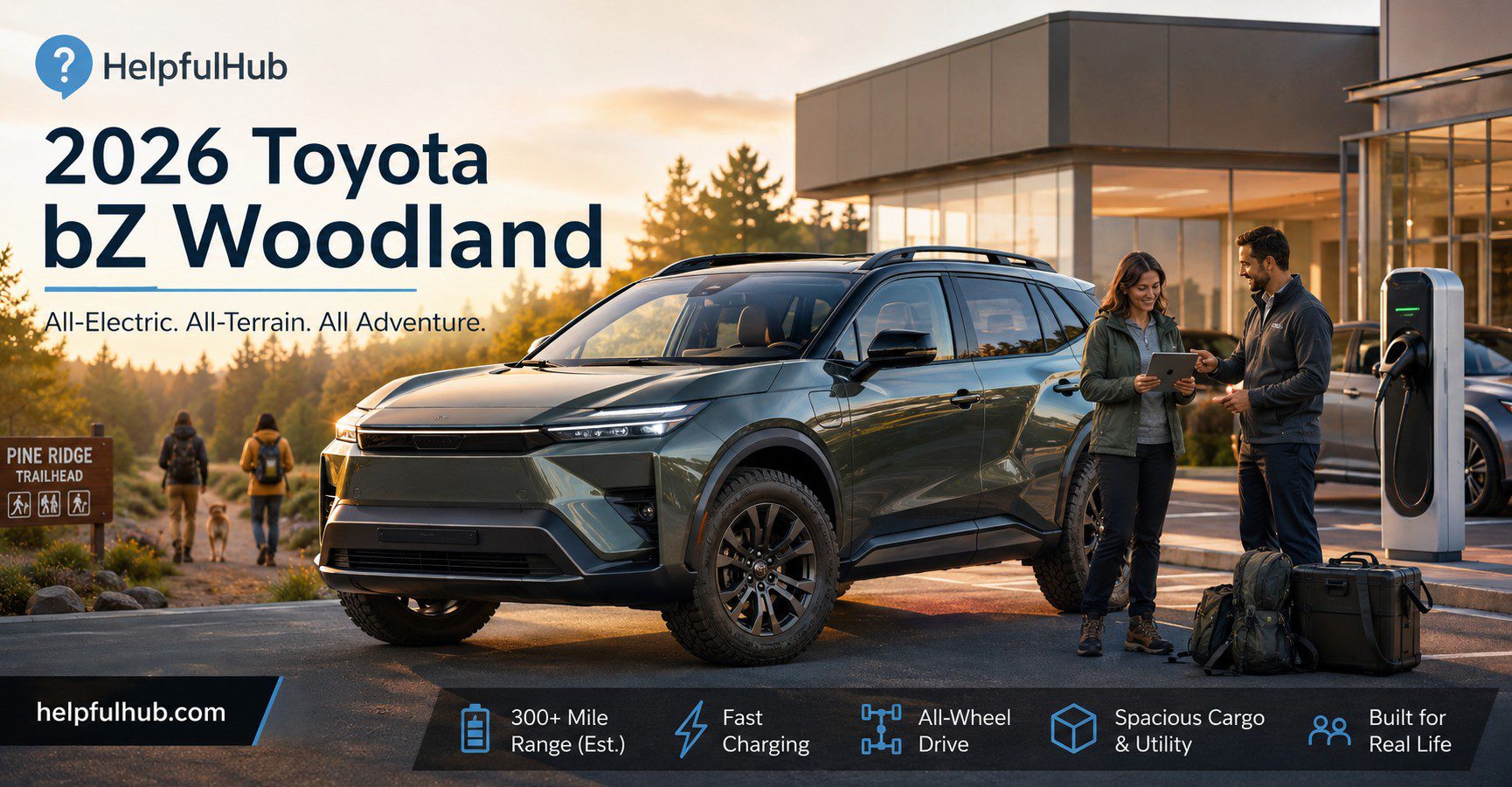
2026 Toyota bZ Woodland: Range, Charging, AWD, Price, Specs, and Buyer Guide
Instead of treating it like a generic EV, this article looks at how the bZ Woodland fits real American driving. That includes highway commuting, winter traction, weekend camping, light trailhead access, apartment charging limits, home charging, EV insurance, financing, and whether this Toyota electric SUV deserves a place on your shortlist. For a wider Toyota overview, start with the 2026 Toyota Models USA guide, then use this page as the deeper bZ Woodland buyer guide.
2026 Toyota bZ Woodland: What US Buyers Should Know
The 2026 Toyota bZ Woodland is Toyota’s more rugged battery-electric SUV choice for buyers who want standard AWD and more outdoor usefulness than a smaller urban EV. Toyota lists two grades, bZ Woodland and bZ Woodland Premium, both positioned for drivers who want an electric SUV with practical cargo room, traction features, and a more adventure-focused personality.
Official Toyota-listed highlights include 375 horsepower combined system output, a 74.7-kWh lithium-ion battery, a NACS charging port, standard all-wheel drive, X-MODE, Grip Control, 8.4 inches of ground clearance, roof rails, and up to 3,500 pounds of towing capacity where properly equipped. Toyota also lists 74.3 cubic feet of rear cargo area with the second-row seats folded flat, which is important for buyers carrying camping gear, sports equipment, luggage, or pet crates.
At the time of writing, Toyota’s public build information lists base MSRP for the bZ Woodland and bZ Woodland Premium, but shoppers should still confirm current pricing, destination charge, dealer fees, accessories, incentives, taxes, registration, and availability in their ZIP code. EV pricing can change quickly, and the monthly payment can look different after trade-in value, down payment, lease terms, interest rate, or dealer-installed accessories.
2026 Toyota bZ Woodland Key Buyer Details at a Glance
| Buyer Detail | Toyota-Listed Information | Why It Matters |
|---|---|---|
| Vehicle type | Rugged battery-electric SUV | Designed for buyers who want a full EV with more outdoor-focused utility. |
| Drivetrain | Standard all-wheel drive | Helpful for snowbelt states, wet roads, gravel roads, and light trailhead access. |
| Power | 375 horsepower combined system output | Strong acceleration, but buyers should not choose it only for horsepower. |
| Battery | 74.7-kWh lithium-ion battery | Supports the listed range and charging capability. |
| Range | 281-mile EPA-estimated rating with standard tires | Good for many daily routines, but real-world range can vary. |
| All-terrain tire range | 260-mile EPA-estimated rating with optional all-terrain tires | More rugged tire choice can reduce listed range. |
| Charging | NACS port, 11-kW onboard charger, adapters listed by Toyota | Important for home charging and public charging flexibility. |
| Towing | Up to 3,500 lbs where properly equipped | Useful for small trailers or weekend gear, but towing can reduce range. |
Why the bZ Woodland Matters in Toyota’s USA Lineup
The bZ Woodland matters because it gives Toyota EV shoppers a more rugged path without moving into a gasoline off-road SUV or a plug-in hybrid. In Toyota’s 2026 lineup, buyers can compare full EVs, hybrids, plug-in hybrids, rugged SUVs, and trucks. The bZ Woodland sits in a special space for people who want an electric SUV with more utility than a compact city EV but do not need a body-on-frame trail vehicle.
For the bigger Toyota shopping picture, use the complete Toyota models guide. That pillar article helps connect the bZ Woodland with other Toyota choices. This page stays focused on the bZ Woodland so readers can understand charging, range, AWD, cargo, and ownership before visiting a dealer.
The model also matters because many US shoppers are still deciding whether a full EV fits their lifestyle. A buyer with a garage, driveway, or reliable workplace charging may see the bZ Woodland differently from someone living in an apartment with no dependable overnight charging. As a result, the best answer depends less on one headline number and more on how the vehicle fits your weekly driving pattern.
Quick Comparison: bZ Woodland vs bZ Woodland Premium
Toyota lists two versions: bZ Woodland and bZ Woodland Premium. Both are focused on standard AWD and electric SUV utility, but the Premium version adds comfort and convenience upgrades. The choice is not only about features. It is about how long you plan to keep the SUV, how much you value comfort, and how the added cost affects your monthly budget.
The regular bZ Woodland makes sense if you want the core rugged EV package and prefer to keep the transaction price lower. The Premium grade can make sense if you care about items such as upgraded audio, ventilated front seats, panoramic roof content, and premium convenience features. However, shoppers should check the exact equipment list at the dealer because available packages, accessories, and inventory can vary.
bZ Woodland vs bZ Woodland Premium Buyer Comparison
| Area | bZ Woodland | bZ Woodland Premium | Buyer Takeaway |
|---|---|---|---|
| Core powertrain | Standard AWD, 375 hp | Standard AWD, 375 hp | Both give the main performance and traction benefits. |
| Range focus | 281-mile EPA-estimated rating with standard tires | 281-mile EPA-estimated rating with standard tires | Confirm the range rating for the exact configuration you buy. |
| Rugged features | X-MODE, Grip Control, roof rails, 8.4-inch ground clearance | Similar rugged foundation with added premium content | Outdoor utility is not limited to the Premium grade. |
| Comfort features | Strong standard equipment | Adds more premium comfort and convenience features | Premium is better for shoppers who value cabin upgrades. |
| Best fit | Value-focused EV adventure buyers | Drivers who want more comfort for daily use and trips | Compare monthly payments before choosing. |
Exterior Design and Rugged Electric SUV Practicality
The bZ Woodland uses a rugged electric SUV design approach rather than a traditional gas-truck look. The point is not to copy a rock-crawling SUV. Instead, it gives EV buyers a more outdoorsy body style, roof rails, available all-terrain tires, and enough ground clearance to feel more useful on rough access roads and trailhead parking areas.
That distinction matters. A driver who regularly needs deep-rutted trail capability may still want to compare a rugged Toyota SUV guide such as the 4Runner. Meanwhile, a driver who mostly handles highways, suburbs, snow, gravel parking lots, camping roads, and weekend gear may find the Woodland’s balance more practical.
Roof rails are another useful detail. They allow buyers to think about cargo boxes, bike carriers, or other accessory needs, subject to Toyota’s accessory guidance and weight limits. Before buying accessories, confirm compatibility and total load limits with the dealer.
Interior Technology, 14-Inch Touchscreen, and Connected Features
Inside, the 2026 Toyota bZ Woodland focuses on modern EV usability. Toyota lists a 14-inch Toyota Audio Multimedia touchscreen, which is important because EV drivers often rely on navigation, charging station routing, phone connectivity, and energy information more than they would in a traditional gas vehicle.
The best technology setup is the one you can use without distraction. During a test drive, check whether you can easily find range information, climate controls, route guidance, audio settings, and charging details. Also test phone pairing, wireless device charging if equipped, USB-C access, and how the screen looks in bright sunlight.
Families should also check rear-seat comfort, cargo loading height, child-seat access, and how the cabin handles backpacks, strollers, coolers, sports gear, or weekend luggage. A vehicle can look good on paper and still feel wrong if the cabin layout does not match your daily routine.
EV Range Explained for Daily Driving, Road Trips, and Outdoor Use
Toyota lists an EPA-estimated 281-mile total driving range rating for the 2026 Toyota bZ Woodland with standard tires. With optional all-terrain tires, Toyota lists a 260-mile EPA-estimated total driving range rating. Those numbers are helpful starting points, but they are not promises for every commute, road trip, or season.
Real-world EV range can change because of highway speed, cold weather, hot weather, tire choice, cabin climate use, terrain, cargo load, passengers, roof accessories, battery temperature, driving habits, and towing. For example, a driver taking short local trips in mild weather may experience the vehicle differently from someone driving 75 mph into a headwind with a roof box and camping gear.
For daily commuting, the key question is not whether the bZ Woodland can reach its full listed range every time. The better question is whether your normal day leaves a comfortable buffer. If your routine is school drop-off, work, errands, and a return home to a Level 2 charger, the range picture may be simple. If your routine includes long rural drives or limited charging access, the decision needs more planning.
For road trips, look beyond the range number. Check fast chargers along your route, backup charging sites, charger reliability, charging speed, weather, and how often your family wants to stop. EV road trips can work well, but they reward planning more than gasoline road trips.
All-Terrain Tires: Range, Comfort, and Adventure Tradeoffs
The optional all-terrain tires are one of the most important bZ Woodland decisions. They can support the adventure EV look and help on rougher surfaces. However, Toyota lists the EPA-estimated range rating at 260 miles with optional all-terrain tires, compared with 281 miles with standard tires.
That does not automatically make all-terrain tires a bad choice. They may be worth considering if you often drive gravel roads, muddy access roads, snowy areas, cabin roads, campsites, or trailhead parking lots. On the other hand, if your driving is mostly highways and suburbs, the standard tire setup may better match range, comfort, noise, and efficiency priorities.
Standard Tire vs All-Terrain Tire Decision Table
| Question | Standard Tires | Optional All-Terrain Tires | Best Buyer Decision |
|---|---|---|---|
| Listed range priority | 281-mile EPA-estimated rating | 260-mile EPA-estimated rating | Choose standard tires if maximum listed range matters most. |
| Road noise and comfort | Usually better for paved daily driving | May feel more rugged depending on surface | Test drive the tire setup you plan to buy. |
| Outdoor use | Fine for normal roads and light use | Better matched to rougher access roads | Choose based on real outdoor driving, not looks alone. |
| Efficiency | More efficient listed range | Lower listed range | Consider your daily charging access before deciding. |
| Buyer fit | Commuters, families, road-trip planners | Outdoor drivers, cabin owners, gravel-road users | Pick the tire that matches your weekly life. |
Charging: Home, Public, NACS, CCS1, and J1772
Charging is where many first-time EV buyers either become confident or become frustrated. Toyota lists a NACS charging port, DC fast charging from 10% to 80% in around 30 minutes under ideal conditions, an 11-kW onboard charger, and a standard dual-voltage 120V/240V home charger. Toyota also lists standard J1772 and CCS1 charging adapters.
For home charging, a regular 120V outlet can help with slow charging, but many EV owners prefer Level 2 charging through a suitable 240V outlet or installed home charging setup. Apartment renters should be extra careful. Ask your property manager about assigned chargers, charging rules, power costs, and whether overnight charging is dependable.
Public charging matters for road trips and for owners who cannot charge at home. The NACS port is a major convenience point, but buyers should still confirm which charging networks, adapters, software features, and Plug and Charge functions are currently supported for the vehicle. Charging access can vary by location, station condition, account setup, and network rules.
Home Charging vs Public Charging Decision Table
| Charging Situation | Why It Matters | What to Check Before Buying |
|---|---|---|
| Garage or driveway charging | Usually the easiest EV ownership setup | Outlet type, installation cost, panel capacity, charging cable details. |
| Apartment charging | Can be convenient or difficult depending on property rules | Assigned chargers, payment rules, overnight access, backup stations. |
| Workplace charging | Can reduce home charging pressure | Availability, cost, time limits, reliability, employee access rules. |
| Public fast charging | Important for trips and backup charging | NACS access, adapter needs, station reliability, route coverage. |
| Road-trip charging | Requires planning beyond advertised range | Charging stops, backup stops, weather, terrain, passenger needs. |
For a broader beginner-friendly overview of EV ownership, charging habits, and future transportation choices, read the electric mobility guide.
Battery Preconditioning and Plug and Charge Explained
Battery preconditioning sounds technical, but the idea is simple. The system helps bring the battery to a better temperature for DC fast charging. This can be especially useful in cold weather because a cold battery may not charge as quickly as a battery in its preferred temperature range.
Plug and Charge is also designed to make public charging easier. Instead of juggling multiple apps every time, compatible systems can help identify and authorize the vehicle at selected charging networks. However, buyers should confirm current network compatibility, subscription requirements, trial details, and setup steps before relying on it for travel.
These features are helpful, but they do not remove the need for planning. A fast charger may be busy, broken, slower than expected, or affected by weather and battery temperature. Therefore, road-trip drivers should still plan backup stops.
Standard AWD, X-MODE, and Grip Control
Standard all-wheel drive is a major reason shoppers may consider the bZ Woodland. In snowbelt states, mountain towns, rainy regions, and areas with gravel roads, AWD can add confidence. However, AWD is not a substitute for careful driving, good tires, safe speeds, and enough stopping distance.
X-MODE is Toyota’s traction-focused system designed to help optimize brake control and power delivery for challenging surfaces. Grip Control is used at low speeds to help the vehicle maintain steady control in adverse conditions. These features support confidence on slippery or uneven surfaces, but the bZ Woodland should not be treated like an extreme off-road SUV.
The best way to evaluate AWD and traction features is to think about your real surfaces. Do you deal with snow-covered driveways, steep wet roads, gravel access roads, or trailhead parking? Or do you mostly drive clean highways and city streets? Your answer helps decide whether the Woodland’s rugged setup is valuable or simply nice to have.
Ground Clearance, Roof Rails, Cargo Space, and Towing
Toyota lists 8.4 inches of ground clearance, roof rails, 74.3 cubic feet of rear cargo area with seats folded flat, and towing capacity up to 3,500 pounds where properly equipped. These numbers make the bZ Woodland more useful than a small commuter EV for many families and weekend drivers.
Cargo space matters for more than luggage. It affects strollers, sports bags, folding chairs, coolers, pet gear, camping boxes, small furniture runs, and road-trip comfort. During a dealer visit, bring your largest regular cargo item or measure it before you go.
Towing needs extra caution in any EV. Towing can reduce range, and the impact depends on trailer weight, trailer shape, speed, hills, wind, weather, and cargo. If you plan to tow, confirm the exact tow rating, hitch equipment, wiring, accessories, payload, and charging plan with Toyota or your dealer before buying.
Daily Commuting and City Driving
For daily commuting, the bZ Woodland can make sense if your drive fits comfortably inside your charging routine. Many US drivers travel far less than the vehicle’s listed range on a normal day, but that does not mean every buyer has the same experience. A buyer with home Level 2 charging will feel more relaxed than someone depending only on public stations.
City and suburban driving also benefit from EV smoothness. Regenerative braking can help recover energy during slowing, and quiet electric driving can make the daily routine feel more refined. However, buyers should test the seating position, visibility, parking ease, screen layout, and rear cargo access because those details matter every day.
Family Use, Weekend Trips, and Outdoor Practicality
The bZ Woodland is strongest as a family EV for buyers who also want weekend flexibility. It gives small families room for everyday use, plus outdoor-friendly features for camping weekends, trailhead parking, gravel roads, ski trips, beach gear, or road-trip luggage. It is not a replacement for every rugged SUV, but it can be a practical middle ground.
Families should test rear-seat comfort, child-seat installation, rear door openings, cargo shape, and how the cabin feels with everyone inside. If you need a larger three-row family direction, the Toyota Highlander electrification outlook may be worth reading as a separate buyer pathway.
Commuter, Family, Road-Trip, and Outdoor Use Case Table
| Use Case | bZ Woodland Strength | Buyer Caution |
|---|---|---|
| Daily commuter | Smooth EV driving, standard AWD, modern tech | Confirm home or workplace charging access. |
| Small family | Useful cargo space and comfortable SUV layout | Test child seats, rear access, and cargo shape. |
| Road trips | NACS port and DC fast charging capability | Plan stops and backup chargers before long drives. |
| Outdoor weekends | Ground clearance, roof rails, AWD, X-MODE | Do not treat it as an extreme trail SUV. |
| Light towing | Up to 3,500 lbs where properly equipped | Towing can reduce range and needs careful planning. |
EV Ownership Cost, Insurance, and Maintenance
EV ownership cost depends on more than the purchase price. You should compare electricity rates, home charger setup cost, insurance quotes, registration fees, tire replacement, financing, lease terms, maintenance, depreciation, and possible repair costs. Local electricity rates can vary widely by state, so a buyer in California may face a different charging cost picture than a buyer in Texas, Georgia, or Michigan.
Insurance is especially important. EV insurance can vary based on repair costs, battery-related components, safety technology, local claim trends, your driving history, ZIP code, annual mileage, coverage limits, deductible, and lender requirements. Before signing paperwork, get quotes for the exact bZ Woodland trim and compare them with gas, hybrid, and used EV options. HelpfulHub’s EV insurance guide can help you understand what to ask.
Maintenance may be simpler in some areas because EVs do not use oil changes like gasoline vehicles. However, EVs still need tires, brakes, cabin filters, suspension checks, software updates, wiper blades, coolant checks where applicable, and normal inspections. Heavier curb weight and strong torque can also make tire choice and rotation habits important.
EV Ownership Cost Checklist
| Cost Area | What to Estimate | Why It Matters |
|---|---|---|
| Monthly payment | Loan or lease payment after down payment and trade-in | Headline MSRP is not your full budget. |
| Charging cost | Home electricity rate and public charging cost | Public fast charging can cost more than home charging. |
| Insurance | Quotes for your ZIP code and driver profile | EV insurance can vary by trim and location. |
| Home charging setup | Outlet, charger, electrical work, permits if needed | Installation cost can affect first-year ownership cost. |
| Tires | Replacement cost for standard or all-terrain tires | EV torque and vehicle weight can make tire planning important. |
| Depreciation | Expected value over your ownership period | EV resale values can change with incentives and market demand. |
Financing, Leasing, Incentives, and Trade-In Tips
Financing or leasing a 2026 Toyota bZ Woodland should start with the total cost, not only the monthly payment. A lower monthly payment can hide a longer loan, higher interest cost, large down payment, mileage limits, or lease-end fees. Compare the out-the-door price, taxes, dealer fees, accessories, add-ons, and financing terms.
Leasing may appeal to buyers who want flexibility because EV technology, incentives, charging access, and resale values can change. Financing may appeal to buyers who plan to keep the SUV longer and want ownership after the loan ends. Neither option is automatically better for everyone.
Use the HelpfulHub car payment calculator to compare down payment, loan term, interest rate, and trade-in value before visiting a dealer. Also check available incentives, but do not assume eligibility. Incentive rules can depend on federal requirements, state programs, income limits, vehicle eligibility, lease structure, dealer participation, and timing.
New 2026 bZ Woodland vs Used EV
A new 2026 Toyota bZ Woodland gives you the latest Toyota-listed bZ Woodland equipment, full new-vehicle shopping experience, current trim choices, and the chance to choose the exact configuration if inventory allows. A used EV may cost less up front, but it requires more research into battery health, remaining warranty, charging standard, accident history, title status, tire condition, software support, and real-world range.
Used EVs can be attractive, especially certified pre-owned options, but buyers should compare charging compatibility carefully. A used EV with an older charging setup may not feel as convenient as a newer model with NACS support. Also compare insurance, financing rates, warranty coverage, and expected depreciation.
New 2026 bZ Woodland vs Used EV Considerations
| Decision Area | New 2026 bZ Woodland | Used EV |
|---|---|---|
| Technology | Current Toyota-listed EV features and charging setup | Depends on model year and software support. |
| Warranty confidence | New-vehicle coverage should be confirmed with Toyota | Remaining warranty varies by age, mileage, and history. |
| Battery condition | New battery with current listed specifications | Battery health should be inspected carefully. |
| Purchase price | Higher starting point in many cases | May cost less upfront. |
| Charging convenience | NACS port and listed adapters | May need adapters or older charging plans. |
| Best fit | Buyers who want latest Toyota EV utility | Budget-focused shoppers willing to research condition. |
For a deeper cost comparison, read the new vs used vehicle cost guide and the buying new vs used car guide.
bZ Woodland vs C-HR EV
The bZ Woodland and C-HR EV should not be viewed as the same type of Toyota EV. The bZ Woodland is the better fit for buyers who want more utility, AWD confidence, cargo flexibility, and outdoor-friendly features. The C-HR EV is better treated as a smaller compact EV choice for city-focused drivers who prioritize easy urban use.
If you live in a dense city, park in tight spaces, and mostly drive short trips, the 2026 Toyota C-HR EV may be the more natural comparison. If you need more space for family gear, road trips, trailhead parking, roof accessories, and light towing needs, the bZ Woodland is the stronger Toyota EV pathway.
bZ Woodland vs RAV4 Plug-in Hybrid
The bZ Woodland is fully electric, while the RAV4 Plug-in Hybrid gives shoppers a different ownership style. A plug-in hybrid can drive on electric power for shorter trips when charged, but it still has a gasoline engine for longer drives. That can be reassuring for buyers who are not ready to depend fully on charging.
The bZ Woodland makes more sense if you want full EV ownership and have reliable charging access. The 2026 Toyota RAV4 Hybrid and Plug-in Hybrid guide is worth reading if you want Toyota SUV practicality but still want gasoline backup. This is one of the most important comparisons for first-time EV buyers.
bZ Woodland vs C-HR EV vs RAV4 Plug-in Hybrid Buyer Fit Table
| Buyer Need | bZ Woodland | C-HR EV | RAV4 Plug-in Hybrid |
|---|---|---|---|
| Powertrain preference | Full EV | Full EV | Plug-in hybrid with gasoline backup |
| Best driving setting | Suburban, highway, outdoor, family use | Urban and compact EV use | Mixed EV and gas driving |
| Outdoor utility | Strongest of these three | More city-focused | Practical SUV use, not full EV only |
| Charging dependence | High, because it is fully electric | High, because it is fully electric | Lower, because gasoline backup is available |
| Best buyer | Adventure EV and family EV shoppers | City EV shoppers | EV-curious buyers who want flexibility |
bZ Woodland vs Toyota bZ and EV Competitors
The regular Toyota bZ may be a better fit if you want a Toyota electric SUV but do not need the Woodland’s extra rugged character, roof rail utility, cargo emphasis, or all-terrain tire option. The bZ Woodland is the more adventure-focused choice, while the standard bZ can make sense for buyers who want a simpler EV crossover decision.
Shoppers may also compare the bZ Woodland with other electric SUVs such as Honda Prologue, Subaru Trailseeker, Chevrolet Blazer EV, and other models in the market. When comparing, avoid relying only on horsepower or advertised range. Compare real charging access, dealer support, cargo shape, insurance quotes, comfort, warranty details, software features, and total ownership cost.
If you are still open to non-EV Toyota options, the 2026 Toyota Camry Hybrid and 2026 Toyota Corolla and Corolla Hybrid guides are better for sedan and compact hybrid shoppers. If you want a truck-style Toyota path, compare the 2026 Toyota Tacoma i-FORCE MAX separately.
Common bZ Woodland Buyer Mistakes to Avoid
The first mistake is buying based only on range. Range matters, but charging access matters just as much. A driver with dependable home charging may be happier with a lower listed range than a driver with no home charging and a longer commute.
The second mistake is choosing all-terrain tires only for appearance. If you need them, they can make sense. If you mostly drive highways, the lower listed range may not be worth it.
The third mistake is ignoring insurance before signing. Get quotes early. Also check financing, lease terms, trade-in value, home charging setup, and public charging routes. Finally, do not treat the bZ Woodland like a dedicated extreme off-road SUV. It is a rugged electric crossover-style SUV for practical adventure use, not a rock-crawling machine.
Practical Expert Insight
Next, decide whether you are buying the rugged features for real use or for style. Standard AWD, X-MODE, Grip Control, ground clearance, and roof rails are meaningful if you visit trailheads, cabins, ski areas, campsites, gravel roads, or snowy neighborhoods. However, if your driving is almost entirely paved urban commuting, you may not need every rugged advantage.
Finally, price the boring items before the exciting ones. Get EV insurance quotes, estimate home charging setup, compare lease and finance offers, check tire costs, confirm public charging near your routes, and calculate the monthly payment. A bZ Woodland that fits your charging life and budget can be a smart adventure EV. A bZ Woodland bought without charging access or cost planning can become frustrating quickly.
FAQ
What is new in the 2026 Toyota bZ Woodland?
The 2026 Toyota bZ Woodland is a rugged battery-electric SUV addition to Toyota’s EV lineup. It focuses on standard AWD, X-MODE, Grip Control, useful cargo space, roof rails, available all-terrain tires, and adventure-friendly practicality. Toyota lists 375 horsepower, a 74.7-kWh lithium-ion battery, a NACS charging port, 8.4 inches of ground clearance, and a 14-inch Toyota Audio Multimedia touchscreen. It is not meant to be a broad Toyota lineup model. Instead, it is aimed at EV buyers who want a more outdoor-ready Toyota electric SUV.
Is the 2026 Toyota bZ Woodland fully electric?
Yes. The bZ Woodland is a battery-electric vehicle, not a hybrid or plug-in hybrid. That means it runs on electricity and needs charging instead of gasoline. This can work well for buyers with reliable home, workplace, or public charging access. However, first-time EV shoppers should compare their charging options before buying. If you are not ready for full EV ownership, a Toyota plug-in hybrid option may be worth comparing because it gives electric driving for some trips while still keeping gasoline backup.
What is the range of the 2026 Toyota bZ Woodland?
Toyota lists an EPA-estimated 281-mile total driving range rating for the bZ Woodland with standard tires. Toyota also lists a 260-mile EPA-estimated total driving range rating when equipped with optional all-terrain tires. Real-world range can vary based on speed, weather, terrain, tire choice, cargo load, passengers, climate control use, battery temperature, driving habits, and towing. Buyers should compare the listed number with their real daily routine, especially if they do not have reliable home charging.
Do all-terrain tires reduce the bZ Woodland range?
According to Toyota-listed information, the optional all-terrain tire setup has a lower EPA-estimated total driving range rating than the standard tire setup. The standard tire rating is listed at 281 miles, while the all-terrain tire rating is listed at 260 miles. That tradeoff may be worth it if you often drive gravel roads, trailhead routes, cabin roads, or rougher outdoor areas. If you mostly commute on paved roads, standard tires may be the more practical choice for range, comfort, and efficiency.
Does the 2026 Toyota bZ Woodland have AWD?
Yes. Toyota lists standard all-wheel drive for the 2026 bZ Woodland. It also includes X-MODE and Grip Control, which are designed to help with traction and control in certain low-speed or slippery conditions. AWD can be useful for rain, snow, gravel, and rough access roads, but it does not replace safe driving or proper tires. Buyers in snowbelt states should still think carefully about winter tire needs, road conditions, and stopping distance.
Does the 2026 Toyota bZ Woodland use NACS charging?
Yes. Toyota lists a North American Charging System, or NACS, charging port for the 2026 bZ Woodland. Toyota also lists standard J1772 and CCS1 charging adapters, which can help with charging flexibility. Buyers should confirm current adapter details, charging network access, Plug and Charge support, subscription requirements, and software setup with Toyota or a local dealer. Public charging can vary by region, so it is smart to check chargers near home, work, school, and planned road-trip routes.
Can the 2026 Toyota bZ Woodland tow?
Toyota lists towing capacity up to 3,500 pounds where properly equipped. That can be useful for small trailers, outdoor gear, or light weekend towing. However, towing with an EV can reduce range, especially at highway speeds or in difficult weather. Before buying, confirm the exact towing equipment, hitch compatibility, payload, trailer weight, accessory requirements, and charging plan. Do not assume your real towing range will match normal daily driving range.
Is the 2026 Toyota bZ Woodland good for families?
The bZ Woodland can be a good family EV for small families or active households that want cargo space, standard AWD, modern technology, and weekend flexibility. Toyota lists 74.3 cubic feet of rear cargo area with the seats folded flat, which helps for trips and gear. Still, families should test rear-seat comfort, child-seat installation, stroller fit, cargo loading, and cabin storage before buying. It is also important to confirm charging access because family schedules can make unreliable charging more stressful.
Should buyers choose bZ Woodland or C-HR EV?
Choose the bZ Woodland if you want more rugged utility, standard AWD, more adventure-focused features, cargo flexibility, roof rails, and light outdoor capability. Consider the C-HR EV if your priority is a smaller electric vehicle for city driving, tighter parking, and urban commuting. The right choice depends on where you drive, how much cargo space you need, whether you need AWD, and whether weekend outdoor use is part of your lifestyle. Compare both in person before making the final decision.
Should buyers compare a new 2026 bZ Woodland with a used EV?
Yes. A used EV may offer a lower purchase price, but it requires careful checks. Review battery health, remaining warranty, accident history, charging compatibility, tire condition, software support, and real-world range. A new bZ Woodland gives you current Toyota-listed features, NACS support, and new-vehicle shopping confidence, but it may cost more. Compare total ownership cost, insurance, financing rates, charging access, and resale expectations before deciding between new and used.
Final 2026 Toyota bZ Woodland Buyer Checklist
- Verify current trim pricing and availability with Toyota or local dealers.
- Compare bZ Woodland and bZ Woodland Premium carefully.
- Confirm the EPA-estimated range rating for the configuration you plan to buy.
- Decide whether optional all-terrain tires match your real driving needs.
- Check whether home charging is possible in your garage, driveway, or parking area.
- Check public charging near home, work, school, and road-trip routes.
- Confirm NACS, CCS1, and J1772 charging accessory details with Toyota or your dealer.
- Compare bZ Woodland with C-HR EV if you want a smaller city EV.
- Compare bZ Woodland with RAV4 Plug-in Hybrid if you are unsure about full EV ownership.
- Compare bZ Woodland with Toyota bZ if you do not need the extra rugged utility.
- Estimate EV insurance before buying.
- Compare financing and lease offers.
- Calculate monthly payment using the HelpfulHub car payment calculator.
- Confirm towing needs before choosing accessories or planning trailers.
- Check available incentives without assuming eligibility.
- Compare a new 2026 bZ Woodland with certified pre-owned or used EV options.
- Review EV maintenance expectations, including tires, brakes, software, and inspections.
- Avoid choosing an EV only because of advertised range or horsepower.
Final Buyer Decision Table
| Buyer Type | Should Consider bZ Woodland? | Reason |
|---|---|---|
| Home-charging commuter | Yes | Daily charging can make EV ownership simple and predictable. |
| Outdoor weekend driver | Yes | AWD, X-MODE, roof rails, cargo space, and ground clearance fit light adventure use. |
| Apartment driver with no charging | Compare carefully | Public-only charging can be inconvenient and more expensive. |
| Long-distance towing buyer | Compare carefully | Towing can reduce range and requires careful charging planning. |
| City-only compact EV shopper | Maybe not | A smaller EV such as C-HR EV may be easier to park and use in dense areas. |
| EV-curious but nervous buyer | Compare plug-in hybrid | RAV4 Plug-in Hybrid may feel safer if you want gasoline backup. |
Conclusion
The 2026 Toyota bZ Woodland is worth considering if you want a Toyota electric SUV with standard AWD, useful cargo space, roof rails, X-MODE, Grip Control, NACS charging, and a more adventure-ready personality than a smaller city EV. It is especially interesting for drivers who can charge regularly and want one vehicle for commuting, family use, road trips, and light outdoor weekends.
However, the best decision depends on your real life. Compare standard tires with optional all-terrain tires, verify range for the exact configuration, check home and public charging, estimate EV insurance, review financing or lease terms, and confirm towing needs before you buy. Also compare the bZ Woodland with the C-HR EV, RAV4 Plug-in Hybrid, Toyota bZ, and used EV options if those choices fit your budget or driving style better.
Overall, the 2026 Toyota bZ Woodland is not just a spec sheet. It is a practical decision about range, charging access, AWD needs, cargo space, towing, ownership cost, and daily usability. If those pieces fit your routine, it can be a strong Toyota EV choice for US buyers who want electric driving with weekend adventure flexibility.