2026 Toyota C-HR EV: Range, Charging, AWD, Price, Specs, and Buyer Guide
Instead of treating the C-HR EV as just another name in the Toyota 2026 lineup, this article focuses on how it fits real life. If you are comparing Toyota electrified vehicles more broadly, start with our 2026 Toyota Models USA guide, then use this page to decide whether the C-HR EV is the right compact electric SUV for your routine.
Quick Answer
The 2026 Toyota C-HR EV is a compact electric crossover for buyers who want a smaller Toyota EV with standard All-Wheel Drive, strong listed performance, and useful range for daily life. Toyota lists an EPA-estimated 287-mile total driving range rating for the SE trim and 273 miles for the XSE trim, so SE may make sense for buyers who want the higher listed range while XSE may fit shoppers who want more premium features. Buyers with home charging or reliable public charging access will have an easier ownership experience. Apartment dwellers should check charging access before choosing a fully electric vehicle. The C-HR EV is worth comparing with the RAV4 Plug-in Hybrid, bZ Woodland, Toyota bZ, and used EV options. Before buying, verify current pricing, availability, destination charge, incentives, dealer fees, charging accessories, and trim details with Toyota or local dealers.
2026 Toyota C-HR EV: What US Buyers Should Know
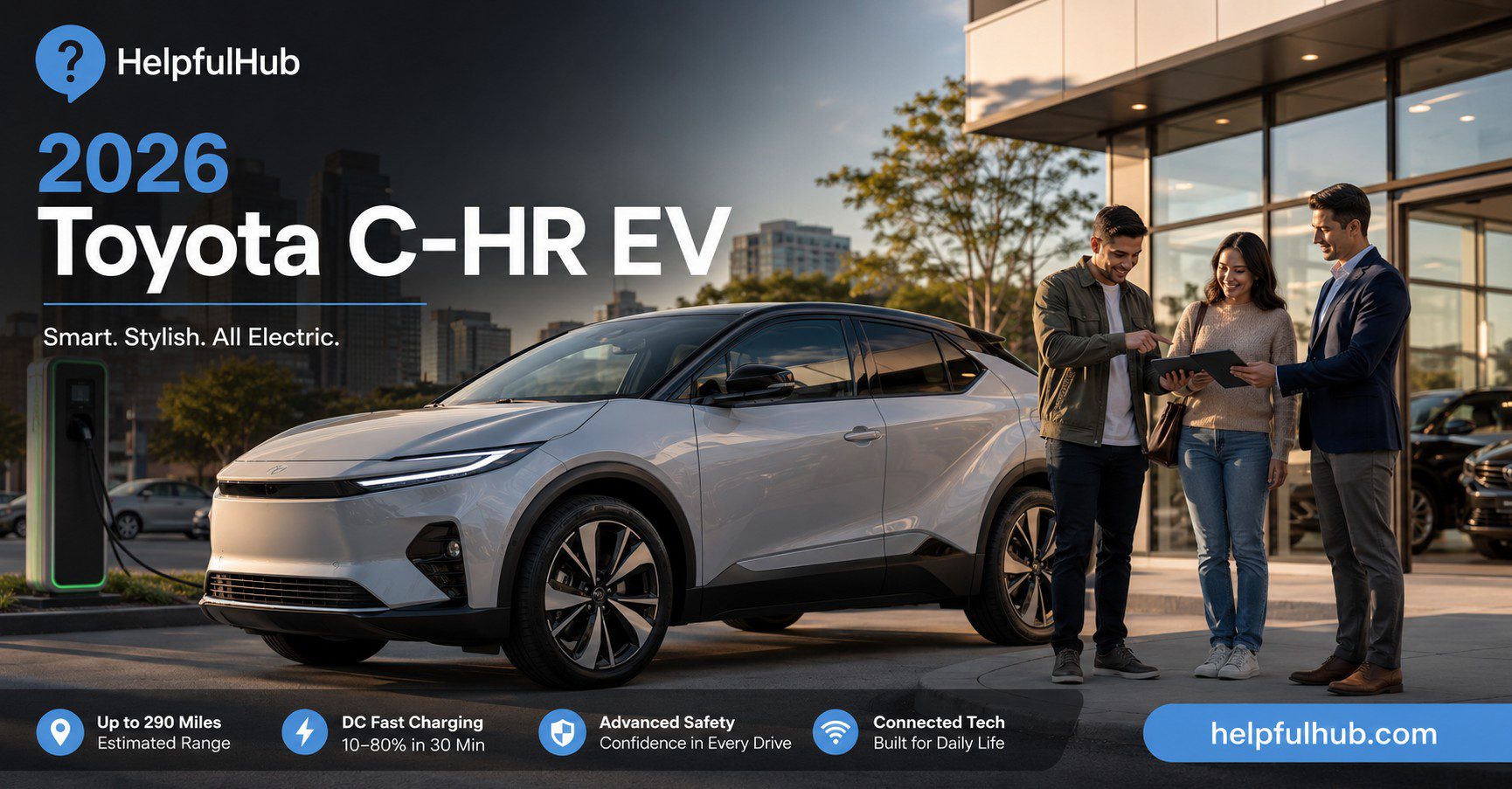
The 2026 Toyota C-HR EV brings the C-HR name back to the US market as an all-electric compact crossover. For shoppers who want a Toyota EV but do not want a larger SUV, that matters. It gives Toyota a smaller battery-electric option aimed at commuters, city drivers, young professionals, small families, and EV beginners.
Toyota lists 338 net combined system horsepower, standard All-Wheel Drive, a 74.7-kWh battery, an 11-kW onboard AC charger, and an EPA-estimated 287-mile total driving range rating on the SE trim. The XSE trim is listed with an EPA-estimated 273-mile total driving range rating. These figures make the C-HR EV more than a simple city runabout, although real-world range will still vary.
The most important question is not only whether the numbers look good. It is whether your charging access, commute length, weather, budget, family needs, and insurance quote make the C-HR EV a smart fit. A compact EV can be excellent when it matches your routine, but it can be frustrating if you buy it without a charging plan.
2026 Toyota C-HR EV Key Buyer Details at a Glance
| Buyer Detail | What Toyota Lists | Why It Matters |
|---|---|---|
| Vehicle type | All-electric compact crossover | Best suited for drivers who want a smaller electric SUV-style vehicle rather than a large family SUV. |
| Power | 338 net combined system horsepower | Strong output for a compact EV, useful for highway merging and confident daily driving. |
| Drivetrain | Standard All-Wheel Drive | Helpful for traction confidence in rain, snowbelt states, and mixed driving conditions. |
| Battery | 74.7-kWh battery | A key part of range, charging planning, and long-term EV ownership decisions. |
| SE range | EPA-estimated 287-mile total driving range rating | Likely the better trim choice for shoppers who prioritize the highest listed range. |
| XSE range | EPA-estimated 273-mile total driving range rating | May fit shoppers who prefer premium features and accept the lower listed range. |
| Charging | NACS port, CCS1 adapter, J1772 compatibility, 11-kW onboard AC charger | Important for home charging, public charging, and route planning. |
| Pricing | Toyota may show current base MSRP by trim online | Verify current MSRP, destination charge, dealer fees, accessories, incentives, and local availability before buying. |
Why the C-HR EV Matters in Toyota’s USA Lineup
The C-HR EV matters because it fills a space between practical hybrids and larger Toyota electric SUVs. Toyota already attracts shoppers with hybrid sedans, hybrid crossovers, plug-in hybrids, rugged SUVs, and trucks. The C-HR EV gives the brand a smaller battery-electric crossover for drivers who want full EV ownership without moving into a larger vehicle.
That makes it useful for readers who are comparing the Toyota 2026 lineup but need a more focused decision. A buyer looking at a Toyota Corolla Hybrid guide may want low running costs without home charging. A buyer researching the 2026 Toyota Camry Hybrid may want a comfortable sedan. The C-HR EV is different because it is fully electric and crossover-shaped.
For Toyota fans, the C-HR EV also helps answer a common question: should you move to a full EV now, or stay with a hybrid or plug-in hybrid for a few more years? The answer depends less on brand loyalty and more on daily life. If charging is easy and your driving pattern is predictable, the C-HR EV may be a strong fit. If charging is uncertain, a hybrid or plug-in hybrid may still be easier.
Quick Comparison: C-HR EV SE vs XSE
The 2026 C-HR EV is expected around two main trims for US shoppers: SE and XSE. The SE appears to be the range-focused and value-minded choice. The XSE adds or replaces features for a more premium feel, but Toyota lists a lower EPA-estimated range rating compared with SE.
That does not automatically make one trim better. A commuter with a long daily drive may care more about the SE’s higher listed range. A buyer who values extra comfort and driver-assistance features may prefer the XSE. The right answer depends on how much you drive, how often you charge, and how much you value upgraded equipment.
C-HR EV SE vs XSE Buyer Comparison
| Area | C-HR EV SE | C-HR EV XSE | Buyer Takeaway |
|---|---|---|---|
| Listed range | EPA-estimated 287-mile total driving range rating | EPA-estimated 273-mile total driving range rating | SE may be better if maximum listed range is your priority. |
| Wheels | 18-inch wheels listed in Toyota materials | 20-inch wheels listed in Toyota materials | Larger wheels can affect ride feel and listed range, so test drive both if possible. |
| Interior focus | Comfortable standard equipment with Toyota Audio Multimedia | More premium seat materials and added convenience features | XSE may feel more upscale for buyers who spend a lot of time in the cabin. |
| Driver assistance | Toyota Safety Sense 3.0 listed where applicable | Adds or upgrades selected assistance and camera features where equipped | Confirm the exact feature list on the vehicle window sticker. |
| Best fit | Range-focused commuters and value-minded EV buyers | Buyers who want a more premium compact EV feel | Choose based on real use, not only trim name. |
Exterior Design and Compact Electric Crossover Practicality
The C-HR EV is designed as a compact electric crossover with a sporty, coupe-like profile. That gives it a different personality from a traditional boxy SUV. It should appeal to drivers who want an EV that feels modern and easy to park, while still offering more crossover utility than a small sedan.
Compact size is a real advantage in many US cities and suburbs. Parking garages, tight apartment lots, school pickup lanes, and crowded shopping centers are all easier when the vehicle is not oversized. For a daily driver, that convenience can matter as much as horsepower.
However, style can also involve trade-offs. A sloping roofline and compact footprint may limit rear-seat headroom or cargo shape compared with larger SUVs. Before buying, sit in both rows, open the cargo area, fold the rear seats, and test whether strollers, sports gear, luggage, or grocery bins fit your lifestyle.
Interior Technology, 14-Inch Touchscreen, and Connected Features
Toyota lists a 14-inch Toyota Audio Multimedia touchscreen for the 2026 C-HR EV, and that is important for modern EV buyers. In an electric vehicle, the screen is not just for music. It often supports navigation, charging information, phone integration, vehicle settings, energy displays, and connected services.
The best way to judge the system is during a dealership visit. Pair your phone, test the backup camera, review charging menus, check the digital gauge cluster, and see whether the interface feels easy while parked. A clean layout matters because EV owners often use the screen to monitor range and charging plans.
Toyota Safety Sense 3.0 is also listed where applicable, which helps the C-HR EV feel competitive for buyers who want driver assistance. Still, every buyer should confirm the exact safety and convenience features on the trim they are purchasing. Features can vary by trim, package, region, subscription, and production timing.
EV Range Explained for Daily Driving and Road Trips
Range is one of the biggest reasons shoppers search for the 2026 Toyota C-HR range. Toyota lists an EPA-estimated 287-mile total driving range rating for the SE trim and 273 miles for the XSE trim. Those numbers are useful for comparison, but they are not a promise that every driver will see the same result every day.
Real-world EV range can vary because of speed, weather, terrain, tire choice, cabin heat, air conditioning, cargo load, battery temperature, and driving style. Cold weather can reduce range. High-speed highway driving can also use more energy than slower city driving. Therefore, a buyer should think in terms of usable daily range, not only the maximum listed number.
For many commuters, the C-HR EV’s listed range should be more than enough for weekday driving if charging is available. For road trips, the important question becomes charging stops. A compact EV can road-trip well when the route has dependable fast chargers, but the experience depends on planning, charger availability, charging speed, and weather.
Charging: Home, Public, NACS, CCS1, and J1772
Charging access should be one of your first questions before buying any EV. The 2026 Toyota C-HR EV includes a NACS charging port, and Toyota says its 2026 battery electric vehicles are equipped with the NACS charging port along with CCS1 and J1772 adapters for compatibility with most chargers, including the Tesla Supercharger Network. That is a major convenience point for US buyers, but you should still confirm accessory details with Toyota or your dealer.
At home, most owners prefer Level 2 charging because it can make overnight charging much easier. Toyota lists an 11-kW onboard AC charger, which is important for Level 2 charging capability when the home charger and electrical setup support it. Home charging costs also depend on your local electricity rate, utility plan, charger installation cost, and whether you can charge during lower-cost hours.
Public charging matters for apartment dwellers, road-trip drivers, college students, and people who cannot install a charger. Before buying, check chargers near home, work, school, grocery stores, and common road-trip routes. Also check whether those chargers are reliable, accessible, priced fairly, and compatible with the vehicle and adapter setup.
Home Charging vs Public Charging Decision Table
| Charging Situation | Best For | What to Check | C-HR EV Buyer Note |
|---|---|---|---|
| Home Level 2 charging | Owners with a garage, driveway, or assigned parking | Electrical panel capacity, charger cost, installation quote, utility rates | Usually the easiest way to own a daily-driver EV. |
| Home Level 1 charging | Short commutes and occasional top-offs | Outlet access, charging time, daily mileage needs | May work for light use, but confirm it fits your routine. |
| Workplace charging | Commuters with employer chargers | Availability, cost, time limits, charger reliability | Can reduce home charging pressure, but should not be your only plan unless dependable. |
| Public Level 2 charging | Apartment dwellers and urban drivers | Distance, pricing, parking rules, charger uptime | Useful, but less convenient than charging where you sleep. |
| DC fast charging | Road trips and quick top-ups | Station network, plug type, speed, congestion, battery temperature | Great for travel, but not always the cheapest daily charging method. |
| NACS, CCS1, and J1772 access | Drivers who need broad charger compatibility | Adapter details, charging network rules, app access, dealer confirmation | Confirm what is included with your vehicle and how each adapter works. |
Standard AWD and Driving Confidence
Standard AWD is one of the most important selling points of the 2026 Toyota C-HR AWD story. Many compact EVs make shoppers choose between front-wheel drive, rear-wheel drive, and AWD. Toyota listing standard dual-motor AWD gives the C-HR EV a simple advantage for buyers who want traction confidence without moving up to a larger SUV.
AWD can be helpful in rainy climates, hilly areas, snowbelt states, and winter commuting. However, AWD is not a substitute for good tires or careful driving. If you live in a cold-weather state, tire choice and winter driving habits are still critical.
For daily driving, AWD can also improve the feeling of control during acceleration and highway merging. Because EVs deliver torque quickly, smooth power delivery matters. Test driving the C-HR EV on local roads and highways will tell you more than spec sheets alone.
Regenerative Braking Explained
Regenerative braking helps an EV recover some energy when slowing down. Instead of wasting all slowing energy as heat through the brakes, the electric system can send some energy back to the battery. Toyota lists adjustable regenerative braking for the C-HR EV, which lets drivers choose how strong the slowing effect feels.
For beginners, the idea is simple. A stronger regenerative setting can make the vehicle slow more noticeably when you lift off the accelerator. A lighter setting can feel closer to a traditional gas vehicle. The best setting depends on traffic, comfort, road conditions, and personal preference.
Regenerative braking can make city driving feel smoother because stop-and-go traffic gives the system many chances to recover energy. It may also reduce brake wear in some situations. However, it does not eliminate normal maintenance, and drivers should still follow Toyota service guidance.
Daily Commuting and City Driving
The C-HR EV’s strongest use case may be daily commuting and city-suburban driving. A compact crossover is easier to park than a large SUV, and electric power can make low-speed driving smooth and quiet. For drivers who spend time in traffic, that quiet cabin and instant response can feel like a major quality-of-life improvement.
For a city driver, the big checklist is simple. Can you charge near home or work? Does the vehicle fit your parking space? Is the rear visibility comfortable? Do you like the seating position? Does the cargo area handle your weekly routine? These questions matter more than online excitement.
If you are coming from a small gas crossover, the C-HR EV may feel familiar in size but very different in ownership. You will no longer plan gas stops, but you will plan charging. You may spend less time on routine powertrain maintenance, but insurance and tire costs can still be meaningful.
Commuter, City Driver, and Small-Family Use Case Table
| Buyer Type | Why C-HR EV May Fit | What to Check First |
|---|---|---|
| Daily commuter | Useful listed range, quiet EV driving, standard AWD, modern tech | Round-trip miles, charging access, highway range needs, insurance quote |
| City driver | Compact footprint, easy parking, smooth low-speed driving | Parking space, visibility, public charging availability, tire replacement cost |
| Suburban driver | Can pair well with home Level 2 charging and weekend errands | Garage or driveway charging, family cargo needs, winter tire needs |
| Small family | Crossover shape, rear seats, flexible cargo area | Child seats, stroller fit, rear-seat comfort, cargo floor height |
| EV beginner | Toyota brand familiarity and broad charging compatibility | Charging apps, home installation quote, range buffer, dealer education |
Small-Family Use, Cargo Needs, and Weekend Practicality
A compact electric crossover can work for a small family, but the word “compact” should guide your expectations. The C-HR EV may be practical for couples, young families, one-child households, commuters with occasional passengers, and people who want crossover flexibility without a large footprint.
Before deciding, bring your real life to the test drive. Install your child seat. Put your stroller or sports bag in the cargo area. Sit behind your normal driving position. Check whether passengers can enter and exit easily. Small details can decide whether a vehicle feels easy after six months.
If you regularly carry multiple kids, large pets, sports gear, or road-trip luggage, compare larger Toyota options. The Toyota Highlander electrification outlook may be more relevant for bigger family needs, while the C-HR EV is better viewed as a compact daily-driver EV.
Road Trips and Charging Planning
The C-HR EV can be considered for road trips, but the experience depends on route planning. EV road trips are easiest when you know where you will stop, how long charging may take, and whether chargers on your route are dependable. Weather, elevation, highway speed, and passenger load can also change energy use.
For weekend trips, build a buffer into your plan. Do not assume you will arrive with the exact range shown at the start. Check fast chargers near your destination, not only along the highway. A hotel with Level 2 charging can be more convenient than relying only on a busy fast charger.
Public charging networks continue to improve, and NACS access can help many Toyota EV buyers. Still, charger availability is not identical in every state. Rural routes, holiday travel days, and cold-weather trips require more planning than normal commuting.
EV Ownership Cost, Insurance, and Maintenance
EV ownership cost is more than the monthly payment. It includes electricity, home charger installation, public charging, insurance, tires, registration fees, maintenance, repairs, depreciation, and resale value. A 2026 Toyota C-HR EV ownership cost estimate should include all of those categories before you sign paperwork.
Electric vehicles usually avoid some gas-engine maintenance items, such as oil changes, but they are not maintenance-free. Tires, brakes, cabin filters, wipers, coolant service where applicable, software updates, alignment, and general inspections still matter. EV tires can also wear faster if a driver uses strong acceleration often.
Insurance is another major variable. EV insurance cost can change based on your state, age, driving record, ZIP code, trim, repair cost, parts availability, annual mileage, credit-based insurance rules where allowed, and coverage level. Before buying, compare quotes using the exact trim and VIN if possible. Our EV insurance guide can help you understand what insurers may consider.
EV Ownership Cost Checklist
| Cost Area | What to Estimate | Why It Matters |
|---|---|---|
| Monthly payment | Vehicle price, down payment, term, APR, lease payment, taxes and fees | A lower payment can still be expensive if the term is too long or fees are high. |
| Charging | Home electricity rate, public charging rates, workplace charging cost | Charging costs vary by state, utility plan, network, and driving style. |
| Home charger | Charger purchase, electrician quote, permits, panel upgrade if needed | Installation can change the true first-year cost of EV ownership. |
| Insurance | Quotes from multiple companies for the exact trim | EV insurance can vary widely by driver and location. |
| Maintenance | Tires, wipers, brakes, inspections, cabin filter, alignment | Lower routine maintenance does not mean zero maintenance. |
| Depreciation | Expected resale value, trade-in market, incentives, used EV supply | Resale value affects long-term ownership cost and lease-versus-finance decisions. |
Financing, Leasing, Incentives, and Trade-In Tips
Financing a new EV is similar to financing any vehicle, but the details can be different. EV incentives, lease offers, dealer discounts, interest rates, trade-in value, and tax rules can change. Do not assume eligibility for a federal, state, utility, or local incentive unless you verify it through current official sources and your dealer.
Leasing may appeal to buyers who want lower commitment while EV technology changes quickly. Financing may appeal to buyers who plan to keep the vehicle longer and want ownership equity. Both choices can make sense, but they should be compared using total cost, not only monthly payment.
Before visiting a dealer, estimate your budget with the HelpfulHub car payment calculator. Try different down payments, loan terms, interest rates, and out-the-door prices. Also compare your trade-in offer with independent used-car values so you are not focused only on the new vehicle price.
New 2026 C-HR EV vs Used EV
A new 2026 Toyota C-HR EV gives buyers the latest design, Toyota’s current EV features, full new-vehicle coverage, current charging hardware, and the ability to choose trim and color. A used EV may cost less upfront, but it requires more careful inspection of battery health, warranty status, charging compatibility, tire condition, accident history, and software support.
The used EV market can be attractive because EV depreciation may create lower prices on older models. However, cheaper is not always better. Some used EVs have shorter real-world range, older charging ports, slower charging, limited warranty remaining, or expensive tire and repair needs.
For a deeper buying framework, compare our new vs used vehicle cost guide and buying new vs used car guide. Then apply those lessons specifically to EV range, charging, battery condition, insurance, and long-term ownership.
New 2026 C-HR EV vs Used EV Considerations
| Decision Area | New 2026 C-HR EV | Used EV | Buyer Advice |
|---|---|---|---|
| Warranty and age | New vehicle coverage and latest Toyota configuration | Coverage depends on age, mileage, and warranty transfer rules | Read warranty documents and confirm battery coverage before deciding. |
| Charging hardware | NACS-focused setup with adapter support listed by Toyota | May use older port standards depending on model year | Make sure the vehicle fits the chargers you will actually use. |
| Range | EPA-estimated range depends on trim | Real-world range depends on age, battery condition, and model | Do not compare listed new range with a used EV without checking battery health. |
| Price | Higher purchase price but current features | Potentially lower upfront cost | Compare out-the-door cost, financing, incentives, insurance, and expected repairs. |
| Technology | Current Toyota multimedia and driver-assistance features | Can vary widely by model and year | Test software, phone connection, navigation, and charging displays. |
| Best fit | Buyers wanting the latest Toyota compact EV | Budget-focused buyers comfortable inspecting EV condition | Used EVs can be smart, but only with careful due diligence. |
C-HR EV vs RAV4 Plug-in Hybrid
The C-HR EV vs RAV4 Plug-in Hybrid decision is really a full-EV versus plug-in hybrid decision. The C-HR EV runs fully on electricity and is best for buyers with dependable charging access. A RAV4 Plug-in Hybrid can offer electric driving for shorter trips while keeping a gasoline engine for longer travel and charging uncertainty.
If you want to avoid gas stations as much as possible and can charge regularly, the C-HR EV may feel more future-focused. If you take frequent long road trips, live where public charging is limited, or cannot install home charging, a plug-in hybrid may reduce stress. Read our 2026 Toyota RAV4 Hybrid and Plug-in Hybrid guide for a deeper comparison.
C-HR EV vs bZ Woodland and Toyota bZ
The Toyota bZ and bZ Woodland give shoppers larger all-electric Toyota pathways. The C-HR EV is the sportier compact choice, while the bZ may appeal to buyers who want more everyday EV utility. The bZ Woodland is more adventure-focused, with a stronger outdoor and utility personality.
If you need more cargo room, more family flexibility, or a more adventure-ready electric Toyota, compare the 2026 Toyota bZ Woodland. If you want a smaller footprint for urban use, the C-HR EV may make more sense. The right choice depends on space, parking, charging habits, road-trip needs, and budget.
C-HR EV vs RAV4 Plug-in Hybrid vs bZ Woodland Buyer Fit Table
| Vehicle Path | Best For | Potential Trade-Off | Buyer Question |
|---|---|---|---|
| 2026 Toyota C-HR EV | Compact EV buyers, commuters, city drivers, small families | Less space than larger SUVs | Can I charge easily and live with compact crossover space? |
| RAV4 Plug-in Hybrid | Drivers unsure about full EV ownership | Still uses gasoline and may cost more depending on configuration | Do I need gasoline backup for long trips or charging gaps? |
| Toyota bZ | Everyday EV shoppers who want more utility than C-HR | May feel larger and different in price or feature mix | Do I need more cabin or cargo flexibility? |
| Toyota bZ Woodland | EV buyers with outdoor, cargo, or adventure needs | Not as compact or city-focused as C-HR | Do I need a more rugged Toyota electric SUV alternative? |
Compact EV Competitor Shopping Context
Shoppers may compare the Toyota C-HR EV with compact electric SUV and crossover options such as the Hyundai Kona Electric, Kia Niro EV, Volvo EX30, Toyota bZ, and used EV alternatives. Because prices, features, incentives, range ratings, and availability can change, the safest approach is to compare current window stickers and official specifications at the time of shopping.
Do not choose only the highest range number or the lowest advertised payment. Instead, compare the full ownership experience. Look at charging compatibility, local dealer support, warranty details, insurance quotes, tire cost, software experience, visibility, cargo space, and resale expectations.
Also think about brand and service comfort. Some buyers value Toyota’s dealer network and hybrid experience. Others may prefer a competitor based on price, range, interior space, or charging features. A balanced comparison will help you avoid buyer regret.
Common C-HR EV Buyer Mistakes to Avoid
The biggest mistake is buying a full EV without a charging plan. A good range rating does not solve daily inconvenience if you cannot charge near home, work, school, or your normal routes. Apartment dwellers should be especially careful.
Another mistake is choosing a trim only because it looks better in photos. The SE and XSE have different listed range ratings and different feature priorities. Test drive both if possible and compare the exact window sticker.
Buyers should also avoid ignoring insurance. A payment can look affordable until the insurance quote changes the monthly budget. Get quotes early, compare coverage levels, and review deductibles before signing.
Finally, do not assume an incentive applies. Incentive rules can change based on vehicle, income, lease structure, state, utility, and timing. Verify current eligibility through official sources, a tax professional when needed, and your dealer.
Practical Expert Insight
The smartest way to evaluate the 2026 Toyota C-HR EV is to build your decision around your normal week, not your ideal road trip. Write down your daily round-trip mileage, weekend driving, parking situation, and charging options. Then compare those needs against the SE and XSE range ratings with a realistic buffer for cold weather, highway speeds, and extra passengers.
If you can install Level 2 charging at home, the C-HR EV becomes much easier to own. If you cannot, spend time checking public charging locations during the exact hours you would use them. A charger that exists on a map is not always available, working, affordable, or convenient.
For trim choice, do not treat XSE as automatically better. The SE may be the stronger practical pick if range and cost control matter most. The XSE may be worth it if you value the upgraded features enough to accept the lower listed range and any price difference.
For long-term ownership, compare monthly payment, insurance, home charging cost, tires, maintenance, and expected resale. The C-HR EV may be a strong compact Toyota EV for city and suburban buyers, but the best purchase is the one that fits your charging access and budget after all costs are counted.
FAQ
What is new in the 2026 Toyota C-HR EV?
The 2026 Toyota C-HR EV brings the C-HR name back to the US as an all-electric compact crossover. Toyota lists standard All-Wheel Drive, 338 net combined system horsepower, a 74.7-kWh battery, an 11-kW onboard AC charger, NACS charging support, and a 14-inch Toyota Audio Multimedia touchscreen where applicable. For buyers, the biggest change is that this is not the older gas C-HR. It is a battery-electric Toyota designed for drivers comparing compact EVs, electric crossovers, and Toyota’s newer electric SUV options.
Is the 2026 Toyota C-HR fully electric?
Yes, the US-focused 2026 Toyota C-HR discussed here is an all-electric compact crossover. That means it does not use gasoline for driving like a hybrid or plug-in hybrid. Instead, it depends on battery charge and electric motors. This can work very well for commuters and city drivers who can charge at home, work, or reliable public stations. However, buyers who cannot charge conveniently should compare plug-in hybrid or hybrid Toyota alternatives before committing to a fully electric vehicle.
What is the range of the 2026 Toyota C-HR EV?
Toyota lists an EPA-estimated 287-mile total driving range rating for the 2026 C-HR EV SE and an EPA-estimated 273-mile total driving range rating for the XSE. These ratings are useful for comparison, but real-world range can vary. Weather, highway speed, terrain, tire choice, cargo load, battery temperature, accessory use, and driving habits can all affect range. For daily use, buyers should keep a practical buffer instead of planning every drive around the maximum listed rating.
Does the 2026 Toyota C-HR EV have AWD?
Yes, Toyota lists standard All-Wheel Drive for the 2026 C-HR EV. That is helpful for shoppers who want extra traction confidence in rain, winter weather, and mixed road conditions. However, AWD does not replace good tires, safe speeds, or careful winter driving. If you live in a snowbelt state, tire choice may matter as much as drivetrain. During a test drive, pay attention to how the vehicle accelerates, corners, brakes, and feels on the roads you drive most often.
Does the 2026 Toyota C-HR EV use NACS charging?
Yes, Toyota lists a NACS charging port for the 2026 C-HR EV. Toyota also says its 2026 battery electric vehicles are equipped with a NACS charging port along with CCS1 and J1772 adapters for broad charging compatibility. That can make public charging simpler for many US buyers. Still, you should confirm the exact charging accessories included with your vehicle, how adapters are used, and which charging networks are available in your area before buying.
Can the 2026 Toyota C-HR EV use Tesla Superchargers?
Toyota says the NACS charging port and adapter setup for its 2026 battery electric vehicles supports compatibility with most chargers, including the Tesla Supercharger Network. In real ownership, access can still depend on network rules, station availability, software, payment setup, and the specific charger location. Before relying on any road-trip route, check current charger access through Toyota resources, charging apps, and the charging network itself. Also ask your dealer to explain the NACS, CCS1, and J1772 setup before delivery.
Is the 2026 Toyota C-HR EV good for commuting?
The 2026 Toyota C-HR EV looks well suited for many commuters because it is compact, all-electric, standard AWD, and listed with useful EPA-estimated range. It should be especially convenient for drivers who can charge at home or at work. However, the best commuter EV depends on your daily miles, highway speed, weather, parking access, insurance quote, and charging plan. If you commute long distances in cold weather, build in a range buffer and compare both SE and XSE carefully.
Is the 2026 Toyota C-HR EV good for small families?
The C-HR EV may work well for small families who want a compact electric crossover for school runs, errands, commuting, and weekend use. However, families should test the rear seat, child-seat fit, cargo area, stroller space, and rear visibility before buying. A compact crossover can be easy to park and efficient for daily use, but it may not replace a larger SUV for families with multiple kids, large pets, or frequent luggage-heavy travel. Bring your real gear to the dealership if possible.
Should buyers choose C-HR EV or RAV4 Plug-in Hybrid?
Choose the C-HR EV if you want a fully electric Toyota, can charge reliably, and prefer a compact crossover for city and suburban driving. Compare the RAV4 Plug-in Hybrid if you want electric driving for shorter trips but still want gasoline backup for longer drives or areas with limited public charging. This is less about which vehicle is better and more about your charging access. Drivers without dependable charging may feel more comfortable with a plug-in hybrid.
Should buyers compare a new 2026 C-HR EV with a used EV?
Yes, especially if budget is a major factor. A new 2026 C-HR EV gives you current Toyota EV hardware, new-vehicle coverage, and the ability to choose the trim you want. A used EV may cost less upfront, but buyers need to check battery health, warranty status, charging port compatibility, tire condition, accident history, and real-world range. Compare total ownership cost, not just purchase price. A certified pre-owned or carefully inspected used EV can be smart for some shoppers.
Final 2026 Toyota C-HR EV Buyer Checklist
- Verify current trim pricing and availability with Toyota or local dealers.
- Compare C-HR EV SE and XSE carefully before choosing a trim.
- Confirm the EPA-estimated range rating for the trim you plan to buy.
- Check whether home charging is possible at your garage, driveway, or assigned parking space.
- Check public charging near home, work, school, grocery stops, and road-trip routes.
- Confirm NACS, CCS1, and J1772 charging accessory details with Toyota or your dealer.
- Compare C-HR EV with RAV4 Plug-in Hybrid if you are unsure about full EV ownership.
- Compare C-HR EV with bZ Woodland or Toyota bZ if you need more EV space or utility.
- Estimate EV insurance before buying.
- Compare financing and lease offers using the full out-the-door cost.
- Calculate monthly payment with the HelpfulHub car payment calculator.
- Check available incentives without assuming eligibility.
- Compare a new 2026 C-HR EV with certified pre-owned or used EV options.
- Review EV maintenance expectations, including tires, brakes, filters, alignment, and inspections.
- Avoid choosing an EV only because of advertised range.
Final Buyer Decision Table
| Your Priority | Best Direction | Why |
|---|---|---|
| Highest listed C-HR EV range | Start with SE | Toyota lists a higher EPA-estimated range rating for SE than XSE. |
| More premium compact EV feel | Compare XSE | XSE may offer added comfort, design, and assistance features where equipped. |
| Easy EV ownership | Confirm home or work charging first | Charging access can matter more than the vehicle’s listed range. |
| Long road trips with less charging stress | Compare RAV4 Plug-in Hybrid | A plug-in hybrid can provide gasoline backup when charging is uncertain. |
| More EV space or outdoor utility | Compare Toyota bZ or bZ Woodland | Larger Toyota EV options may better fit cargo, family, or adventure needs. |
| Lower upfront cost | Compare used EVs carefully | A used EV may save money, but battery health and charging compatibility matter. |
Conclusion
The 2026 Toyota C-HR EV is one of Toyota’s most important compact electric crossover options for US buyers who want a smaller EV with standard AWD, useful listed range, modern charging support, and a tech-focused cabin. It is not the right vehicle for everyone, but it can make strong sense for commuters, city drivers, EV beginners, and small families with dependable charging access.
Before deciding, compare SE vs XSE, verify current pricing and availability, estimate insurance, understand charging options, and calculate the full ownership cost. Also compare the C-HR EV with the RAV4 Plug-in Hybrid if you are unsure about full EV ownership, or with the bZ Woodland and Toyota bZ if you need more space or utility.
Overall, the 2026 Toyota C-HR EV is worth considering if your daily life fits a compact electric crossover. The best next step is to check your charging access, test drive the trim you prefer, compare real monthly costs, and choose based on range, charging, AWD, insurance, ownership cost, and everyday usability rather than hype alone.