2026 Toyota RAV4 Hybrid and Plug-in Hybrid: Range, MPG, Trims, Price, and Buyer Guide
This is not a broad Toyota lineup overview. For the full brand-level breakdown, see the 2026 Toyota Models USA guide. Here, the focus stays on the RAV4 Hybrid and RAV4 Plug-in Hybrid because that is where most compact SUV buyers will need practical help before visiting a Toyota dealership.
Quick Answer
The 2026 Toyota RAV4 Hybrid is the easier choice for buyers who want strong fuel savings, compact SUV practicality, and no charging routine. It fits apartment dwellers, busy families, commuters, and drivers who simply want to fuel up and go. The 2026 Toyota RAV4 Plug-in Hybrid makes more sense for buyers who can charge regularly at home or work and want more electric-only driving for short daily trips. It may be the stronger choice for commuters who can use EV range most days, while the regular Hybrid may be simpler for buyers without reliable charging. Before buying, compare trims, AWD or FWD needs, fuel cost, electricity cost, insurance, financing, resale value, charging access, and long-term ownership. Also verify current pricing, availability, destination charge, incentives, dealer fees, accessories, and trim details with Toyota or local dealers before signing paperwork.
2026 Toyota RAV4 Hybrid and Plug-in Hybrid: What US Buyers Should Know
The 2026 Toyota RAV4 Hybrid and Plug-in Hybrid are aimed at buyers who want compact SUV utility with better efficiency than a traditional gas-only setup. For US drivers, that matters because compact SUVs often serve as everything: commuter car, school-run vehicle, weekend road-trip machine, grocery hauler, and first family SUV.
The regular RAV4 Hybrid uses a gas engine and electric motor system to improve efficiency without asking the driver to plug in. You drive it like a normal SUV, and the hybrid system works in the background. That simplicity is the biggest reason many buyers will choose it.
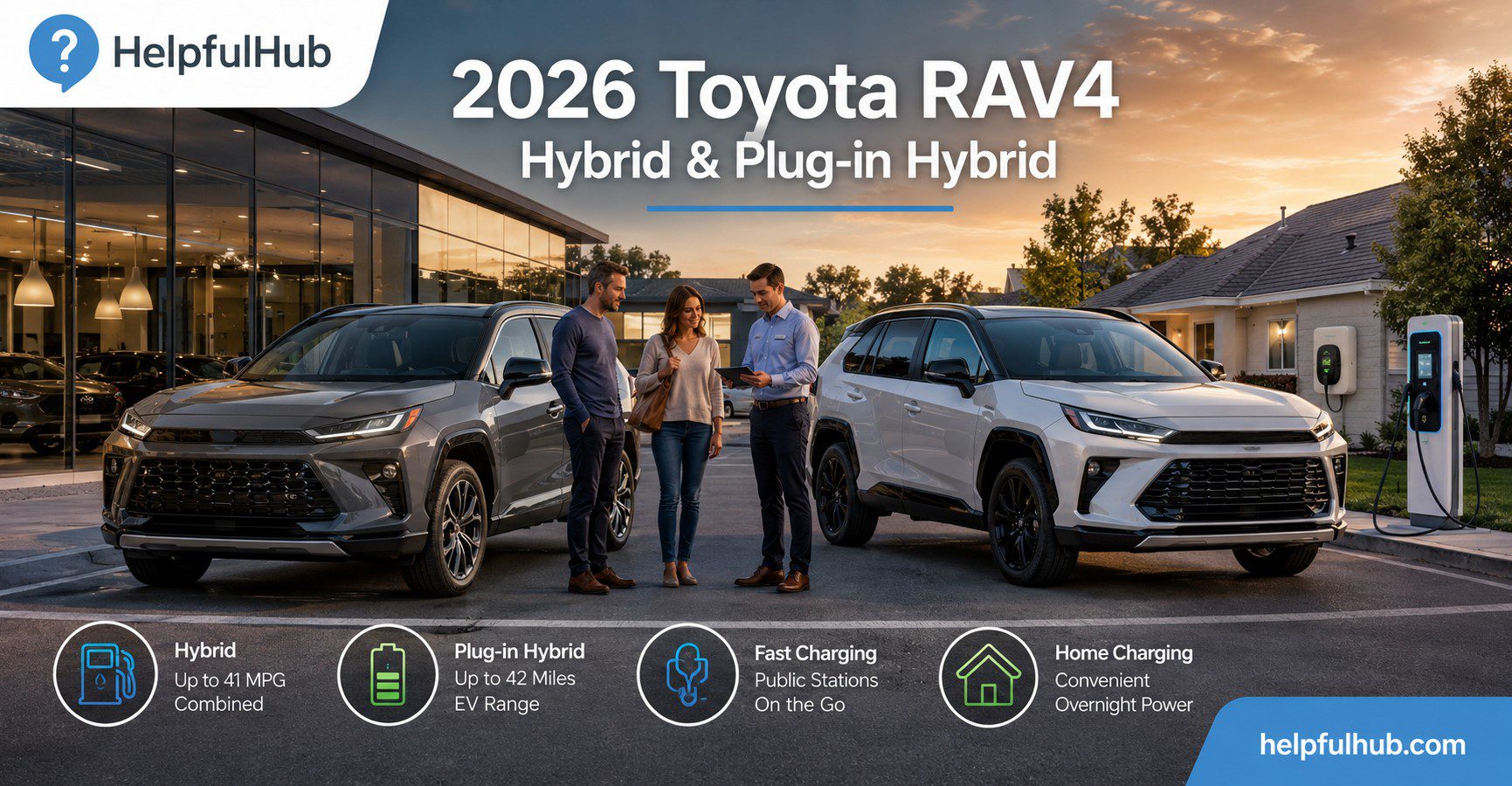
The RAV4 Plug-in Hybrid adds a larger battery that can be charged from an external power source. That gives it meaningful EV-only driving for many daily trips, while still keeping a gas engine for longer drives. Toyota lists the 2026 RAV4 Plug-in Hybrid with 324 net combined horsepower and an EPA-estimated 54-mile all-electric driving range rating on the SE trim. Real-world range can still vary based on speed, weather, tires, elevation, cargo, and driving style.
2026 Toyota RAV4 Hybrid and Plug-in Hybrid at a Glance
| Topic | RAV4 Hybrid | RAV4 Plug-in Hybrid |
|---|---|---|
| Main buyer appeal | Simple fuel savings with no charging routine | Electric-only driving for buyers who can charge regularly |
| Powertrain type | Hybrid electric vehicle | Plug-in hybrid electric vehicle |
| Charging needed | No external charging required | Best value comes from home or workplace charging |
| Best for | Apartment dwellers, families, commuters, simple ownership | Short commutes, home charging, EV-curious buyers, higher performance interest |
| Key buying question | Which trim and drivetrain fit your budget? | Can you charge often enough to justify the upgrade? |
| Details to verify | Current MSRP, MPG, availability, dealer fees, equipment | Current MSRP, EV range by trim, charging details, incentives, equipment |
Why the 2026 RAV4 Matters in Toyota’s USA Lineup
The RAV4 sits in one of the most competitive parts of the US market. Compact SUVs appeal to buyers who want a higher seating position than a sedan, easier parking than a large SUV, and enough cargo space for real life. That makes the 2026 RAV4 important not only for Toyota fans, but also for buyers comparing hybrid SUVs, plug-in hybrid SUVs, and electric alternatives.
Toyota is also using the RAV4 to show how electrified powertrains can fit mainstream buyers. Some shoppers are ready for a full EV. Others want better fuel economy but still prefer a gas backup. The RAV4 Hybrid and RAV4 Plug-in Hybrid give those buyers two different paths.
If you are comparing several Toyota models, start with the RAV4 as the center point. Then ask whether you need a smaller car, a larger SUV, a tougher off-road-style vehicle, or a truck. That approach keeps the buying process practical instead of overwhelming.
For broader electrified-car context, the hybrid and electric mobility guide can help explain how hybrids, plug-in hybrids, and EVs fit different driving habits.
Quick Comparison: RAV4 Hybrid vs RAV4 Plug-in Hybrid
The core decision is simple: choose the RAV4 Hybrid if you want efficiency without changing your routine, and consider the RAV4 Plug-in Hybrid if you can charge often enough to use the electric range. However, the best choice also depends on price, trim features, insurance, commute length, local electricity rates, and whether you have a place to plug in.
The RAV4 Hybrid may be better for a driver who parks on the street, lives in an apartment without charging, or takes unpredictable long drives. The RAV4 Plug-in Hybrid may be better for someone with a garage, a Level 2 home charger, a predictable daily commute, and the discipline to plug in regularly.
RAV4 Hybrid vs RAV4 Plug-in Hybrid Buyer Comparison
| Buyer Question | RAV4 Hybrid | RAV4 Plug-in Hybrid |
|---|---|---|
| Do you want to plug in? | No. It works like a normal vehicle. | Yes, regular charging helps unlock the value. |
| Do you drive short daily trips? | Good fit, especially in mixed city and suburban driving. | Potentially excellent if EV-only range covers many daily miles. |
| Do you need lower upfront cost? | Usually the more budget-friendly starting point. | Usually higher transaction price, depending on trim and market. |
| Do you want stronger acceleration? | Practical and efficient, but not the performance-focused choice. | Stronger output and quicker feel, especially for buyers who value power. |
| Do you live in a snowbelt state? | Consider AWD if available on your preferred trim. | AWD is a key part of the plug-in hybrid appeal, but confirm trim details. |
| Do you road trip often? | Easy fuel stops and no charging planning. | Gas backup helps, but charging strategy may affect total savings. |
RAV4 Hybrid Trims and Buyer Use Cases
Toyota lists 2026 RAV4 Hybrid trims such as LE, SE, XLE Premium, Woodland, XSE, and Limited. Pricing, equipment, and availability can change, so use Toyota and local dealer pages for current numbers before buying. Still, each trim has a clear buyer personality.
The LE is the logical starting point for value-focused shoppers. The SE adds a sportier look and may appeal to commuters who want more style. The XLE Premium is often the kind of trim families consider when they want more comfort without going all the way to the top. Woodland is aimed at buyers who like outdoor styling and light adventure cues. XSE and Limited are better for shoppers who want more features, technology, or a premium feel.
2026 RAV4 Hybrid Trim Buyer Guide
| Trim | Best Fit | Buyer Notes |
|---|---|---|
| LE | Value-focused commuters and first-time Toyota buyers | Start here if monthly payment and basic efficiency matter most. |
| SE | Drivers who want a sportier hybrid look | Good for buyers who want more style without jumping to upper trims. |
| XLE Premium | Small families and comfort-focused commuters | Often worth comparing if seat comfort, convenience, and daily usability matter. |
| Woodland | Outdoor-style buyers and weekend travelers | Check tire type, ride comfort, MPG, and cargo needs before choosing it. |
| XSE | Tech and design-focused hybrid shoppers | May suit buyers who want a more premium look and cabin experience. |
| Limited | Feature-focused buyers who want the most comfort | Compare final price against the Plug-in Hybrid before deciding. |
The smartest trim is not always the most expensive one. A daily commuter may be perfectly happy with LE or SE. A family may prefer XLE Premium or Limited if the budget allows. An outdoor-minded buyer may like Woodland, but should test drive it because tire type and ride feel can change the experience.
RAV4 Plug-in Hybrid Trims and Buyer Use Cases
Toyota lists the 2026 RAV4 Plug-in Hybrid in SE, Woodland, XSE, and GR Sport trims. The plug-in version is the more performance-oriented and EV-capable side of the lineup. It is also the version where charging access matters most.
The SE may be the practical starting point because Toyota lists the EPA-estimated 54-mile all-electric driving range rating on the SE trim. Woodland adds outdoor-oriented details. XSE targets buyers who want a more premium and sporty plug-in hybrid. GR Sport is the most enthusiast-focused option, but it should be chosen for the full package, not only because it sounds exciting.
2026 RAV4 Plug-in Hybrid Trim Buyer Guide
| Trim | Best Fit | Buyer Notes |
|---|---|---|
| SE | Plug-in hybrid shoppers focused on value and EV range | Strong first trim to compare if you want electric driving without maxing out the budget. |
| Woodland | Outdoor-style plug-in hybrid buyers | Check range, tire type, ride comfort, charging details, and actual availability. |
| XSE | Buyers who want more technology, comfort, and style | Good to compare against a loaded Hybrid trim and against the GR Sport. |
| GR Sport | Drivers who want the sportiest RAV4 Plug-in Hybrid personality | Do not choose it only for power. Test ride comfort, tire setup, insurance cost, and price. |
The Plug-in Hybrid can be tempting because of its output and EV-only capability. However, the right buyer should look beyond acceleration. Ask how often you will charge, whether your daily route fits the electric range, and how much more you will pay compared with a regular RAV4 Hybrid.
EV-Only Range and Charging Explained
EV-only range means the vehicle can drive on battery power for a certain distance before the gas engine becomes more involved. Toyota lists an EPA-estimated 54-mile all-electric driving range rating on the 2026 RAV4 Plug-in Hybrid SE. That does not mean every driver will see the same number every day.
Cold weather, high speeds, steep hills, heavy cargo, roof racks, tire choice, and aggressive acceleration can reduce electric range. On the other hand, calm city driving and regular charging can help many drivers use the plug-in hybrid like an EV for short local trips.
Charging time depends on the charger, battery state, temperature, and vehicle equipment. Some official pages and dealer pages may mention charging features by trim, but buyers should confirm charging capability trim by trim before purchase. Do not assume every plug-in hybrid trim supports the same charging speed or charging hardware.
Home Charging vs Public Charging
Home charging is the biggest factor in whether the RAV4 Plug-in Hybrid makes financial and practical sense. If you can plug in overnight, you may start many mornings with usable electric range. That can reduce gas use on school runs, short commutes, errands, and local driving.
If you cannot charge at home, the RAV4 Plug-in Hybrid can still operate as a hybrid, but the value calculation changes. You may pay more upfront and not use the battery advantage as often. Public charging can help, but it is less convenient than plugging in where you live or work.
Home Charging vs No Home Charging Decision Table
| Charging Situation | Best RAV4 Choice | Why It Matters |
|---|---|---|
| Garage or driveway with home charging | RAV4 Plug-in Hybrid may make strong sense | You can use electric miles often and reduce gasoline use for short trips. |
| Workplace charging available | RAV4 Plug-in Hybrid may still work well | Charging during the day can support commuting savings. |
| Apartment with no reliable charger | RAV4 Hybrid may be easier | You avoid charging stress and still get hybrid efficiency. |
| Mostly road trips and highway driving | Compare both carefully | The plug-in battery may help less if you rarely charge between long drives. |
| Uncertain charging access | Start with the RAV4 Hybrid | Do not pay extra for plug-in capability unless you can use it regularly. |
AWD vs FWD: Which RAV4 Setup Makes Sense?
AWD can be useful for snowbelt states, mountain roads, wet climates, gravel driveways, and buyers who want extra traction confidence. FWD can be attractive for buyers who live in milder areas and want to keep cost and efficiency in check. The right answer depends on where you live and how you drive.
For example, a driver in Florida, Texas, or Southern California may not need AWD as much as a driver in Colorado, Michigan, Vermont, or upstate New York. However, even snowbelt buyers should remember that tires matter. AWD helps you move, but good tires and safe driving habits help you stop and steer.
Confirm which trims offer FWD, AWD, or standard AWD before buying. Also compare how drivetrain choice affects MSRP, MPG, availability, and resale value in your local market.
Daily Commuting and City Driving
For commuters, the RAV4 Hybrid is simple. You get in, drive, and refuel when needed. It is a practical match for drivers who do not want to think about charging or who park in different places every day.
The RAV4 Plug-in Hybrid can be excellent for commuting if your daily miles fit within the EV-only range and you charge consistently. A driver with a 20-mile round trip and home charging may use very little gas during the workweek. A driver with a long highway commute and no charger may not benefit as much.
Commuter, Family, and Road-Trip Use Case Table
| Use Case | RAV4 Hybrid Fit | RAV4 Plug-in Hybrid Fit |
|---|---|---|
| Short city commute | Good, simple, and efficient | Excellent if charged regularly |
| Long highway commute | Very practical with no charging stops | Good, but savings depend on charging and speed |
| School runs and errands | Easy for busy families | Strong if local trips use electric driving |
| Weekend road trips | Simple fuel planning | Gas backup helps, but charging may improve savings |
| Apartment living | Usually the safer choice | Only if reliable charging is available nearby |
| Home garage ownership | Still good | Often the best plug-in hybrid scenario |
Family SUV Practicality and Cargo Needs
A compact SUV has to work in normal life. That means car seats, backpacks, sports bags, groceries, pet supplies, strollers, luggage, and weekend gear. Before choosing a 2026 RAV4 trim, sit in the front and rear seats, check visibility, test the cargo opening, and fold the rear seats if cargo flexibility matters.
Families should not choose only by powertrain. The better vehicle is the one that works every day. Seat comfort, rear-seat space, child-seat access, cargo floor height, driver visibility, noise levels, and infotainment usability can matter more than a small difference in efficiency.
If your family is growing or you regularly carry adults in the second row, compare the RAV4 with larger Toyota options through the Toyota Highlander electrification outlook. The RAV4 may be enough for many families, but some households need more cabin space.
Road Trips, Fuel Stops, and Charging Planning
The RAV4 Hybrid is straightforward for road trips. You plan fuel stops like any other gas vehicle, and the hybrid system helps with efficiency. That simplicity matters if you drive across states, visit rural areas, or do not want to plan around chargers.
The RAV4 Plug-in Hybrid has a different rhythm. You can use electric driving around town, then rely on the gas engine for longer trips. That makes it more flexible than a full EV for some buyers. However, public charging may not always be convenient, available, or priced attractively, so do not base your entire road-trip plan on charging unless you have checked stations along your route.
For buyers who want a full EV alternative instead of a plug-in hybrid, compare the RAV4 against the 2026 Toyota C-HR EV and the 2026 Toyota bZ Woodland when those fit your driving needs and local availability.
Hybrid vs Plug-in Hybrid Ownership Cost
Ownership cost is where many buyers make mistakes. They compare only MSRP or only MPG, then forget insurance, electricity rates, home charger cost, dealer fees, taxes, interest rate, tires, maintenance, depreciation, and resale value. A smarter comparison looks at the whole ownership picture.
The RAV4 Hybrid may cost less upfront and may be easier to own if you do not have charging access. The RAV4 Plug-in Hybrid may save more fuel if you charge often and your daily driving uses electric miles. However, insurance and financing can change the total cost quickly.
Ownership Cost Checklist
| Cost Item | What to Check | Why It Matters |
|---|---|---|
| MSRP and transaction price | Compare current Toyota pricing, dealer fees, accessories, and markups | The final out-the-door price matters more than the advertised starting price. |
| Fuel cost | Estimate annual miles, local gas prices, and driving mix | Hybrid savings depend on how and where you drive. |
| Electricity cost | Check home utility rates and charging habits | Plug-in savings depend on cheap and convenient charging. |
| Insurance | Get quotes for the exact trim and VIN if possible | Higher-value trims may cost more to insure. |
| Financing | Compare APR, term length, down payment, and monthly payment | A lower fuel bill can be offset by a higher monthly payment. |
| Maintenance | Ask about service intervals and hybrid or plug-in hybrid components | Long-term ownership should be planned before buying. |
| Resale value | Research local demand for Hybrid and Plug-in Hybrid trims | Strong demand may help value, but local market conditions still matter. |
Before choosing a trim, use the HelpfulHub car payment calculator to estimate your monthly RAV4 payment. Add insurance, fuel or electricity, and expected maintenance to understand the real monthly cost.
Insurance, Maintenance, and Long-Term Reliability Considerations
Insurance can vary by state, driver age, credit-based insurance rules where allowed, ZIP code, driving record, mileage, coverage limits, deductible, and trim value. A RAV4 Plug-in Hybrid may cost more to insure than a lower-priced RAV4 Hybrid trim because insurers consider repair cost, parts cost, technology, and vehicle value.
Plug-in hybrid and EV-related insurance questions can also be different from gas-only vehicles. Before buying, compare quotes and read the hybrid and EV insurance guide for broader context.
Maintenance expectations should be practical. Hybrid systems have been common in Toyota vehicles for many years, but buyers should still follow Toyota service guidance, keep tires in good condition, maintain brakes, and use qualified service centers. For plug-in hybrid buyers, also ask about battery warranty details, charging equipment, software updates, and any trim-specific maintenance guidance.
Financing, Leasing, and Trade-In Tips
Financing a 2026 RAV4 is about more than the monthly payment. A longer loan can make the payment look easier, but it may increase total interest. A shorter loan may cost more per month, but it can reduce total finance cost. Always compare the full loan amount, APR, term, taxes, fees, and add-ons.
Leasing may appeal to buyers who want lower commitment, frequent upgrades, or predictable terms. However, lease mileage limits, wear charges, acquisition fees, and end-of-lease choices matter. Plug-in hybrid shoppers should also confirm how incentives, if any, are applied. Do not assume eligibility for tax credits or local rebates unless you verify current rules from official sources.
A trade-in can reduce the amount financed, but you should know its value before visiting the dealer. Get multiple trade-in estimates, check your loan payoff, and negotiate the new RAV4 price separately from the trade-in when possible.
New 2026 RAV4 vs Used RAV4: What Buyers Should Consider
A new 2026 RAV4 may give you the newest design, latest technology, fresh warranty coverage, and the exact trim you want if inventory is available. A used RAV4 Hybrid may cost less upfront and may be easier to find in some markets. Both can be smart, depending on your budget.
The key is to compare total cost, not just sticker price. A used RAV4 may have lower purchase price but higher mileage, older tires, less warranty coverage, and fewer features. A new RAV4 may cost more but could offer better financing, newer safety technology, and a longer expected ownership runway.
New 2026 RAV4 vs Used RAV4 Considerations
| Question | New 2026 RAV4 | Used RAV4 Hybrid |
|---|---|---|
| Upfront price | Usually higher, depending on trim and dealer pricing | Usually lower, but depends on mileage and demand |
| Warranty coverage | Starts fresh, based on Toyota terms | Depends on age, mileage, and certified pre-owned status |
| Technology | Newest Toyota features and updated interface | May have older infotainment and driver-assistance features |
| Condition | New vehicle condition | Needs inspection, service history review, and tire/brake check |
| Financing | May have new-car offers if available | Used-car rates can vary widely |
| Best for | Buyers wanting latest features and long ownership | Budget-focused buyers who find a clean example |
For a deeper cost comparison, review the new vs used vehicle cost guide and the buying new vs used car guide before deciding.
RAV4 vs C-HR EV and bZ Woodland
The RAV4 Plug-in Hybrid is not the same thing as a full EV. It can drive on electricity for local trips, but it still has a gas engine. That can be ideal for buyers who are EV-curious but not ready to depend entirely on charging.
The Toyota C-HR EV and bZ Woodland are better comparison points for buyers who want a battery-electric Toyota path. Keep this comparison short and practical: choose the RAV4 Hybrid for no charging, the RAV4 Plug-in Hybrid for part-time electric driving with gas backup, and a Toyota EV if you are ready for full charging-based ownership.
Before choosing a full EV, confirm home charging, road-trip charging, local incentives, insurance cost, and winter range expectations. The right answer depends on your lifestyle, not only on the badge or powertrain.
RAV4 vs Highlander, Camry Hybrid, Corolla Hybrid, 4Runner, and Tacoma
The RAV4 is not the right Toyota for everyone. If you want a sedan, compare it with the 2026 Toyota Camry Hybrid or the 2026 Toyota Corolla and Corolla Hybrid. These may fit buyers who value lower seating height, easier city parking, or sedan efficiency more than SUV cargo shape.
If you need more space for family travel, compare the RAV4 with Highlander. If you want rugged SUV character, compare it with the 2026 Toyota 4Runner. If you need a pickup bed, the 2026 Toyota Tacoma i-FORCE MAX is a more logical pathway.
The RAV4 works best for buyers who want a balanced compact SUV. It is not a large three-row family SUV, not a pickup, and not a pure off-road machine. Knowing that can save you from buying the wrong vehicle.
Common RAV4 Buyer Mistakes to Avoid
One common mistake is choosing the Plug-in Hybrid only because it has more power. More output is appealing, but the plug-in version makes the most sense when charging fits your life. If you rarely plug in, you may not get the full value.
Another mistake is ignoring insurance before buying. A higher trim, larger wheels, more technology, and plug-in hybrid hardware can change the insurance quote. Get quotes before signing.
Buyers also sometimes choose AWD without thinking about tires, climate, and actual driving conditions. AWD can be useful, but it is not a replacement for good tires or careful driving. Meanwhile, some buyers skip AWD in snowbelt states to save money, then regret it during winter.
Finally, do not shop only by monthly payment. A dealer can stretch the loan term to make a vehicle seem affordable. Look at total cost, interest, trade-in value, maintenance, insurance, and how long you plan to keep the RAV4.
Practical Expert Insight
The best way to choose between the 2026 RAV4 Hybrid and RAV4 Plug-in Hybrid is to map your real week of driving. Write down your daily commute, school runs, errands, weekend trips, parking situation, and charging options. Then ask which version fits that routine with the least friction.
If you can charge at home and most of your weekday trips are short, the Plug-in Hybrid deserves serious attention. You may use electric driving often and still have a gas engine for long trips. However, if you live in an apartment, park on the street, or do not want to plan charging, the regular RAV4 Hybrid may be the more satisfying long-term choice.
Trim choice should come after powertrain choice. A well-matched Hybrid trim can be better than a Plug-in Hybrid that stretches your budget. On the other hand, a Plug-in Hybrid can be worth the premium if you will use its electric range, enjoy the stronger performance, and can insure it comfortably.
At the dealership, test drive the exact trim you plan to buy. Check seat comfort, cabin noise, rear visibility, steering feel, screen usability, cargo loading, and brake feel. Also ask for an out-the-door price, not just MSRP, and compare that number with your insurance quote and monthly payment estimate.
FAQ
What is new in the 2026 Toyota RAV4 Hybrid and Plug-in Hybrid?
The 2026 RAV4 lineup puts a major focus on electrified powertrains, including Hybrid and Plug-in Hybrid versions. Toyota lists updated trims, modern technology, and a plug-in hybrid model with 324 net combined horsepower. For US buyers, the biggest change is not only the equipment list. It is the decision process. You now need to compare regular hybrid simplicity against plug-in hybrid electric driving, charging access, insurance, financing, and long-term ownership. Always verify final trim details, availability, pricing, and features with Toyota or local dealers before buying.
Is the 2026 RAV4 hybrid-only?
Toyota’s current US RAV4 pages focus on electrified powertrains, including Hybrid and Plug-in Hybrid versions. That means buyers should think of the 2026 RAV4 as an electrified compact SUV choice rather than a traditional gas-only compact SUV. However, wording, inventory, regional availability, and trim details can change, so it is smart to confirm current information on Toyota’s official website and with local dealers. The practical takeaway is simple: most buyers will be comparing RAV4 Hybrid simplicity with RAV4 Plug-in Hybrid electric-driving potential.
Is the RAV4 Hybrid or RAV4 Plug-in Hybrid better?
The better choice depends on your daily life. The RAV4 Hybrid is usually better if you want lower complexity, no charging routine, and easy ownership. It fits apartment dwellers, road-trip drivers, and families who do not want to think about plugs or charging stations. The RAV4 Plug-in Hybrid may be better if you can charge at home or work and your daily driving often fits within the EV-only range. It also offers stronger performance, but the extra cost should make sense for your budget and charging habits.
What is the EV-only range of the 2026 RAV4 Plug-in Hybrid?
Toyota lists an EPA-estimated 54-mile all-electric driving range rating on the 2026 RAV4 Plug-in Hybrid SE. That figure is useful for comparison, but real-world range can vary. Cold weather, highway speed, hills, tire choice, cargo weight, and driving style can reduce electric range. Also, do not assume every trim will perform exactly the same in every condition. Before buying, ask the dealer to confirm the range rating and charging details for the specific RAV4 Plug-in Hybrid trim you are considering.
Do I need home charging for the RAV4 Plug-in Hybrid?
You do not absolutely need home charging for a plug-in hybrid to operate, because the gas engine can still support longer driving. However, home charging is what makes the RAV4 Plug-in Hybrid most practical. If you can plug in overnight, you can use electric miles more often for commuting, errands, and school runs. Without home or workplace charging, you may rely more on gasoline and may not recover the added cost as easily. In that case, the regular RAV4 Hybrid may be the easier choice.
Is AWD worth it on the 2026 RAV4?
AWD can be worth it if you live in a snowbelt state, drive through heavy rain, visit mountain areas, use gravel roads, or simply want extra traction confidence. However, AWD can also affect price, fuel economy, and availability depending on trim. Buyers in warmer climates with mostly city and highway driving may be comfortable with FWD where available. Remember that AWD does not replace good tires. If winter safety matters, compare drivetrain, tire type, and real driving conditions before choosing your RAV4.
Is the 2026 RAV4 good for families?
The 2026 RAV4 can be a strong family compact SUV choice for many households because it offers a practical size, useful cargo shape, and hybrid or plug-in hybrid options. Still, families should test the details. Try installing child seats, check rear-seat space, sit in the front seats for comfort, and make sure the cargo area fits strollers, sports gear, groceries, pets, or travel bags. If you regularly need a third row or more cargo room, compare the RAV4 with a larger Toyota SUV before buying.
Should buyers compare a new 2026 RAV4 with a used RAV4?
Yes. A used RAV4 Hybrid may be a smart choice if it has a clean history, reasonable mileage, good maintenance records, and a price that makes sense. A new 2026 RAV4 may be better if you want the latest design, fresh warranty coverage, updated technology, and your preferred trim. Compare out-the-door price, financing rate, insurance, mileage, warranty, tires, brakes, and expected ownership period. Certified pre-owned options can also be worth reviewing if you want a middle ground between new and used.
Is the RAV4 Plug-in Hybrid worth it for commuters?
The RAV4 Plug-in Hybrid can be worth it for commuters who can charge regularly and keep most daily driving within the electric range. A short or moderate commute with home charging is the ideal scenario. In that case, the vehicle can feel close to an EV during the week while keeping gasoline flexibility for long drives. However, if your commute is long, mostly highway, or you cannot charge reliably, the regular RAV4 Hybrid may offer a simpler and more cost-effective ownership experience.
What should buyers check before buying a 2026 RAV4?
Before buying, check current MSRP, destination charge, dealer fees, availability, accessories, trim equipment, drivetrain, MPG or MPGe, EV range, charging capability, insurance quote, financing rate, lease terms, trade-in value, and warranty details. Test drive the exact trim you plan to buy, not just a similar one. Also check seat comfort, visibility, cargo space, infotainment controls, driver-assistance features, and ride quality. If choosing the Plug-in Hybrid, confirm your charging plan before signing. A great RAV4 deal should fit your real driving life, not only your wish list.
Final 2026 Toyota RAV4 Buyer Checklist
- Verify current trim pricing and availability with Toyota or local dealers.
- Compare RAV4 Hybrid and RAV4 Plug-in Hybrid carefully.
- Decide whether you can charge at home or work.
- Compare fuel cost and electricity cost for your real driving routine.
- Choose AWD or FWD based on your state, weather, roads, and driving conditions.
- Test drive the exact trim you plan to buy.
- Check seat comfort, driving position, and visibility.
- Check cargo space for family use, commuting, pets, or weekend gear.
- Estimate insurance before buying.
- Compare financing and lease offers.
- Calculate monthly payment before visiting the dealer.
- Check available incentives without assuming eligibility.
- Compare a new 2026 RAV4 with a certified pre-owned or used RAV4.
- Review hybrid and plug-in hybrid maintenance expectations.
- Avoid choosing the Plug-in Hybrid only because it has higher power.
- Use the car payment calculator to estimate your monthly RAV4 payment.
Final Buyer Decision Table
| Choose This | If You Are This Buyer | Final Reminder |
|---|---|---|
| RAV4 Hybrid | You want simple efficiency, no charging, and lower ownership complexity. | Compare trims, AWD needs, insurance, and total payment. |
| RAV4 Plug-in Hybrid SE | You want plug-in capability and strong electric-driving potential. | Confirm current EV range, charging details, and out-the-door price. |
| RAV4 Plug-in Hybrid Woodland | You want outdoor styling with plug-in hybrid capability. | Test ride comfort, tires, MPG/MPGe, and availability. |
| RAV4 Plug-in Hybrid XSE | You want more technology, comfort, and sporty style. | Compare price against Limited Hybrid and GR Sport. |
| RAV4 Plug-in Hybrid GR Sport | You want the sportiest RAV4 personality. | Check insurance, tire cost, ride feel, and real budget fit. |
| Used RAV4 Hybrid | You want lower upfront cost and find a clean vehicle. | Review history, warranty, inspection, mileage, and financing. |
Conclusion
The 2026 Toyota RAV4 Hybrid and Plug-in Hybrid give US compact SUV buyers two useful paths. The RAV4 Hybrid is the simpler choice for drivers who want fuel savings without charging. The RAV4 Plug-in Hybrid is the more advanced choice for buyers who can charge often and want more electric-only driving with gas backup.
The right decision depends on your commute, home charging access, trim budget, AWD needs, family use, insurance quote, financing terms, and long-term ownership plan. Do not choose only by horsepower, MPG, EV range, or monthly payment. Compare the full ownership picture.
Before buying, test drive the trim you want, verify current Toyota details, compare new and used options, calculate your monthly payment, and ask whether the RAV4 fits your real life. If you do that, the 2026 Toyota RAV4 Hybrid and Plug-in Hybrid decision becomes much easier and more practical.