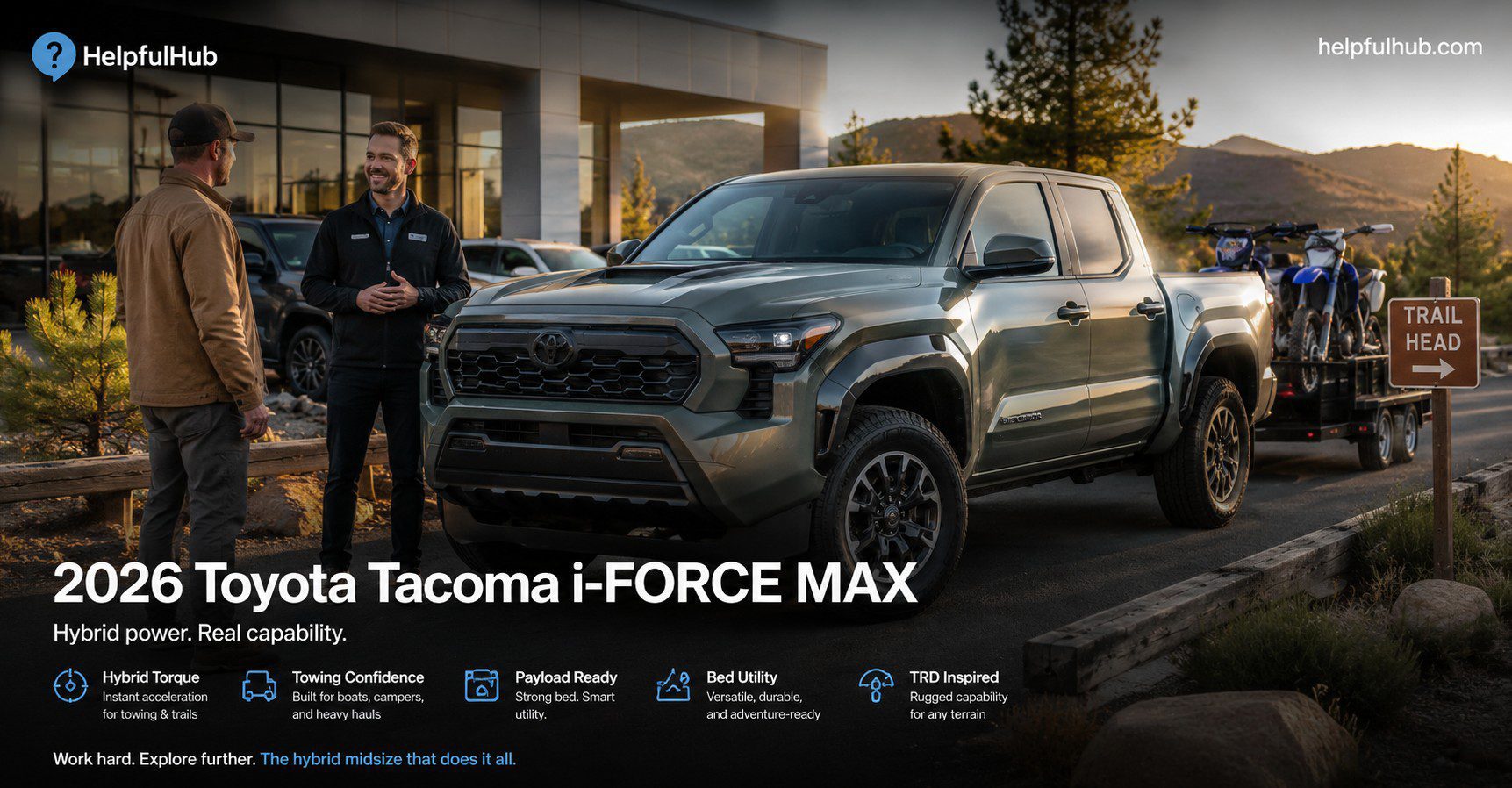
2026 Toyota Tacoma i-FORCE MAX: Hybrid Power, Towing, Trims, MPG, Price, and Buyer Guide
This buyer guide focuses on what matters before you visit a Toyota dealership: i-FORCE vs i-FORCE MAX, towing, payload, bed length, cab utility, TRD trim choices, 4WD, ownership cost, insurance, maintenance, financing, and long-term value. It also connects the Tacoma to the broader 2026 Toyota Models USA lineup, without turning this into a general Toyota lineup article.
Quick Answer
The 2026 Toyota Tacoma i-FORCE MAX is a midsize hybrid pickup for buyers who want strong torque, truck utility, and Toyota off-road trim choices in a more compact package than a full-size truck. The i-FORCE MAX may make sense if you value low-speed torque, trail use, premium Tacoma trims, available 4WD capability, and convenience features such as a 2400W power supply on applicable trims. However, buyers who mainly want the lowest upfront cost, a simpler work truck, or the best configuration for a specific towing job should compare i-FORCE gas models carefully. Before buying, compare towing, payload, bed length, cab layout, 4WD system, trim equipment, insurance, financing, maintenance, and long-term ownership cost. Also verify current pricing, availability, destination charge, incentives, dealer fees, towing ratings, payload ratings, MPG, and trim details with Toyota or local dealers before signing paperwork.
2026 Toyota Tacoma i-FORCE MAX: What US Buyers Should Know
The 2026 Toyota Tacoma i-FORCE MAX sits in a very specific place in the US truck market. It is for buyers who want a midsize pickup, but do not want a basic truck experience. It gives Tacoma shoppers access to Toyota’s available hybrid truck powertrain, strong torque, available premium technology, and off-road-focused trims.
Toyota lists the standard i-FORCE engine with up to 278 horsepower and 317 lb-ft of torque. The available i-FORCE MAX hybrid system is listed with up to 326 horsepower and 465 lb-ft of torque. That difference matters because truck buyers often care about torque more than peak horsepower. Torque is what helps a truck feel strong when pulling away, climbing grades, carrying gear, or moving through uneven terrain.
However, the Tacoma i-FORCE MAX is not automatically the best Tacoma for every buyer. A commuter who rarely tows, rarely leaves pavement, and wants the lowest payment may be better served by a non-hybrid Tacoma configuration. Meanwhile, an outdoor driver, contractor, frequent camper, or buyer who wants Trailhunter or TRD Pro capability may find the hybrid Tacoma more appealing.
2026 Toyota Tacoma i-FORCE MAX Key Buyer Details at a Glance
| Buyer Detail | What to Know | What to Verify Before Buying |
|---|---|---|
| Vehicle type | Midsize pickup truck | Confirm cab, bed, drivetrain, and trim availability near you |
| Powertrain focus | Available i-FORCE MAX turbocharged hybrid system | Compare with standard i-FORCE for price, MPG, and needs |
| Power and torque | Toyota lists up to 326 horsepower and 465 lb-ft of torque | Confirm exact figures by trim and configuration |
| Truck utility | Designed for towing, payload, bed use, work gear, and adventure equipment | Check ratings by cab, bed, drivetrain, package, and accessories |
| 4WD availability | Available On-Demand or Full-Time 4WD depending on configuration | Confirm which 4WD system comes with the trim you are considering |
| Technology | Available 14-inch touchscreen and Toyota Safety Sense 3.0 | Check standard vs available features by trim |
| Power supply | 2400W power supply is listed on applicable i-FORCE MAX trims | Verify location, output, and trim availability |
Why Tacoma i-FORCE MAX Matters in Toyota’s USA Lineup
Toyota’s US lineup now includes more hybrid, plug-in hybrid, electric, and electrified choices than many shoppers realize. The Tacoma i-FORCE MAX matters because it brings electrified assistance into a truck format, while still keeping the personality of a body-on-frame pickup.
That makes it different from a compact hybrid SUV, a family hybrid sedan, or a battery-electric crossover. The Tacoma is still a pickup first. It has a truck bed, towing considerations, payload limits, available off-road hardware, and a different ownership profile than something like a RAV4 Hybrid or Camry Hybrid.
For shoppers comparing Toyota’s broader direction, the electric mobility guide can help explain how hybrids, plug-in hybrids, EVs, and electrified powertrains fit into future transportation. However, the Tacoma i-FORCE MAX should be judged as a truck. Its main value is not simply fuel economy. It is torque, utility, capability, and trim-specific equipment.
Quick Comparison: i-FORCE vs i-FORCE MAX
The i-FORCE vs i-FORCE MAX decision is the center of this Tacoma buying process. The standard i-FORCE engine may appeal to buyers who want Tacoma capability with a lower starting point, simpler configuration choices, or a more traditional truck buying path. The i-FORCE MAX is for buyers who want stronger torque and access to certain premium or adventure-focused Tacoma trims.
The right choice depends on how you actually use the truck. A driver who commutes Monday through Friday and carries bikes or tools on weekends may not need the most aggressive hybrid off-road trim. On the other hand, a buyer who tows, camps, drives rough roads, and wants maximum Tacoma torque may see the i-FORCE MAX as the better long-term fit.
i-FORCE vs i-FORCE MAX Buyer Comparison
| Category | i-FORCE | i-FORCE MAX |
|---|---|---|
| Powertrain type | 2.4-liter turbocharged gas engine | 2.4-liter turbocharged hybrid system |
| Best for | Lower cost, general truck use, traditional Tacoma shoppers | Stronger torque, premium trims, towing confidence, adventure use |
| Toyota-listed output | Up to 278 horsepower and 317 lb-ft of torque | Up to 326 horsepower and 465 lb-ft of torque |
| Transmission context | Automatic or manual availability may depend on trim | Paired with an 8-speed automatic transmission |
| Buyer concern | May not offer the same torque or hybrid features | May cost more and may not be necessary for every buyer |
| What to verify | Trim availability, MPG, 4WD, tow package, bed length | Trim availability, MPG, towing, payload, insurance, payment |
Hybrid Torque: Why It Matters in a Midsize Truck
Torque matters because trucks do not live only on smooth roads with no cargo. Many Tacoma buyers carry lumber, tools, camping equipment, coolers, bikes, recovery gear, or a small trailer. A high-torque hybrid system can help the truck feel more responsive in these heavier-use moments.
That does not mean the Tacoma i-FORCE MAX replaces a full-size truck. It also does not mean every buyer needs it. Instead, the hybrid system gives Tacoma shoppers a stronger powertrain option inside a midsize truck footprint.
For example, a Tacoma i-FORCE MAX can make sense for a buyer who lives in Colorado, Utah, Vermont, Pennsylvania, Washington, or another area where grades, snow, gravel, and outdoor routes are common. It can also appeal to a small business owner who wants a truck that feels strong with tools in the bed, but who does not want the size or cost of a larger pickup.
Towing and Payload: What Buyers Should Verify
Towing and payload are two of the most misunderstood truck numbers. Towing describes how much a vehicle can pull when properly equipped. Payload describes how much weight the truck can carry in and on the truck, including passengers, cargo, accessories, tongue weight, and gear in the bed.
Some automotive references report hybrid Tacoma towing up to 6,000 lbs and payload up to around 1,710 lbs depending on configuration. However, those numbers can vary by trim, cab, bed, drivetrain, equipment, tire choice, accessories, and option packages. Always confirm the exact label and Toyota documentation for the truck you plan to buy.
This is especially important if you tow a small camper, boat, utility trailer, landscaping trailer, motorcycle trailer, or work trailer. Being under the maximum rating is not the only concern. You also need to think about braking, tongue weight, passengers, cargo, road grade, wind, temperature, and how often you tow.
Towing, Payload, Bed, and Cab Verification Table
| Item to Check | Why It Matters | Safe Buyer Action |
|---|---|---|
| Towing rating | Changes by configuration and equipment | Confirm the exact rating for the VIN or build sheet |
| Payload rating | Includes people, cargo, accessories, and trailer tongue weight | Check the door sticker and Toyota documentation |
| Bed length | Affects cargo fit, parking, and overlanding setup | Measure common gear before choosing 5-foot or 6-foot bed |
| Cab layout | Impacts rear-seat room and storage | Sit in the rear seat and test child-seat or passenger needs |
| 4WD system | Can affect traction, price, weight, and capability | Confirm On-Demand or Full-Time 4WD by trim |
| Accessories | Racks, tents, bumpers, and toolboxes add weight | Add accessory weight before calculating payload |
| Trailer setup | Hitch, brakes, wiring, mirrors, and tires matter | Use proper equipment and avoid overloading |
Cab, Bed, and Truck Utility Considerations
A Tacoma buyer should think about cab and bed choices before falling in love with a trim color or wheel design. A truck is useful only if it fits the way you carry people and gear. If you regularly drive with passengers, rear-seat comfort matters. If you carry long items, the bed length matters.
The Double Cab layout is the more family-friendly and passenger-friendly direction. It is often the more practical choice for buyers who drive kids, coworkers, or friends. However, bed size and configuration can vary, so do not assume every Tacoma i-FORCE MAX trim gives you the same cargo setup.
A 5-foot bed may work for camping bins, sports gear, home improvement supplies, and weekend loads. A 6-foot bed can be more useful for longer tools, ladders, work materials, or overlanding setups. However, a longer bed can also make parking and city driving less convenient.
4WD, Trail Use, and Rough-Weather Confidence
Many Tacoma shoppers look at 4WD because they drive in snowbelt states, rural areas, construction sites, trailheads, boat ramps, campgrounds, or mountain roads. Available 4WD can add confidence, but it does not remove the need for good tires, safe speed, and careful driving.
Toyota lists available On-Demand or Full-Time 4WD depending on configuration. Full-Time 4WD may be attractive for buyers who want all-weather traction without constantly thinking about when to engage the system. Other 4WD configurations may be better for traditional truck buyers who use 4WD only when needed.
Do not buy 4WD only because it looks rugged. Buy it because it fits your weather, terrain, work, towing, camping, and resale needs. In addition, ask the dealer to explain the exact 4WD system on the truck you are testing.
Trim Overview: TRD Sport, TRD Off-Road, Limited, Trailhunter, and TRD Pro
The 2026 Tacoma i-FORCE MAX trim decision should start with how the truck will be used. TRD Sport, TRD Off-Road, Limited, Trailhunter, and TRD Pro do not target the same buyer. Each one changes the Tacoma’s personality.
TRD Sport i-FORCE MAX is generally the more street-focused choice for buyers who like a sporty look and responsive road manners. TRD Off-Road i-FORCE MAX is more appealing for buyers who want trail hardware without going all the way to the most specialized trims. Limited i-FORCE MAX is the comfort-focused direction. Trailhunter is built around overlanding and off-grid style adventure. TRD Pro is the high-performance off-road image and capability choice.
2026 Tacoma i-FORCE MAX Trim Buyer Guide
| Trim | Best Buyer Fit | What to Check |
|---|---|---|
| TRD Sport i-FORCE MAX | Daily driver who wants hybrid torque and a sportier Tacoma feel | Ride comfort, tire choice, 4WD availability, payment, and MPG |
| TRD Off-Road i-FORCE MAX | Buyer who wants trail ability, rough-road confidence, and strong value | Off-road features, available packages, tire noise, and daily comfort |
| Limited i-FORCE MAX | Buyer who wants premium comfort, technology, and refined daily use | Luxury features, 4WD system, insurance, and long-term cost |
| Trailhunter | Overlanding, camping, and off-grid style buyer | Bed setup, payload with accessories, ride quality, and parking comfort |
| TRD Pro | Buyer who wants the most aggressive Tacoma off-road personality | Seat comfort, tire setup, suspension feel, pricing, and real need |
TRD Sport vs TRD Off-Road vs Trailhunter vs TRD Pro
TRD trims can look similar online, but they drive and live differently. The mistake many shoppers make is choosing the most aggressive trim because it looks exciting. That can lead to a higher payment, firmer ride, more expensive tires, or features that do not get used.
TRD Sport is easier to understand as a road-focused Tacoma with attitude. TRD Off-Road is the better fit for buyers who actually take gravel roads, rutted trails, dirt access roads, or snowy secondary roads. Trailhunter is more specialized for overlanding and gear-heavy adventures. TRD Pro is the halo off-road trim for buyers who want the strongest Tacoma off-road identity.
TRD Sport vs TRD Off-Road vs Trailhunter vs TRD Pro Buyer Fit Table
| Trim Direction | Best Use Case | Potential Tradeoff |
|---|---|---|
| TRD Sport | Commuting, suburban driving, light weekend use, sporty style | Not as trail-focused as off-road trims |
| TRD Off-Road | Gravel roads, trail access, camping, snow, rough work roads | May ride or sound different than a street-focused trim |
| Trailhunter | Overlanding, off-grid camping, accessory-heavy adventure builds | Higher cost and more specialized equipment |
| TRD Pro | Serious off-road image, rough terrain, high-performance trail focus | May be more truck than a daily commuter needs |
Work Use, DIY Projects, and Weekend Gear
The Tacoma i-FORCE MAX can be attractive for DIY homeowners, small business owners, and weekend project drivers. A midsize truck can fit into more parking spots than a full-size pickup, while still offering a bed for tools, mulch, lumber, sports gear, or camping bins.
Before buying, make a real list of what you carry. Include toolboxes, ladders, coolers, bicycles, generators, camping gear, spare tires, recovery boards, and trailer tongue weight. Then compare that list with payload and bed size. This step is more useful than simply asking which trim looks best.
The available 2400W power supply on applicable i-FORCE MAX trims can also matter for camping, worksites, tailgating, and small power needs. However, buyers should verify exactly how the outlet works, where it is located, what it can power, and whether it fits their use case.
Daily Driving and City Usability
A Tacoma is still a truck, so it will not feel like a compact sedan in traffic or a small crossover in tight parking lots. However, its midsize footprint can be easier to live with than a full-size pickup. That is one reason the Tacoma is popular with buyers who want truck capability without moving up to a larger truck.
For city and suburban driving, test visibility, turning radius, brake feel, seat comfort, road noise, and parking confidence. Also test the exact trim you plan to buy. A TRD Pro with aggressive tires may feel different from a Limited i-FORCE MAX on the same road.
If daily fuel efficiency and low operating cost are your top priorities, it is worth comparing Toyota’s car and SUV choices too. A commuter who does not need a truck bed may find the 2026 Toyota Camry Hybrid or 2026 Toyota Corolla and Corolla Hybrid more affordable to own.
Family Use and Road-Trip Practicality
Some buyers want one vehicle that can commute, carry family members, haul weekend gear, and handle road trips. The Tacoma i-FORCE MAX can work for that role if the cab space, ride quality, and bed setup match your family. Still, families should test it carefully.
Bring the people and gear you actually use. If you have child seats, install them during the test drive. If you travel with dogs, sports equipment, strollers, coolers, or luggage, think about where everything will go. A covered bed, bed divider, cargo system, or lockable storage may become important.
For larger families who rarely need a pickup bed, a three-row SUV may make more sense. In that case, compare Toyota family SUV options and read the Toyota Highlander electrification outlook before deciding.
Off-Road Use and Adventure Safety Considerations
The Tacoma i-FORCE MAX is easy to imagine at a trailhead, campsite, mountain overlook, or beach access road. However, off-road capability should be matched with safe behavior. The right tires, recovery planning, legal trail use, weather awareness, and realistic driving speed matter more than online hype.
TRD Off-Road, Trailhunter, and TRD Pro trims may appeal to different types of adventure buyers. Yet many owners only need occasional rough-road capability, not the most specialized equipment. If you mostly drive paved roads and only visit maintained campgrounds, a less aggressive trim may be smarter.
Do not overload the truck with racks, rooftop tents, bumpers, winch equipment, fuel cans, water tanks, and camping gear without checking payload. Overlanding accessories can add weight quickly. That weight can change handling, braking, ride height, fuel economy, and safety.
MPG and Real-World Fuel Economy Considerations
MPG is important, but it should not be the only reason to choose the Tacoma i-FORCE MAX. Toyota’s hybrid truck system is more about power, torque, and drivability than turning a pickup into a small economy car. Real-world MPG can vary based on trim, tires, speed, terrain, weather, traffic, cargo, towing, and driving habits.
A truck on all-terrain tires with a roof rack, camping gear, and highway speeds will not behave like a lightly loaded commuter vehicle. Likewise, towing can reduce fuel economy significantly. Buyers should review the window sticker, Toyota’s current information, and owner feedback once more 2026 trucks are on the road.
If your main goal is reducing fuel cost and you do not need a bed, compare the 2026 Toyota RAV4 Hybrid and Plug-in Hybrid as a more efficient SUV alternative.
Safety and Driver Assistance Features
Toyota lists Toyota Safety Sense 3.0 as part of the Tacoma technology conversation. Driver assistance features can help with daily driving, highway travel, and long-distance fatigue. However, they do not replace attention, safe following distance, proper trailer setup, or careful off-road judgment.
Before buying, check which safety and convenience features are standard on the trim you want. Features may vary by trim, package, and production timing. Also test the camera views, parking aids, blind spot visibility, mirrors, headlights, and driver display in real conditions.
Insurance companies may also consider safety features, repair costs, trim value, location, driver profile, and claims history. That means a higher-trim Tacoma may cost more to insure than a lower-trim truck, even if both have strong safety technology.
Technology, 14-Inch Touchscreen, and 2400W Power Supply
Technology can make a truck easier to live with every day. Toyota lists available 14-inch touchscreen displays on the 2026 Tacoma, and that can be helpful for navigation, camera views, media, phone integration, and general usability. However, a large screen should not be the only reason to choose a trim.
The 2400W power supply on applicable i-FORCE MAX trims may be a bigger truck-specific feature. It can support practical needs at a campsite, jobsite, tailgate, or outdoor event, depending on how Toyota equips the exact trim. Ask the dealer to show you how it works before purchase.
Also check basic details that matter more than they seem: USB ports, wireless charging, physical controls, seat adjustments, rear-seat storage, cup holders, bed lighting, camera quality, and phone connection reliability. These small items shape ownership satisfaction.
Tacoma i-FORCE MAX vs 4Runner
The Tacoma i-FORCE MAX vs 4Runner decision is mostly a truck vs SUV decision. The Tacoma gives you an open bed, payload planning, trailer use, and work utility. The 4Runner gives you enclosed cargo space, SUV packaging, and a different family or adventure layout.
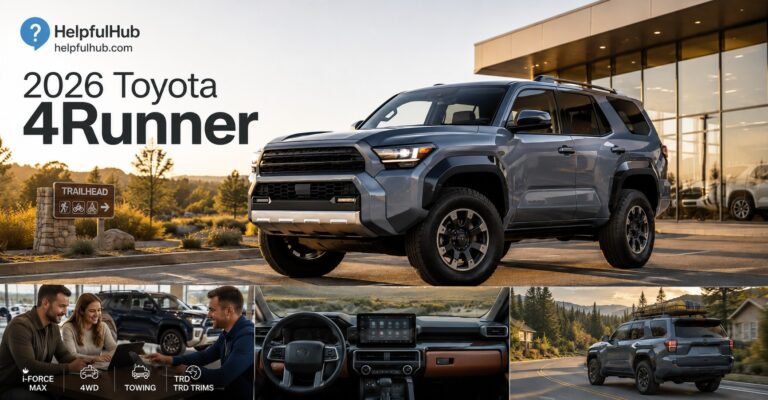
If you carry dirty gear, tools, bikes, camping bins, or home improvement supplies, the Tacoma may be more practical. If you want enclosed cargo, easier passenger comfort, and SUV road-trip packaging, the 2026 Toyota 4Runner deserves a close look.
Do not choose between them only by styling. Sit in both. Load the kind of gear you use. Think about weather protection, parking, rear-seat comfort, pets, security, towing, and long-term ownership cost.
Tacoma i-FORCE MAX vs RAV4 Hybrid
The Tacoma i-FORCE MAX vs RAV4 Hybrid comparison is about truck utility vs efficient SUV practicality. The RAV4 Hybrid is likely the better fit for many commuters, small families, and buyers who want lower operating costs without needing a pickup bed.
The Tacoma makes more sense when you need open-bed utility, truck-style capability, towing flexibility, 4WD-focused trims, or off-road potential. The RAV4 Hybrid makes more sense when you want easy daily driving, strong fuel efficiency, enclosed cargo, and lower-cost practicality.
For many US buyers, the smartest answer is not “which one is better?” It is “which one fits the real job?” If you do not use the bed, you may be paying for capability you rarely need.
Tacoma i-FORCE MAX vs bZ Woodland
The Tacoma i-FORCE MAX vs bZ Woodland comparison is a hybrid truck vs rugged EV SUV decision. The Tacoma is not an EV, and it should not be treated like one. It uses a hybrid system to support truck power and torque, while the bZ Woodland fits a different electric SUV path.
Buyers interested in EV ownership, home charging, and electric driving should compare the 2026 Toyota bZ Woodland separately. EV ownership depends on charging access, range needs, climate, insurance, local electricity rates, and road-trip patterns.
If you want a truck bed, towing flexibility, and midsize pickup capability, the Tacoma i-FORCE MAX is the more natural fit. If you want an electric SUV for daily driving and outdoor lifestyle use, the bZ Woodland may be worth comparing.
Tacoma i-FORCE MAX vs Tundra i-FORCE MAX
The Tacoma i-FORCE MAX vs Tundra i-FORCE MAX decision comes down to midsize vs full-size truck needs. The Tacoma is easier to park, easier to maneuver, and often more appealing for buyers who want adventure capability without a larger footprint.
The Tundra makes more sense if you need more truck, more space, or stronger full-size pickup capability. Buyers who tow often, carry heavier loads, or need a larger cabin should compare Tundra configurations carefully.
Do not buy a Tacoma if your real needs are full-size truck needs. Likewise, do not buy a Tundra if you only need occasional weekend utility and want easier daily parking. The right truck is the one that fits your actual work, trailer, family, garage, fuel budget, and insurance profile.
Tacoma vs 4Runner vs RAV4 Hybrid vs bZ Woodland Buyer Fit Table
| Vehicle Direction | Best For | Think Twice If |
|---|---|---|
| Tacoma i-FORCE MAX | Truck bed, hybrid torque, towing, payload, trail use, work gear | You do not need a bed or truck capability |
| 4Runner | Rugged SUV use, enclosed cargo, adventure family driving | You need open-bed utility or frequent dirty cargo hauling |
| RAV4 Hybrid | Efficient commuting, family errands, enclosed cargo, lower operating focus | You need towing and payload flexibility from a pickup |
| bZ Woodland | Electric SUV interest, home charging, rugged EV lifestyle | You need truck-bed utility or hybrid truck torque |
Ownership Cost, Insurance, and Maintenance
The purchase price is only one part of Tacoma ownership. Buyers should also estimate fuel, insurance, maintenance, tires, accessories, registration, financing cost, depreciation, and repair risk after warranty. A high-trim hybrid truck can be more expensive to insure and maintain than a basic commuter car.
Insurance cost can vary by state, ZIP code, age, driving record, credit-based insurance factors where allowed, coverage limits, deductible, trim value, claims history, and repair costs. Before buying, get quotes for the exact trim you are considering. Do not assume every Tacoma costs the same to insure.
Hybrid maintenance expectations should also be reviewed. The i-FORCE MAX is not a plug-in hybrid, so you do not need home charging. However, it has hybrid components, a turbocharged engine, truck tires, brakes, fluids, and drivetrain items that should be serviced according to Toyota’s schedule.
If you are also comparing EVs or plug-in hybrids, the hybrid and EV insurance guide can help you think about how vehicle type, battery systems, repair cost, and coverage choices may affect premiums.
Hybrid Truck Ownership Cost Checklist
| Cost Area | Why It Matters | Buyer Tip |
|---|---|---|
| Fuel | Real-world MPG depends on speed, load, tires, terrain, and towing | Estimate fuel cost using your actual driving pattern |
| Insurance | Higher trims and repair costs can affect premiums | Get quotes before choosing a trim |
| Tires | All-terrain tires can cost more and may affect noise and MPG | Check replacement tire prices |
| Maintenance | Truck use, towing, off-road driving, and weather can affect service needs | Follow Toyota’s schedule and keep records |
| Accessories | Racks, covers, lights, tents, and toolboxes add cost and weight | Budget accessories before signing |
| Financing | Rate, term, down payment, and fees change total cost | Compare total cost, not just monthly payment |
Financing, Leasing, and Trade-In Tips
Financing a Tacoma i-FORCE MAX should begin with a realistic monthly payment target. Consider the selling price, destination charge, dealer fees, taxes, registration, down payment, trade-in value, loan rate, loan term, and accessories. A lower monthly payment can hide a longer loan and higher total interest.
Use the HelpfulHub car payment calculator before you visit the dealership. Estimate several scenarios: lower down payment, higher down payment, shorter loan, longer loan, and different interest rates. This helps you negotiate with a clear budget.
Leasing may appeal to buyers who want a newer truck more often and do not plan to modify it heavily. However, leases may include mileage limits, wear rules, and restrictions that do not fit off-road use, heavy work use, or major accessories. If you plan to build an overlanding Tacoma, financing may be more flexible.
Trade-in timing also matters. Clean your current vehicle, gather service records, check multiple value sources, and compare dealer trade-in offers with private-sale options. A strong trade-in can reduce the amount financed, but it should not distract you from the total Tacoma deal.
New 2026 Tacoma i-FORCE MAX vs Used Tacoma
A new 2026 Toyota Tacoma i-FORCE MAX gives you the latest configuration, current technology, warranty coverage, and the ability to choose the trim you want if inventory is available. A used Tacoma may offer lower purchase cost, slower depreciation, and more budget flexibility.
The best choice depends on your budget and risk tolerance. A new truck may make sense if you want the i-FORCE MAX powertrain, specific TRD trim, known service history, and current features. A used Tacoma may make sense if you want lower cost and do not need the newest hybrid setup.
Read a new vs used vehicle cost guide and a buying new vs used car guide before deciding. The right answer is not always new, and it is not always used. It depends on price, financing, warranty, mileage, condition, maintenance history, and how long you plan to keep the truck.
New 2026 Tacoma i-FORCE MAX vs Used Tacoma Considerations
| Question | New 2026 Tacoma i-FORCE MAX | Used Tacoma |
|---|---|---|
| Do you want the hybrid powertrain? | Better fit if i-FORCE MAX is a priority | May not offer the same powertrain or features |
| Is payment the main concern? | May cost more depending on trim and financing | May offer lower purchase price |
| Do you want warranty confidence? | New-vehicle coverage may be attractive | Certified pre-owned may help, but verify details |
| Do you plan to modify it? | Warranty and lease rules should be considered | Used truck may be more flexible for some builds |
| Do you need exact trim availability? | Order or inventory search may help | Inventory depends on what is available locally |
Common Tacoma i-FORCE MAX Buyer Mistakes to Avoid
The first mistake is choosing a trim based only on appearance. TRD Pro and Trailhunter models look exciting, but they may not be the best fit for every driver. A buyer who mostly commutes may be happier with TRD Sport, TRD Off-Road, or Limited, depending on priorities.
The second mistake is ignoring payload. Towing gets attention, but payload often becomes the real limit once passengers, cargo, accessories, and tongue weight are included. Always calculate total load before assuming the truck can handle your setup.
The third mistake is treating the hybrid system like an EV system. The Tacoma i-FORCE MAX is not a plug-in hybrid and does not need charging. It is a hybrid truck powertrain designed to support power and torque.
The fourth mistake is shopping only by monthly payment. A longer loan can make the payment look better while increasing total cost. Compare total out-the-door cost, interest, insurance, accessories, and maintenance.
The fifth mistake is skipping the test drive. A truck can look perfect online and feel wrong in person. Test ride comfort, seating position, rear-seat space, visibility, parking, bed access, and road noise before buying.
Practical Expert Insight
The smartest way to evaluate the 2026 Toyota Tacoma i-FORCE MAX is to build the truck around your real use case, not around the most dramatic trim photo. Start with three questions: Do you need a truck bed? Do you need the stronger hybrid torque? Do you need off-road hardware, or do you mainly like the look?
If you tow or carry gear often, ask the dealer to show towing and payload ratings for the exact cab, bed, drivetrain, and trim. Do not rely only on a general maximum number. A Tacoma with accessories, passengers, a loaded bed, and trailer tongue weight can reach practical limits faster than many buyers expect.
If you are comparing TRD Sport, TRD Off-Road, Trailhunter, and TRD Pro, drive them like you will actually use them. Test city roads, highway speeds, parking, and rough pavement. A trim that feels exciting during a short test drive may feel too stiff, loud, expensive, or specialized after six months.
For financing, compare i-FORCE and i-FORCE MAX payment differences with insurance quotes included. A hybrid Tacoma can be a strong long-term choice for the right buyer, but it still needs to fit your monthly budget, fuel costs, maintenance expectations, and resale plan. The best Tacoma is not always the highest trim. It is the trim that fits your work, family, road trips, weather, trails, and wallet.
FAQ
What is new in the 2026 Toyota Tacoma i-FORCE MAX?
Toyota announced 2026 Tacoma updates that include color and trim-related changes, while the i-FORCE MAX remains the key hybrid powertrain choice for Tacoma buyers who want stronger torque. Toyota also lists items such as available On-Demand or Full-Time 4WD, available 14-inch touchscreen displays, and trims that include TRD Sport i-FORCE MAX, TRD Off-Road i-FORCE MAX, Limited i-FORCE MAX, Trailhunter, and TRD Pro where applicable. Buyers should verify current availability, packages, colors, pricing, destination charge, and dealer inventory because details can change by region and production timing.
Is the 2026 Toyota Tacoma i-FORCE MAX a hybrid?
Yes. The 2026 Toyota Tacoma i-FORCE MAX is a hybrid truck powertrain, but it is not a plug-in hybrid and it is not a battery-electric pickup. Toyota describes i-FORCE MAX as a turbocharged hybrid powertrain that combines gasoline power with electric motor assistance for added power. The main buyer benefit is stronger torque and drivability, especially when the truck is loaded, climbing, towing where properly equipped, or driving through rougher conditions. Buyers should not expect it to operate like an EV or replace charging-based electric vehicle ownership.
What is the difference between i-FORCE and i-FORCE MAX?
The standard i-FORCE is Toyota’s 2.4-liter turbocharged gas engine, while i-FORCE MAX is the available turbocharged hybrid powertrain. Toyota lists the standard i-FORCE engine with up to 278 horsepower and 317 lb-ft of torque. Toyota lists the i-FORCE MAX hybrid with up to 326 horsepower and 465 lb-ft of torque. The i-FORCE may make sense for buyers who want lower cost or simpler Tacoma configurations. The i-FORCE MAX may make sense for buyers who want stronger torque, premium trims, truck utility, and off-road-focused choices.
How much can the 2026 Tacoma i-FORCE MAX tow?
Some major automotive references report hybrid Tacoma towing up to 6,000 lbs depending on configuration. However, towing capacity can vary by cab, bed, drivetrain, trim, equipment, hitch setup, trailer brakes, accessories, and load. Buyers should never assume that every 2026 Tacoma i-FORCE MAX has the same towing rating. Before buying, ask the Toyota dealer for the exact towing rating for the truck you are considering and confirm it with Toyota documentation. Also consider passengers, cargo, terrain, weather, and how often you tow.
What payload can the 2026 Tacoma i-FORCE MAX carry?
Payload depends on the exact truck configuration. Some references report payload up to around 1,710 lbs depending on setup, but buyers should verify the rating on the specific truck. Payload includes passengers, cargo, bed gear, accessories, trailer tongue weight, and anything added after purchase. This is important for campers, contractors, overlanding builds, and buyers who plan to add racks, tents, toolboxes, bumpers, or recovery gear. Always check the door sticker, Toyota documentation, and total accessory weight before assuming the truck can carry your setup safely.
Which 2026 Tacoma i-FORCE MAX trim should buyers consider?
The best trim depends on use. TRD Sport i-FORCE MAX may fit buyers who want hybrid torque with a more road-focused personality. TRD Off-Road i-FORCE MAX may be the practical choice for rough roads, trail access, and outdoor use. Limited i-FORCE MAX fits buyers who want more comfort and technology. Trailhunter is more focused on overlanding and off-grid style adventure. TRD Pro is the aggressive off-road halo trim. Buyers should compare ride comfort, tires, equipment, insurance, payment, and real-world needs before choosing.
Is the Tacoma i-FORCE MAX good for daily driving?
The Tacoma i-FORCE MAX can work as a daily driver if you are comfortable with a midsize truck. Its size is more manageable than many full-size pickups, and the hybrid torque can feel useful in normal driving. However, trim choice matters. A Limited may feel more comfort-focused, while Trailhunter or TRD Pro may feel more specialized. Test visibility, seat comfort, parking, road noise, rear-seat space, ride quality, and fuel economy expectations. If you do not need a truck bed, a hybrid SUV or sedan may be more efficient and easier to own.
Should buyers choose Tacoma i-FORCE MAX or 4Runner?
Choose Tacoma i-FORCE MAX if you need a truck bed, open cargo utility, payload planning, towing flexibility, or work and adventure gear separation. Choose 4Runner if you prefer an SUV layout, enclosed cargo space, and a more passenger-focused adventure vehicle. Both can appeal to outdoor drivers, but they solve different problems. The Tacoma is better for dirty gear, tools, bed accessories, and truck tasks. The 4Runner may be better for families, pets, luggage security, and enclosed road-trip storage. Test both before deciding.
Should buyers choose Tacoma i-FORCE MAX or Tundra i-FORCE MAX?
Choose Tacoma i-FORCE MAX if you want a midsize truck that is easier to park, easier to maneuver, and still useful for towing, payload, outdoor gear, and everyday truck needs. Choose Tundra i-FORCE MAX if you need a full-size pickup with more cabin and truck capability. Buyers who tow often, carry heavier loads, or need more room should compare Tundra carefully. Buyers who mostly drive in suburbs, park in tight areas, and need weekend utility may prefer Tacoma. Always match the truck size to the actual job.
Should buyers compare a new 2026 Tacoma i-FORCE MAX with a used Tacoma?
Yes. A new 2026 Tacoma i-FORCE MAX may offer the latest hybrid powertrain, technology, warranty coverage, and trim choices. A used Tacoma may offer lower upfront cost and less depreciation risk, depending on mileage, condition, and market pricing. Buyers should compare financing rates, insurance, warranty coverage, maintenance history, certified pre-owned options, and long-term ownership plans. If you specifically want i-FORCE MAX torque and newer technology, new may make more sense. If budget is the priority, used Tacoma options deserve a serious look.
Final 2026 Toyota Tacoma i-FORCE MAX Buyer Checklist
- Verify current trim pricing and availability with Toyota or local dealers.
- Compare i-FORCE and i-FORCE MAX carefully before choosing.
- Confirm towing and payload ratings for the exact cab, bed, drivetrain, and trim.
- Decide whether 4WD makes sense for your work, weather, and outdoor use.
- Compare TRD Sport, TRD Off-Road, Limited, Trailhunter, and TRD Pro features where available.
- Decide whether you need bed utility, off-road equipment, or premium comfort most.
- Confirm trailer, payload, and accessory needs before buying.
- Compare Tacoma with 4Runner if you are unsure between truck and SUV.
- Compare Tacoma with Tundra if you need a larger truck.
- Estimate insurance before buying.
- Compare financing and lease offers.
- Calculate monthly payment before visiting the dealership.
- Test drive the trim you plan to buy.
- Check bed access, rear-seat space, visibility, ride comfort, and parking comfort.
- Compare a new 2026 Tacoma i-FORCE MAX with certified pre-owned or used Tacoma options.
- Review hybrid truck maintenance expectations.
- Avoid choosing the most aggressive off-road trim only because of appearance.
- Use the HelpfulHub car payment calculator where relevant.
Final Buyer Decision Table
| If You Need | Best Tacoma Direction | Why |
|---|---|---|
| Lowest Tacoma cost | Compare i-FORCE trims first | The hybrid may not be necessary for basic use |
| Strong torque and premium Tacoma features | Consider i-FORCE MAX trims | The hybrid powertrain is the main advantage |
| Daily road use with style | TRD Sport i-FORCE MAX | More road-focused than the most aggressive off-road trims |
| Balanced trail and daily use | TRD Off-Road i-FORCE MAX | Strong fit for buyers who leave pavement but still commute |
| Comfort and technology | Limited i-FORCE MAX | Better fit for premium daily use |
| Overlanding build | Trailhunter | Designed around adventure and off-grid style use |
| Maximum Tacoma off-road identity | TRD Pro | Best for buyers who truly want the halo off-road trim |
Conclusion
The 2026 Toyota Tacoma i-FORCE MAX is worth considering if you want a midsize hybrid pickup with strong torque, real truck utility, available 4WD, practical bed use, and a trim lineup that ranges from road-focused to overlanding-ready. It is especially appealing for buyers who want Tacoma capability with more powertrain confidence than the standard i-FORCE setup.
However, it is not automatically the right Tacoma for every shopper. Before deciding, compare powertrain value, trim equipment, towing, payload, bed length, 4WD needs, insurance, ownership cost, financing, maintenance, and long-term practicality. Also compare alternatives such as 4Runner, RAV4 Hybrid, bZ Woodland, Tundra, and used Tacoma options if your needs are not purely truck-focused.
The best next step is simple: build your real use case first, then choose the truck. Test drive the exact trim, verify the numbers, calculate the payment, and make sure the 2026 Toyota Tacoma i-FORCE MAX fits your daily life, weekend plans, work needs, and long-term budget.