Future Tiny EV Cars for Crowded Cities 2026 – Helpful Guides
Future Tiny EV Cars for Crowded Cities
Walk through almost any major city today and you’ll notice the same problem everywhere:
- endless traffic
- impossible parking
- rising fuel costs
- crowded roads
- polluted air
- stressful commuting
Modern cities were not built for millions of oversized vehicles competing for limited space.
That is exactly why the automotive world is moving toward something radically different:
tiny smart electric vehicles designed specifically for future crowded cities.
In 2026, the future of transportation is no longer about massive SUVs or powerful gasoline engines. The real innovation is happening in the compact EV world — ultra-small intelligent vehicles designed for:
- narrow city streets
- high-density urban environments
- smart traffic systems
- sustainable transportation
- AI-powered commuting
These futuristic micro EVs are not just “small cars.”
They represent an entirely new philosophy of urban mobility.
This HelpfulHub guide explores how future tiny EV cars for crowded cities are changing transportation forever — including futuristic designs, AI technology, battery innovations, autonomous systems, smart infrastructure, and how urban commuting may look by 2030.
Why Big Cities Are Moving Toward Tiny EVs
Modern urban infrastructure is under pressure.
Cities around the world are struggling with:
- traffic congestion
- parking shortages
- environmental regulations
- energy consumption
- transportation efficiency
Large vehicles simply consume too much space.
Future micro EVs solve these problems by focusing on:
- minimal footprint
- maximum efficiency
- intelligent movement
- connected transportation
Instead of building larger roads forever, cities are redesigning mobility itself.
The End of Traditional Urban Cars?
For decades, car manufacturers competed to build:
- larger vehicles
- stronger engines
- bigger dimensions
But urban reality is changing.
In cities like:
- Tokyo
- Amsterdam
- Singapore
- Seoul
- Paris
drivers increasingly prefer:
- smaller vehicles
- electric transportation
- compact mobility solutions
Future tiny EV cars for crowded cities fit perfectly into this new urban lifestyle.
What Makes Future Tiny EV Cars Different?
These vehicles are not simply “small versions” of traditional cars.
They are being designed from the ground up for future smart cities.
Key differences include:
- AI-assisted driving
- ultra-compact architecture
- connected city systems
- autonomous parking
- lightweight battery platforms
- intelligent energy management
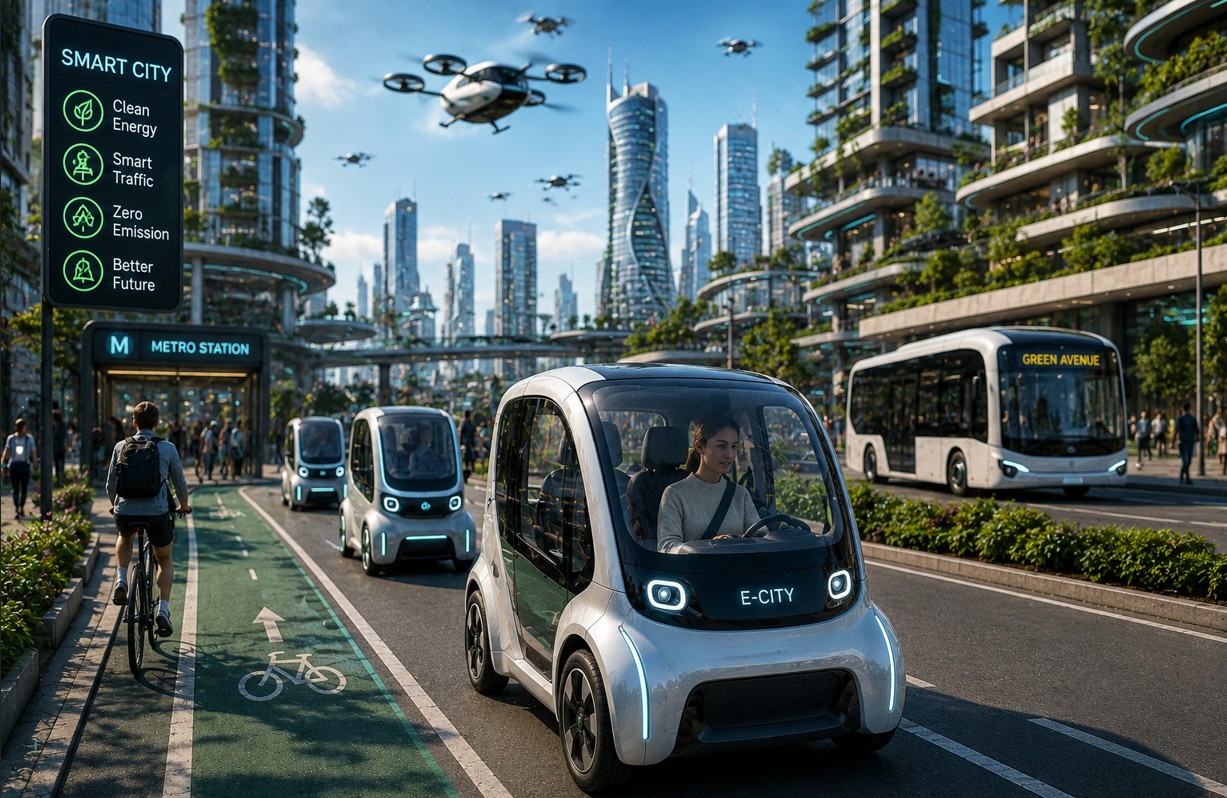
Many upcoming EV concepts look more like futuristic mobility pods than traditional cars.
AI-Powered Urban Driving
Artificial intelligence is becoming the brain of future compact EVs.
Future systems may automatically:
- detect traffic congestion
- optimize driving routes
- reserve parking spaces
- manage charging schedules
- reduce battery waste
Some future EVs may even communicate directly with city traffic infrastructure.
Cars That Think for Themselves
Future micro EVs are expected to include:
- self-parking capability
- automatic traffic adaptation
- collision prediction systems
- AI driving assistants
- voice-controlled operation
Driving itself may become far less stressful.
Why Tiny EVs Are Perfect for Crowded Roads
Large SUVs struggle in:
- narrow streets
- heavy traffic
- dense parking areas
Tiny EVs are designed specifically for those conditions.
Advantages include:
- easier movement
- faster parking
- better efficiency
- reduced energy consumption
- improved traffic flow
Upcoming designs focus heavily on:
- aerodynamic efficiency
- modular interiors
- panoramic visibility
- compact wheelbase layouts
- digital interfaces
Some futuristic EV concepts already feature:
- rotating seats
- joystick steering
- fully digital dashboards
- retractable controls
The future of mobility is becoming more technology-focused than mechanical.
Micro EVs and Smart Cities
Future smart cities are being planned around compact electric transportation.
Why?
>Because tiny EVs help cities:
- reduce congestion
- improve air quality
- optimize parking
- lower energy demand
- create quieter streets
Urban planners increasingly see micro electric vehicles for future smart cities as a key transportation solution.
Tiny EV Parking Revolution
Parking is one of the biggest urban problems today.
Future tiny EVs may:
- park automatically
- fit into ultra-small spaces
- use robotic parking systems
- integrate with AI parking networks
Some future parking systems may store compact EVs vertically like automated storage systems.
Battery Technology Is Getting Smaller and Smarter
Future EV batteries are becoming:
- lighter
- faster charging
- more energy dense
- longer lasting
This allows tiny EVs to deliver impressive range despite compact size.
Many future compact EVs may achieve:
- 250–400 miles range
while remaining significantly smaller than today’s vehicles.
Future Charging Technology
Charging technology is evolving rapidly.
Future tiny EVs may support:
- ultra-fast charging
- wireless charging roads
- solar-assisted charging
- battery swap systems
- AI charging optimization
Charging itself may eventually become almost invisible to users.
Autonomous Tiny EV Fleets
Many experts believe future cities may rely heavily on shared autonomous micro EV fleets.
Instead of owning large personal vehicles, people may simply:
- summon tiny EVs
- use autonomous transportation
- pay per trip
- reduce parking demand
This could completely transform urban transportation economics.
Future Tiny EVs Will Be More Affordable
As battery production scales increase, compact EVs are expected to become:
- cheaper
- simpler to maintain
- more accessible globally
Tiny EVs may eventually become the most affordable type of personal transportation.
Why Younger Generations Prefer Tiny Smart EVs
Younger drivers increasingly prioritize:
- sustainability
- smart technology
- lower ownership cost
- practical urban mobility
- connected digital experiences
Future smart EVs perfectly match these priorities.
Future Tiny EV Interiors
The interiors of future micro EVs are becoming increasingly futuristic.
Features may include:
- holographic displays
- AI voice assistants
- flexible seating
- panoramic glass roofs
- minimalist controls
Many future vehicles may feel more like smart lounges than traditional cars.
Environmental Benefits of Tiny EVs
Tiny EVs require:
- fewer raw materials
- smaller batteries
- lower manufacturing energy
- less road space
This makes them significantly more sustainable compared to large vehicles.
Future cities focused on carbon reduction are likely to strongly support compact EV adoption.
Can Tiny EVs Replace Traditional Cars?
Not completely.
Large SUVs and long-range vehicles will still remain important for:
- family travel
- long-distance driving
- cargo transportation
However, for urban commuting, tiny EVs may eventually dominate city transportation.
Challenges Future Tiny EVs Still Face
Despite exciting innovation, some challenges remain.
Public Acceptance
Many drivers still associate larger vehicles with safety and status.
Infrastructure Adaptation
Cities need:
- better charging systems
- EV-friendly parking
- smart traffic integration
Regulatory Changes
Autonomous EV regulations are still evolving globally.
What Urban Transportation Could Look Like by 2035
By 2035, many experts predict cities may feature:
- autonomous EV lanes
- AI traffic systems
- compact shared EV fleets
- wireless charging streets
- ultra-small personal mobility pods
The traditional gasoline-powered urban car may gradually disappear from crowded downtown environments.
Future Tiny EV Concepts Already Emerging
Several automakers are already experimenting with futuristic compact EVs.
New concept vehicles focus heavily on:
- modular mobility
- autonomous driving
- ultra-efficient battery systems
- urban optimization
The shift toward compact intelligent transportation has already begun.
The Psychology of Future Urban Mobility
Interestingly, future transportation is becoming less about:
- horsepower
- engine size
- aggressive design
and more about:
- convenience
- intelligence
- efficiency
- sustainability
- connected mobility
Tiny EVs represent this cultural shift perfectly.
Final Thoughts
The future of crowded city transportation is becoming:
- smaller
- smarter
- cleaner
- more connected
Future tiny EV cars are not simply another automotive trend.
They are part of a massive transformation in how people move through modern urban environments.
Whether through:
- AI-powered navigation
- autonomous driving
- compact city mobility
- futuristic smart transportation
tiny EVs are rapidly becoming one of the most important innovations in the future of urban life.
For drivers living in increasingly crowded cities, compact electric mobility may soon become not just an option — but the smartest way to travel.
The future of transportation is no longer about building bigger vehicles.
It is about building smarter cities around smaller, intelligent electric mobility.
Explore More Helpful EV Guides
Continue reading related electric vehicle guides from HelpfulHub.
FAQ Section
Why are tiny EV cars becoming popular in cities?
Because they are easier to park, more energy efficient, environmentally friendly, and better suited for crowded urban environments.
Will future tiny EVs be autonomous?
Many future compact EVs are expected to include advanced autonomous driving and AI-assisted mobility features.
Are micro EVs safe?
Modern compact EVs are increasingly using advanced safety engineering, AI collision systems, and reinforced lightweight structures.
Can tiny EVs travel long distances?
Future battery technology is expected to significantly improve compact EV driving range.
Why are smart cities supporting compact EVs?
Because compact EVs help reduce congestion, pollution, parking demand, and urban energy consumption.