Beyond the Steering Wheel: The Ultimate Guide to Modern Automotive Technology and Future Driving Trends
Beyond the Steering Wheel: The Ultimate Guide to Modern Automotive Technology and Future Driving Trends
The American driving experience is undergoing its most significant transformation since the invention of the assembly line. For decades, the relationship between a driver and their car was purely mechanical—a series of pedals, gears, and cables. Today, that relationship has shifted into the digital realm. As we look toward the horizon of 2026 and beyond, automotive technology is no longer just a luxury add-on; it is the central nervous system of every vehicle on the road. Whether you are navigating the congested streets of New York City or cruising the open plains of the Midwest, the tech inside your car is working silently to keep you safe, connected, and efficient.
For many US buyers, the sheer pace of innovation can feel overwhelming. From vehicles that can park themselves to dashboards that look more like high-end gaming computers than traditional instrument clusters, the learning curve is steep. This guide is designed to demystify these advancements, offering practical advice for families, tech enthusiasts, and daily commuters alike. We will explore how modern sensors see the world, why your insurance company cares about your lane-keep assist, and what the future of transportation looks like as we transition toward a more automated world.
In this comprehensive exploration, we won’t just look at the gadgets; we will examine the infrastructure, the costs, and the psychological shift required to trust a machine with your family’s safety. From the silicon chips in the dashboard to the high-capacity batteries under the floorboards, every element of the modern vehicle is being reimagined for a smarter, cleaner future.
Table of Contents
- Understanding the Foundation of Modern Automotive Technology
- The ADAS Systems Guide: Your Advanced Digital Co-Pilot
- Smart Dashboard Features and the Digital Cockpit Revolution
- The Truth About Self-Driving Technology: Levels 0 to 5
- Connected Cars and the Rise of V2X Communication
- Smart Sensors and the Electric Vehicle Powerhouse
- The Real Cost of Tech: Insurance, Repairs, and Maintenance
- Regional US Considerations: Tech in Different Climates
- Future Automotive Technology Trends 2026 and Beyond
- Step-by-Step Buying Advice for the Modern Car Shopper
- My Practical Recommendation: Finding the Sweet Spot
- Frequently Asked Questions (Comprehensive Guide)
Understanding the Foundation of Modern Automotive Technology
To grasp the current state of the industry, we must first define what automotive technology means in the modern context. It is no longer just about horsepower or torque. Instead, it is about the “Software-Defined Vehicle” (SDV). An SDV is a car whose features and functions are primarily enabled through software, allowing it to improve over time, much like your smartphone or laptop.
The foundation of this technology lies in the integration of hardware and software. Modern vehicles are equipped with dozens of Electronic Control Units (ECUs) that manage everything from engine timing to seat adjustments. In 2026, we are seeing a move toward centralized computing, where one or two high-powered “brain” chips handle all the car’s data. This allows for faster processing speeds, which is essential for future automotive technology trends 2026 such as real-time hazard detection and complex autonomous maneuvers.
The Shift from Passive to Active Safety
Historically, safety technology was “passive.” We relied on seatbelts, airbags, and reinforced steel frames to protect us during a crash. While these remain critical, the industry has pivoted toward “active” safety. Active safety systems use sensors to actively monitor the environment and intervene to prevent a crash from occurring. This is the hallmark of latest vehicle technology for safer driving. By using radar, cameras, and ultrasonic sensors, cars can now “see” in the dark, through heavy rain, and around corners in ways a human driver simply cannot.
The ADAS Systems Guide: Your Advanced Digital Co-Pilot
Advanced Driver Assistance Systems, or ADAS, represent the most tangible advancement for the everyday driver. These systems are designed to bridge the gap between human driving and full automation. For families in the US, ADAS has become a non-negotiable requirement when looking for a new vehicle.
Deep Dive into Core ADAS Components
- Adaptive Cruise Control (ACC): This is the evolution of the standard cruise control we’ve used for decades. Using radar sensors in the front grille, ACC adjusts your speed to maintain a safe following distance from the vehicle ahead. In heavy highway traffic on the I-95 or I-405, this tech significantly reduces driver fatigue by handling the constant braking and accelerating.
- Automatic Emergency Braking (AEB): This is perhaps the most life-saving feature in modern automotive technology. If the car detects a pedestrian, cyclist, or another vehicle in your path and determines a collision is imminent, it will automatically apply the brakes. Most modern systems now include “Rear AEB” to prevent backing into objects in parking lots.
- Lane Keeping Assist and Lane Centering: While Lane Keeping Assist (LKA) “nudges” you back if you drift, Lane Centering actively keeps the car in the middle of the lane. When combined with ACC, this creates a Level 2 semi-autonomous experience that makes long road trips across the Midwest far more relaxing.
- Traffic Sign Recognition (TSR): Cameras scan the side of the road for speed limit signs and stop signs, displaying them directly on your dashboard. Some systems can even adjust your cruise control speed automatically to match the posted limit.
Comparative Analysis of Safety Systems
When looking at automotive AI safety systems comparison, it’s important to understand the hardware behind them. Some manufacturers, like Tesla, rely solely on cameras (Vision-only), while others, like Ford and Cadillac, use a combination of camera, radar, and Lidar (Light Detection and Ranging). Radar is excellent for detecting distance and speed in bad weather, while Lidar provides a high-resolution 3D map of the surroundings. For the highest level of safety, a “multi-modal” approach—using multiple types of sensors—is generally considered superior in the US market.
Smart Dashboard Features and the Digital Cockpit Revolution
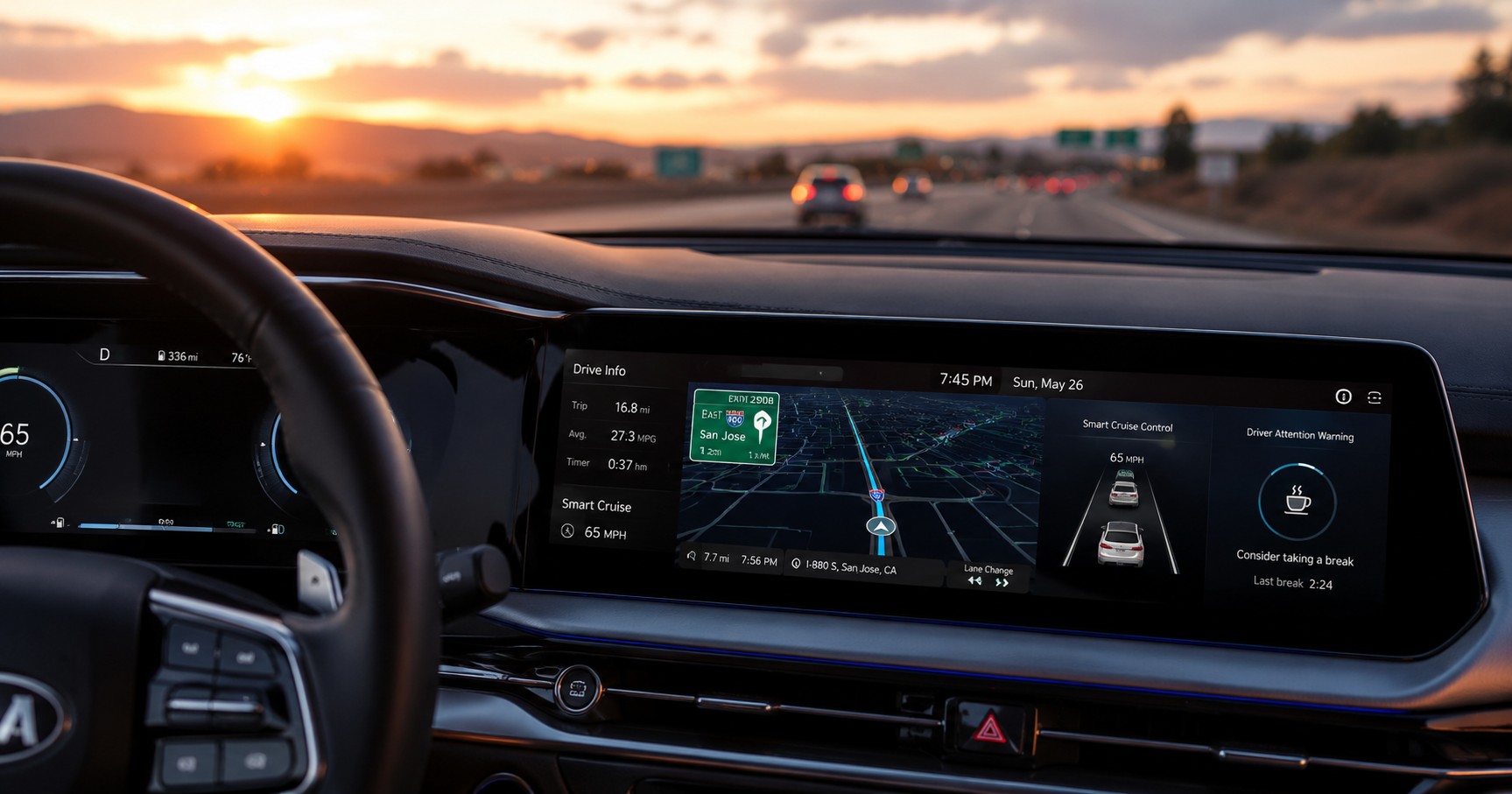
The interior of a modern car has been transformed into a “living space.” Future car dashboard technology ideas focus on making the drive more intuitive and less distracting. The centerpiece is the “Digital Cockpit,” a term used to describe the transition from analog gauges to high-resolution screens.
The Rise of Large-Scale Displays
We are seeing screens that span the entire width of the dashboard. These displays aren’t just for entertainment; they are context-aware. For example, if you are low on fuel, the dashboard will automatically highlight nearby gas stations or EV charging hubs. If the weather is snowy, the display might shift to show more prominent safety alerts and traction control data.
Augmented Reality (AR) Head-Up Displays
One of the best smart car technology features today is the AR-HUD. Instead of looking down at a screen, vital information is projected onto the windshield. AR takes this further by “painting” navigation arrows directly onto the road from your perspective. If you need to take the next exit, a blue arrow will appear to hover over that specific lane, ensuring you never miss a turn in a complex cloverleaf interchange.
Voice and Gesture Control
To combat driver distraction, manufacturers are leaning heavily into natural language voice control. In 2026, you don’t need to memorize specific commands. You can simply say, “I’m cold,” and the car will raise the temperature. Some luxury models also use gesture control, allowing you to wave your hand to dismiss a phone call or twirl your finger to adjust the volume, keeping your eyes strictly on the road.
The Truth About Self-Driving Technology: Levels 0 to 5
There is a lot of marketing “fluff” around self driving car technology explained. To be a smart buyer, you must understand the SAE Levels of Automation. This prevents over-reliance on a system that isn’t designed to handle every situation.
Detailed Breakdown of SAE Levels
| Level | Title | What the Driver Does | What the Car Does |
|---|---|---|---|
| Level 0 | No Automation | Everything. | Maybe provides a blind-spot beep. |
| Level 1 | Hands On | Must be fully engaged. | Controls either speed (ACC) OR steering (LKA). |
| Level 2 | Hands Off (Conditional) | Must monitor the road at all times. | Controls both speed AND steering (e.g., Tesla Autopilot, Ford BlueCruise). |
| Level 3 | Eyes Off (Conditional) | Can look away but must be ready to take over. | Handles all driving tasks in specific highway conditions (e.g., Mercedes Drive Pilot). |
| Level 4 | Mind Off | Can sleep or watch a movie. | Drives completely on its own within a specific area (Geofencing). |
| Level 5 | Full Automation | Occupant only. | Drives everywhere in any condition. No steering wheel needed. |
For most US consumers in 2026, Level 2+ is the gold standard. Level 3 is slowly being rolled out in premium models, but it usually only works on specific pre-mapped highways at speeds under 40-60 mph. Level 4 and 5 remain the “holy grail” and are currently limited to commercial robotaxi fleets in cities like Phoenix and San Francisco.
Connected Cars and the Rise of V2X Communication
The phrase future connected car innovations refers to a vehicle’s ability to communicate with the world around it. This is often called V2X (Vehicle-to-Everything) communication. This is not just about 5G hotspots; it’s about infrastructure safety.
The Components of V2X
- V2V (Vehicle-to-Vehicle): Cars share data about their speed, position, and braking status. If a car three vehicles ahead slams on its brakes, your car receives that data instantly—before you can even see the brake lights—and prepares your safety systems.
- V2I (Vehicle-to-Infrastructure): Your car communicates with traffic lights, stop signs, and work zones. It can tell you how many seconds are left until a light turns green or warn you of a hidden construction crew around a curve.
- V2P (Vehicle-to-Pedestrian): Using smartphone signals, cars can detect pedestrians or cyclists who are hidden behind parked cars or buildings, alerting the driver to their presence.
This connectivity also enables Over-the-Air (OTA) updates. This means your car’s automotive technology stays current. A manufacturer can push a software patch that improves battery efficiency or adds a new safety feature overnight while your car is parked in your garage.
Smart Sensors and the Electric Vehicle Powerhouse
As the US shifts toward electrification, smart sensors used in electric vehicles are becoming more advanced. In an EV, sensors do more than just monitor safety; they manage the very lifeblood of the car: the battery.
Thermal Management and Range Optimization
Temperature is the enemy of battery life. Modern EVs use hundreds of sensors to monitor the heat of individual battery cells. If you are driving through the Arizona heat, the car uses active liquid cooling to keep the battery at an optimal temperature. Conversely, in a Minnesota winter, the car uses a “heat pump” to warm the battery, ensuring you don’t lose 30% of your range to the cold. This is a critical piece of automotive technology for any US buyer in extreme climates.
Regenerative Braking and Efficiency
Sensors also manage regenerative braking. When you lift off the accelerator, the electric motor reverses, acting as a generator to put energy back into the battery. Smart systems use radar to determine how much “regen” to apply. If there is a car in front of you, the car will increase regenerative braking to slow you down more aggressively, capturing more energy and saving your mechanical brakes from wear and tear.
The Real Cost of Tech: Insurance, Repairs, and Maintenance
While automotive technology adds value, it also adds complexity. For the average American family, understanding the long-term financial impact is vital. We must look at the “Total Cost of Ownership” in the digital age.
Insurance and the “Safety Discount” vs. “Repair Premium”
Most major US insurance companies like State Farm, Progressive, and Geico now offer discounts for vehicles with ADAS features. They know that a car with AEB is 50% less likely to be involved in a front-end collision. However, if you do get into an accident, the repair cost is significantly higher. A front bumper on a 2026 SUV isn’t just plastic; it contains radar units and ultrasonic sensors that must be perfectly calibrated. A $500 fender-bender can easily become a $4,000 repair bill once sensor replacement and labor are included.
Maintenance Checklist for Modern Vehicles
| Service Item | Frequency | Why It Matters |
|---|---|---|
| Sensor Cleaning | Weekly / Monthly | Dirt and ice can blind your safety “eyes.” |
| Software Updates | As Prompted | Fixes security bugs and improves system performance. |
| ADAS Calibration | After any impact or windshield change | Ensures the cameras are “looking” at the right spot. |
| EV Coolant Check | Every 100,000 miles | Prevents battery overheating and degradation. |
Regional US Considerations: Tech in Different Climates
In the United States, automotive technology performs differently depending on where you live. This is a practical reality that many brochures won’t tell you.
- The Rust Belt (Midwest/Northeast): Road salt is a major enemy. It can coat sensors and cameras, rendering your ADAS useless in the winter. Look for vehicles with “heated” camera lenses or sensor cleaning systems.
- The Sun Belt (Southwest): Extreme heat can cause digital screens to delaminate or processors to throttle. Ensure your vehicle has a robust cabin overheat protection system to keep the electronics cool while parked.
- Mountain Regions: If you live in Colorado or the Appalachians, prioritize vehicles with high-resolution radar, as Lidar and cameras can struggle in the thick fog and heavy snow common in high altitudes.
Looking ahead, we are seeing the rise of the “Biometric Vehicle.” Your car won’t just know where you are going; it will know how you feel. Future automotive technology trends 2026 include driver monitoring systems that use infrared cameras to detect fatigue or medical emergencies. If the car detects you have fallen asleep or are having a heart attack, it can safely pull itself to the shoulder and call 911.
We are also moving toward “Software as a Service” (SaaS) in cars. You may buy a car and then “subscribe” to a performance boost for a month-long road trip, or subscribe to heated seats only during the winter months. While controversial, this allows for a lower initial purchase price for some consumers.
Shopping for automotive technology requires a different strategy than shopping for an engine. Follow these steps:
- Request a “Tech Demo”: Don’t just drive the car. Sit in the parking lot and have the salesperson show you how to set up the adaptive cruise and the emergency braking sensitivity.
- Check for Subscription Fees: Ask explicitly which features are “standard” and which require a monthly fee after the first year.
- Verify OTA Support: Ensure the vehicle can receive “Full Vehicle” OTA updates, not just maps. This keeps the engine and safety software fresh.
- Test the Interface with Gloves: If you live in a cold climate, see if the touchscreen works with your winter gloves or if there are physical buttons for the heat.
- Insurance Quote First: Get the VIN of the car you are considering and call your insurance agent. See how the tech package affects your specific rate.
Based on years of analyzing the US automotive market, my practical recommendation for 2026 is to seek the “Sweet Spot of Levels.” You don’t need to spend $15,000 on a “Full Self-Driving” package that is still in testing. Instead, look for a vehicle that offers Level 2 Hands-On assistance as standard.
Brands like Hyundai/Kia with their “Highway Driving Assist” and Honda/Toyota with their “Sensing” suites offer incredible value. These systems are reliable, easy to use, and provide 90% of the daily benefit at a fraction of the cost. Focus on safety technology over “entertainment gadgets.” A car that can stop itself in a crisis is worth far more than a car that can play video games on the dashboard.
1. Are these “self-driving” features safe for my family?
>Yes, when used as intended. The term “self-driving” is a bit of a misnomer. These are advanced driver assistance systems. They are designed to support you, not replace you. Statistics show that when drivers use these systems as intended—keeping their hands on or near the wheel and eyes on the road—the risk of an accident is significantly reduced. They are especially helpful in mitigating human errors like distraction or slow reaction times. However, treating them like a “chauffeur” where you stop paying attention is extremely dangerous and is the cause of most tech-related accidents in the US.
2. Why is my car insurance so expensive despite all this safety tech?
This is the “Complexity Tax.” While you are less likely to crash, the cost to fix your car if you do have an accident has skyrocketed. A bumper on a 1990s car was a piece of plastic. A bumper on a 2026 car is a housing for sophisticated radar and sonar equipment. Furthermore, after a repair, these sensors must be “re-calibrated” by a specialist, which can cost several hundred dollars in labor alone. Insurance companies are still balancing the savings from fewer accidents against the higher cost of those that do occur.
3. Will my car’s software become outdated in a few years?
>If you buy a vehicle with Over-the-Air (OTA) capabilities, the answer is “not for a long time.” Just like an iPhone, your car can receive updates that improve performance and add features. However, older vehicles without OTA will suffer from “static tech.” This is why we recommend that 2026 buyers prioritize cars from manufacturers with a strong software focus. A car that can’t update its maps or safety algorithms will lose its resale value much faster than one that can stay current with the latest automotive technology trends.
4. Do I need to pay for a data plan for my car?
>In most cases, yes, if you want the “Connected” features. While basics like FM radio and Bluetooth are free, things like live traffic, high-definition maps, weather alerts, and in-car Wi-Fi usually require a subscription through a provider like AT&T or Verizon. Some manufacturers include the first 1-3 years for free. Always check the “fine print” at the dealership so you aren’t surprised by a $20/month bill a year after you buy the car.
5. Can car sensors see through heavy fog or snow?
>Radar can “see” through fog and snow because it uses radio waves that bounce off solid objects. However, cameras and Lidar (which uses light) struggle in low-visibility conditions. Most modern automotive technology uses a “sensor fusion” approach where it combines data from all three. If the cameras are blinded by snow, the car will usually disable its Lane Keeping features but might keep the Radar-based Adaptive Cruise Control active. Your car will always notify you on the dashboard when a specific system is offline due to weather.
6. How do I protect my car from being hacked?
As cars become more connected, cybersecurity is a real concern. Manufacturers use “encryption” and “gateways” to protect the car’s vital systems (like steering and brakes) from the entertainment systems. To stay safe, only download official updates from your manufacturer and be cautious about plugging unknown USB devices into your car’s ports. US regulators are currently working on national standards for automotive cybersecurity to ensure that the future connected car innovations remain safe for everyone.
7. Is Lidar better than Cameras for self-driving?
There is no “better,” only “different.” Cameras are great at reading signs and seeing colors (like traffic lights). Radar is great at measuring speed and distance. Lidar is great at creating a precise 3D map of the world. The safest cars in the US market use all three. Relying on just one (like Vision-only systems) is possible but requires much more powerful software to compensate for the lack of redundant data. For a buyer, a car with Lidar is often more expensive but provides an extra layer of “vision” in complex environments.
8. What happens to all the data my car collects about me?
Modern cars are data-gathering machines. They know where you go, how fast you drive, and even your favorite radio stations. In the US, data privacy laws for cars are still evolving. Some manufacturers sell “anonymized” data to traffic planners or map makers. Others might share driving behavior data with insurance companies if you opted-in for a “safe driver” discount. You should always go into the “Privacy” or “Settings” menu of your car and review what you are sharing. You usually have the right to opt-out of non-essential data collection.
Final Checklist for Your Next Vehicle Purchase
- [ ] Confirm the car has Automatic Emergency Braking (AEB) with pedestrian detection.
- [ ] Verify if the vehicle supports Over-the-Air (OTA) updates for the entire system.
- [ ] Test the “Digital Cockpit” to ensure it isn’t too distracting or laggy.
- [ ] Ask about the cost of sensor recalibration after a windshield replacement.
- [ ] Check if Apple CarPlay or Android Auto is wireless or requires a cord.
- [ ] Inquire about the warranty period for the battery and high-tech sensors.
- [ ] Look for a Driver Monitoring System if you do a lot of night driving.
- [ ] Verify the monthly subscription costs for “connected” services after the trial ends.
Conclusion
The journey toward the future of automotive technology is not a sprint; it’s a steady evolution. For US drivers, the goal is to leverage these incredible tools to make our lives safer and more productive without losing the joy of the open road. By staying informed about ADAS, connectivity, and the realities of self-driving progress, you can choose a vehicle that doesn’t just get you from point A to point B, but does so with the intelligence and foresight of a digital guardian. The road ahead in 2026 is exciting, and with the right tech by your side, you are ready for whatever lies around the next curve.