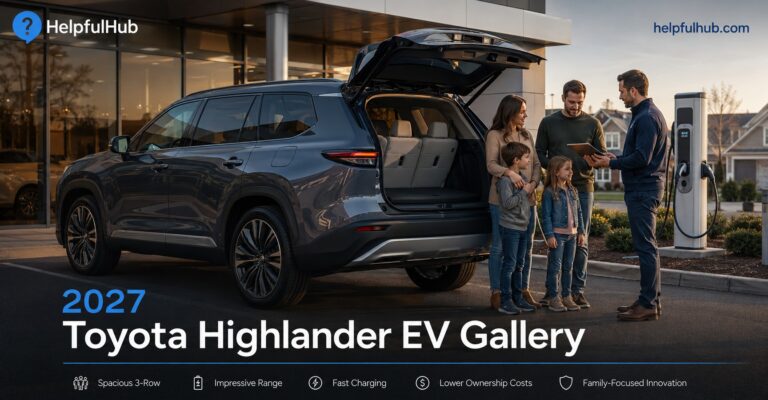
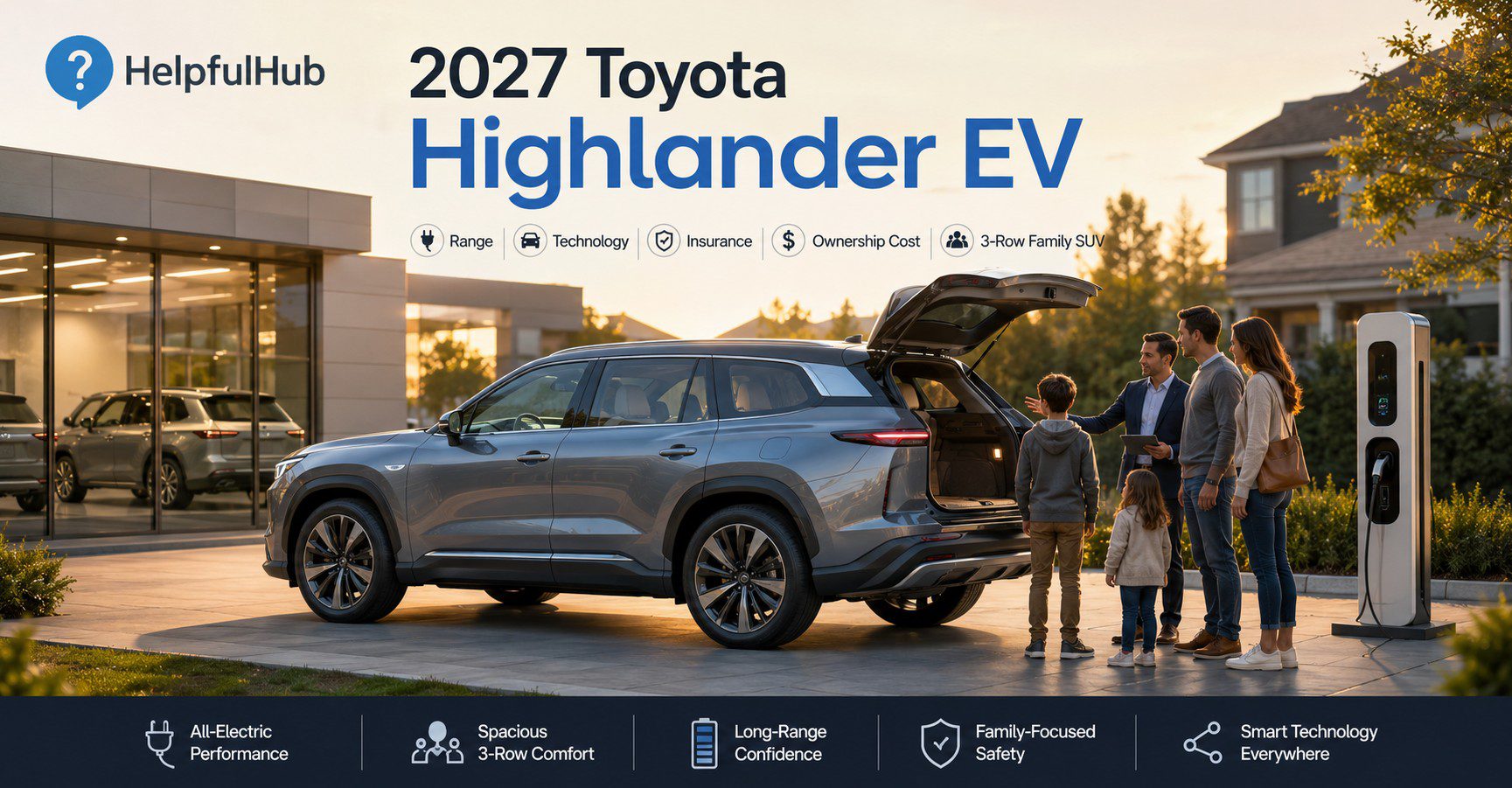
2027 Toyota Highlander EV: Complete US Family SUV Buyer Guide
For many buyers, the big question is simple. Can an all-electric Highlander work as a real family SUV? The answer depends on range, charging access, cargo space, seating comfort, insurance cost, and final pricing. This guide explains the Toyota Highlander EV in a practical way so families can compare it with gas SUVs, hybrid SUVs, plug-in hybrids, and other three-row electric SUVs.
Quick Answer
The 2027 Toyota Highlander EV is Toyota’s all-electric three-row Highlander for family SUV buyers. It matters because three-row EV choices are growing, but families still need confidence about range, charging, cargo space, comfort, safety, insurance, and ownership cost. Toyota lists a 320-mile manufacturer-estimated combined range rating on XLE AWD and Limited AWD models equipped with the 95.8-kWh battery where applicable. However, a manufacturer estimate is not the same as a final EPA rating unless confirmed.
The Highlander EV may fit families with home charging, predictable commutes, school runs, and a need for three rows. It may also appeal to Toyota loyalists who want an electric family SUV without moving to a luxury brand. However, buyers without easy charging access, apartment residents with unreliable charging, or families that take frequent rural road trips should compare hybrid options as well. US buyers should verify final pricing, trims, incentives, insurance, dealer availability, and home charging setup before deciding.
What Is the 2027 Toyota Highlander EV?
The 2027 Toyota Highlander EV is the all-electric version of Toyota’s well-known Highlander family SUV. Instead of using a gasoline engine or hybrid powertrain, it uses a battery electric powertrain. That means it is designed to drive on electricity only, with no gasoline engine under normal operation.
It is still aimed at family SUV buyers. That is important. This is not just an EV with three rows added as an afterthought. Toyota presents the Highlander EV as a practical family vehicle with seating for up to seven, useful cargo space, and technology designed for daily life.
The biggest difference from a gas Highlander or Highlander Hybrid is the ownership routine. A gas SUV depends on fuel stations. A hybrid SUV uses gasoline but can improve efficiency. The Highlander EV depends on charging. For the right household, that can be convenient and cost-effective. For the wrong household, it can become frustrating.
That is why shoppers should evaluate the 2027 Toyota Highlander EV as a family vehicle first and an EV second. Before getting excited about battery size or screen size, check the third row, cargo area, child-seat access, garage fit, visibility, and local charging options.
For more background on Toyota’s move toward an electric Highlander, read our Toyota Highlander electrification outlook.
2027 Toyota Highlander EV Quick Facts for US Buyers
| Category | What Toyota has indicated | What buyers should verify |
|---|---|---|
| Vehicle type | All-electric three-row family SUV | Final US market specs and availability |
| Seating | Up to seven passengers | Third-row comfort and child-seat access |
| Grades | XLE and Limited | Final trim equipment and packages |
| Range | Up to 320 miles manufacturer-estimated on select AWD models with the 95.8-kWh battery | Final EPA rating and real-world range |
| Charging | Home and public charging support, including Level 2 and DC fast charging capability | Home charger cost and charging network access |
| Best use case | Family commuting, school runs, suburban use, and planned road trips | Daily mileage, winter driving, and long-distance routes |
Why the Highlander EV Matters for US Families
The US three-row SUV market is built around families. Parents want room for kids, friends, strollers, sports gear, groceries, luggage, and weekend trips. At the same time, many families want to reduce gasoline use. That is where a Toyota three-row EV becomes interesting.
Until recently, many electric SUVs were either small crossovers or expensive luxury models. Three-row electric SUVs are now becoming more common, but choices are still limited compared with gas and hybrid SUVs. The 2027 Highlander EV enters that space with a familiar name and Toyota’s large dealer network.
For Toyota shoppers, familiarity matters. A buyer who already trusts the Highlander name may be more willing to consider EV ownership if the vehicle still feels like a practical family SUV. That may help Toyota reach buyers who are curious about EVs but not ready for a niche or luxury-only option.
The Highlander EV also matters because it will compete with vehicles such as the Kia EV9, Hyundai Ioniq 9, Rivian R1S, Volvo EX90, Tesla Model X, and Mercedes-Benz EQS SUV. Each competitor has its own strengths. Some may focus more on luxury. Some may offer more performance. Others may offer different charging or pricing advantages.
However, buyers should not assume the Highlander EV is automatically better because it has a Toyota badge. The smart approach is to compare real range, seat comfort, cargo measurements, dealer experience, charging compatibility, warranty details, insurance quotes, and total ownership cost.
Exterior Design and Three-Row SUV Presence
The 2027 Toyota Highlander EV has a modern electric SUV look. Toyota has shown a cleaner front design, broad fenders, full-width lighting details, and flush electronic door handles. These details help create a more aerodynamic and futuristic appearance.
For families, exterior design is not only about style. Shape affects visibility, cabin space, cargo usability, efficiency, and garage fit. A sleek SUV may look attractive, but parents still need easy entry, useful doors, clear rear visibility, and a liftgate that works in real life.
The Highlander EV appears to keep a family SUV footprint rather than becoming a low, sporty crossover. That is good for buyers who want a practical three-row SUV. A family vehicle needs to be easy to load, easy to park, and comfortable for passengers in all rows.
Aerodynamics also matter for EV range. At highway speeds, wind resistance can reduce efficiency. A cleaner body shape, smoother front end, and careful lighting design may help the Highlander EV use energy more efficiently. Still, real-world range will depend on speed, temperature, tire choice, passenger load, cargo, and driving style.
Interior, Seating, Cargo, and Family Comfort
The interior may be the most important part of the 2027 Toyota Highlander EV. Families do not buy three-row SUVs only for style. They buy them because daily life is busy. A good family SUV should handle school pickup, grocery runs, sports equipment, child seats, weekend luggage, and long drives without feeling stressful.
Toyota lists three-row seating and seating for up to seven. Depending on configuration, the Highlander EV may offer second-row captain’s chairs or available bench seating where applicable. Captain’s chairs can make third-row access easier. A bench can be better for families that want maximum seating flexibility.
Third-row access is a key test. Parents should check how easily kids can climb into the back row, whether child seats block entry, and whether the second row moves smoothly. If the third row is only comfortable for small children, that may be fine for some families. Others may need adult-friendly space for carpools or road trips.
Cargo space also needs an in-person test. Toyota lists useful cargo capacity, including space behind the third row and larger capacity when rear seats are folded. Still, numbers do not always tell the full story. Bring a stroller, sports bag, cooler, or suitcase during a test drive if possible.
Convenience features may include USB charging in all three rows where applicable, dual wireless charging where applicable, smart storage, and an available panoramic roof. These features can make daily driving easier, especially when multiple passengers need phones, tablets, or charging cables.
2027 Toyota Highlander EV Family Practicality Checklist
| Family need | Why it matters | What to test in person |
|---|---|---|
| Third-row comfort | Kids may be fine, but adults may need more room | Sit in the third row for at least five minutes |
| Child-seat access | Car seats can block second-row movement | Bring your actual car seat if possible |
| Cargo behind third row | Daily groceries and school bags still need space | Check stroller, backpacks, and sports bags |
| Road-trip luggage | Family trips require more than passenger space | Fold seats and measure usable cargo floor |
| Rear climate comfort | Back-seat passengers need airflow | Test vents, controls, and cabin cooling |
| Charging ports | Families often charge several devices | Check USB access in all rows |
| Driver visibility | School zones and parking lots require confidence | Check mirrors, camera views, and blind spots |
| Parking and garage fit | Three-row SUVs can feel large in tight spaces | Compare dimensions with your garage |
Battery, Range, and Charging
Range is one of the biggest reasons families will research the 2027 Toyota Highlander EV. Toyota lists a 320-mile manufacturer-estimated combined range rating on XLE AWD and Limited AWD models equipped with the 95.8-kWh battery where applicable. That number is helpful, but buyers should understand what it means.
A manufacturer-estimated range is not the same as a final EPA rating unless the EPA rating is confirmed. Real-world range can also be lower or higher depending on conditions. Highway speeds, cold weather, elevation, tire choice, passenger load, cargo, roof boxes, towing if applicable, and driving style can all affect range.
Home charging is the most important part of EV ownership. A Level 2 home charger can make an electric family SUV much easier to live with. Instead of visiting a public charger every few days, families can start most mornings with a charged battery. That routine is one of the strongest reasons to consider an EV.
Public charging still matters. Families should check charging options near work, schools, shopping centers, hotels, and road-trip routes. Toyota lists NACS charging support, which may improve access to many DC fast charging stations. Still, not every station is equal. Speed, reliability, pricing, and availability vary by location.
Toyota also mentions vehicle-to-home or grid capability where applicable. This can be valuable for emergency backup or energy flexibility, but buyers should verify equipment requirements, installation cost, local utility rules, and final Toyota availability before assuming it will work for their home.
For shoppers comparing smaller Toyota EV options, our Toyota C-HR EV buyer guide can help explain how compact EV needs differ from a three-row electric SUV.
Battery, Range, and Charging Factors
| Factor | Why it matters | Buyer tip |
|---|---|---|
| Manufacturer-estimated range | It helps compare trims before final ratings | Do not treat it as guaranteed real-world range |
| Final EPA rating | It gives a standardized range estimate | Check FuelEconomy.gov when available |
| Home charging | It can make daily EV ownership easier | Get an installation estimate before buying |
| Public charging | It matters for road trips and backup charging | Map your real family routes |
| Cold weather | Winter can reduce range | Plan extra charging margin |
| Heavy cargo | Passenger and luggage load affects efficiency | Test range expectations with family use in mind |
| Vehicle-to-home | It may add backup power value | Verify hardware, utility, and installation needs |
Performance, AWD, and Daily Driving
The 2027 Toyota Highlander EV should feel different from a gas Highlander because electric motors deliver smooth and quick response. For family buyers, that does not mean the SUV needs to be a sports car. It means the vehicle should feel confident when merging onto highways, leaving traffic lights, and carrying passengers.
Toyota lists front-wheel-drive and all-wheel-drive availability depending on grade and configuration. AWD may appeal to buyers in areas with rain, light snow, hills, and mixed weather. However, AWD is not a replacement for good tires or careful driving.
Toyota has also listed official total system output figures for the lineup. Still, shoppers should focus less on numbers and more on real driving feel. A three-row EV should be judged by smoothness, confidence, brake feel, ride comfort, visibility, and range consistency.
Regenerative braking will also matter. Some drivers love strong regen because it can reduce brake use and make city driving feel easier. Others need time to adjust. During a test drive, try low-speed parking, stop-and-go traffic, and highway cruising.
For daily life, the best electric family SUV is not always the fastest one. It is the one that makes Monday morning easier, keeps passengers comfortable, and gives the driver confidence in normal traffic.
Technology, Infotainment, and Smart Features
Toyota lists a 14-inch multimedia touchscreen where applicable, and this should be one of the main cabin features shoppers notice. A large screen can help with navigation, media, camera views, and charging information. However, the interface should still be easy to use while driving.
Wireless Apple CarPlay and Android Auto where applicable can be important for families that already use phone-based navigation and music. Digital Key 2.0 capability where applicable may let compatible smartphones or smart devices unlock and start the vehicle. Smart Key features can also make daily use easier when carrying bags, backpacks, or child items.
Charging route planning will be especially important in an EV. A good system should help drivers find compatible chargers, estimate arrival battery level, and plan stops. Buyers should test the navigation system during a dealership demo rather than assuming it works exactly like a phone app.
Families should also think about privacy and data settings. Modern vehicles may connect to apps, cloud services, driver profiles, phone keys, and subscriptions. Before buying, review what features require trials, subscriptions, connected services, or data permissions.
For a broader look at Toyota’s current and upcoming US lineup, see our 2026 Toyota models USA guide.
Safety and Driver Assistance
Safety is one of the biggest reasons families choose a three-row SUV. The 2027 Toyota Highlander EV should be evaluated with the same seriousness as any family vehicle. Shoppers should review active safety technology, crash-test results, visibility, braking feel, headlights, and child-seat fit.
Toyota says the Highlander EV will include the latest Toyota safety technology, but buyers should verify the final feature list by trim. Driver assistance can be useful, but it does not replace an attentive driver. Systems can have limits in bad weather, faded lane markings, construction zones, bright sunlight, and heavy traffic.
Do not assume NHTSA or IIHS safety ratings before official testing is available. Ratings can vary by model year, body structure, equipment, and test agency. When results are published, compare both NHTSA and IIHS information.
Families should also test practical safety details. Can the driver see clearly over the hood? Are the cameras sharp? Are the parking sensors easy to understand? Is the third row easy to exit? Do child seats install securely? These small details matter every day.
Ownership Cost, Insurance, and Maintenance
The total cost of owning the 2027 Toyota Highlander EV will be more than the window sticker. Final pricing may vary by trim, destination charge, dealer fees, accessories, financing terms, lease terms, taxes, and local market demand. Buyers should wait for official pricing and compare real out-the-door offers.
Electricity cost can be lower than gasoline for many households, especially with home charging. However, public fast charging can cost more than expected. Home charger installation can also add upfront expense. Some homes may need electrical upgrades, permits, or professional installation.
Insurance is another major factor. EVs can cost more to insure in some cases because of battery systems, repair complexity, parts prices, and vehicle value. Before signing paperwork, get quotes from multiple insurers using the exact trim and VIN when available. Our best car insurance options in the USA 2026 guide can help shoppers compare policy basics.
Maintenance may be simpler in some areas because EVs do not require oil changes. However, EV tires can wear faster due to weight and torque. Brake maintenance may be reduced by regenerative braking, but brakes still need inspection. Battery warranty details, repair coverage, and dealer service readiness should also be verified.
For general buying steps, compare this SUV with our complete new car buying guide 2026 USA.
2027 Toyota Highlander EV Ownership Cost Factors
| Cost factor | Why it matters | What buyers should check |
|---|---|---|
| Monthly payment | EVs can have higher upfront prices | Compare loan and lease offers |
| Home charging | Installation can affect total cost | Get an electrician estimate |
| Public charging | Fast charging prices vary | Check networks on your routes |
| Insurance | EV repair costs can affect premiums | Request quotes before deposit |
| Tires | Heavy EVs may wear tires faster | Check replacement tire prices |
| Maintenance | Some service costs may be lower | Verify scheduled maintenance needs |
| Registration | Some states charge EV fees | Check state and county fees |
| Depreciation | EV resale values can shift quickly | Compare demand and incentives |
| Warranty | Battery coverage is important | Read warranty terms carefully |
| Dealer availability | Inventory may vary by region | Contact multiple Toyota dealers |
Highlander EV vs Hybrid and Gas SUVs
The Highlander EV will not be the right answer for every family. Some buyers will love the quiet drive, home charging routine, and reduced gasoline use. Others will prefer the simplicity of a hybrid or gas SUV.
A Highlander Hybrid or Grand Highlander Hybrid can be easier for long road trips because fueling is quick and familiar. Hybrids do not require a home charger, and they can make sense for apartment residents, rural drivers, and families that travel through areas with limited charging.
The 2027 Toyota Highlander EV may be stronger for families with home charging, predictable daily driving, and a desire to avoid gasoline. It may also appeal to buyers who want modern EV technology and quiet commuting. However, road-trip planning, cold-weather range, insurance, and first-year pricing must be considered.
Plug-in hybrid alternatives may also make sense for some families. A PHEV can offer some electric driving while keeping gasoline backup. For Toyota shoppers considering smaller hybrid and plug-in hybrid options, see our Toyota RAV4 Hybrid and Plug-in Hybrid guide.
Highlander EV vs Hybrid vs Gas SUV
| Buyer priority | Highlander EV | Hybrid SUV | Gas SUV |
|---|---|---|---|
| Daily commuting | Strong if home charging is available | Efficient and easy | Simple but uses more fuel |
| Road trips | Needs charging planning | Very convenient | Very convenient |
| Fuel or charging | Electricity only | Gasoline with hybrid efficiency | Gasoline only |
| Home setup | Best with Level 2 charging | No charger required | No charger required |
| Family space | Three-row layout | Depends on model | Depends on model |
| Ownership simplicity | Simple if charging is easy | Simple for most drivers | Most familiar |
| Long-term tech | Modern EV platform | Balanced efficiency | Traditional ownership |
| Best buyer type | Home-charging EV family | Efficiency-focused family | Budget or rural-use buyer |
Highlander EV vs Other Three-Row EVs
The three-row electric SUV market is becoming more competitive. The Toyota Highlander EV will likely be compared with the Kia EV9, Hyundai Ioniq 9, Rivian R1S, Volvo EX90, Tesla Model X, Mercedes-Benz EQS SUV, and future three-row EVs.
Toyota’s potential strength is family familiarity. Many US shoppers already know Toyota dealers, Toyota service departments, and the Highlander name. That can reduce hesitation for buyers moving from gas or hybrid vehicles to EV ownership.
However, competitors may offer different strengths. Some may have more luxury features. Some may offer stronger performance. Others may have larger interiors, different charging systems, or more established EV ownership communities. Shoppers should avoid brand-only decisions.
The right comparison should include range, charging speed, charging access, third-row comfort, cargo space, warranty, insurance, ride quality, software, dealer support, and actual transaction price. A vehicle that looks strong on paper may not fit your family’s real routine.
Highlander EV vs Three-Row EV Competitors
| Competitor | Why buyers may compare it | What to check carefully |
|---|---|---|
| Kia EV9 | Popular mainstream three-row EV option | Pricing, range, cargo, incentives, and charging |
| Hyundai Ioniq 9 | Family-focused electric SUV alternative | Interior space, charging speed, and availability |
| Rivian R1S | Adventure-focused electric SUV | Price, service access, size, and insurance |
| Volvo EX90 | Premium safety-focused EV SUV | Luxury pricing, features, and delivery timing |
| Tesla Model X | Established EV with strong charging ecosystem | Price, seating layout, service, and practicality |
| Mercedes-Benz EQS SUV | Luxury electric SUV choice | Cost, depreciation, insurance, and cargo usability |
Who Should Consider the 2027 Toyota Highlander EV?
The 2027 Toyota Highlander EV may be a strong fit for families that need three rows and can charge at home. It may also work well for Toyota loyalists who are ready to move from gasoline to electricity but still want a practical SUV shape.
Daily commuters with predictable mileage should pay close attention. If your weekday routine includes school drop-off, work commuting, errands, and short weekend drives, home charging can make EV ownership easy. The SUV charges while parked, and you avoid routine gas station stops.
Tech-forward family SUV shoppers may also like the Highlander EV. A large touchscreen, digital key capability, charging tools, and connected features can make the ownership experience feel modern. Still, technology should support the family, not distract from simple usability.
Buyers comparing the EV9, Ioniq 9, Rivian R1S, and Volvo EX90 should add the Toyota Highlander EV to the shopping list. It may not win every category, but it could offer a strong mix of familiarity, space, dealer access, and EV range.
On the other hand, some buyers may not be the best fit. Apartment residents without dependable charging should be cautious. Frequent rural road-trip drivers should map real charging routes first. Budget-focused shoppers should compare hybrid and used SUV options. Families that need a reliable SUV immediately should also consider current inventory instead of waiting.
Common Mistakes to Avoid
- Assuming manufacturer-estimated range equals real-world range.
- Ignoring home charging setup before placing a deposit.
- Ignoring public charging availability on family road-trip routes.
- Forgetting to get insurance quotes before buying.
- Comparing only sticker price instead of total ownership cost.
- Ignoring tire replacement costs.
- Forgetting to test third-row comfort.
- Not testing child-seat access with your real family setup.
- Not checking cargo room with all seats up.
- Assuming every EV incentive applies.
- Buying before verifying final EPA ratings.
- Buying without comparing hybrid alternatives.
- Waiting for an EV if the family needs a reliable SUV now.
Practical Expert Insight
The 2027 Toyota Highlander EV should be judged as a family SUV first. Range, charging, and technology matter, but families also need usable seats, easy school-run comfort, good cargo space, predictable ownership cost, and dealer support.
The best buyer is not just someone who wants an EV. The best buyer is someone whose daily life fits EV ownership. That means home charging, predictable driving, realistic range expectations, and a clear budget.
Before buying, compare home charging access, daily commute distance, road-trip routes, third-row comfort, cargo needs, child-seat access, insurance quotes, real out-the-door price, tax and registration costs, warranty coverage, dealer availability, and hybrid alternatives.
Final Buyer Checklist
| Checklist item | Why it matters | Done? |
|---|---|---|
| Verify final Toyota specs | Early details can change before sale | Check Toyota and dealer documents |
| Check final EPA range | Manufacturer estimates are not final EPA ratings | Review FuelEconomy.gov when listed |
| Price the home charger | Installation can affect total cost | Get a written estimate |
| Map road-trip chargers | Family trips need reliable stops | Test routes before buying |
| Get insurance quotes | Premiums can change the budget | Compare multiple insurers |
| Test the third row | Comfort depends on passenger size | Sit in every row |
| Check cargo with seats up | Daily family use needs space | Bring real bags if possible |
| Compare hybrids | A hybrid may fit some families better | Drive both if available |
FAQs
Is the 2027 Toyota Highlander EV fully electric?
Yes, Toyota describes the 2027 Toyota Highlander EV as an all-electric Highlander with a battery electric powertrain. That means it is designed to run on electricity rather than gasoline. For families, the important part is not only that it is electric. The important question is whether the charging routine fits daily life. If you can charge at home and your commute is predictable, an electric Highlander may be practical. If you do not have reliable charging, a hybrid SUV may still be easier to own.
What is the range of the 2027 Toyota Highlander EV?
Toyota lists a 320-mile manufacturer-estimated combined range rating on XLE AWD and Limited AWD models equipped with the 95.8-kWh battery where applicable. Buyers should not treat that as a guaranteed real-world number. Final EPA ratings may differ, and real-world range depends on speed, weather, passengers, cargo, terrain, tires, and driving style. Families should also think about winter range and highway trips. A smart buyer will wait for official EPA information and then compare it with real family driving needs.
Is the 2027 Toyota Highlander EV a three-row SUV?
Yes, Toyota describes the Highlander EV as a three-row SUV with seating for up to seven. That makes it especially important for families, carpool drivers, and buyers who want more flexibility than a two-row electric crossover. However, third-row comfort can vary by passenger size and seating configuration. Before buying, sit in all three rows, test second-row access, and check cargo room with the third row up. Families with child seats should test installation before making a final decision.
When will the 2027 Toyota Highlander EV be available in the US?
Toyota has announced the 2027 Highlander as an upcoming model, but shoppers should confirm final availability with Toyota or local dealers. Availability can vary by state, dealer allocation, trim, color, and production timing. Early interest may also affect inventory. If you are serious about buying, contact more than one Toyota dealer and ask about updates, waitlist policies, deposit rules, expected trims, and whether deposits are refundable. Do not rely only on rumors or unofficial delivery estimates.
How much will the 2027 Toyota Highlander EV cost?
Final pricing should be verified with Toyota and local dealers when official US pricing is available. Buyers should avoid making decisions based on guessed prices. The real cost will include MSRP, destination charge, dealer fees, accessories, taxes, financing or lease terms, insurance, registration, charging installation, and electricity cost. Some dealers may also have different inventory situations. The safest approach is to compare real out-the-door quotes and total monthly ownership cost, not only the advertised starting price.
Is the Highlander EV better than the Highlander Hybrid?
It depends on the buyer. The Highlander EV may be better for families with home charging, predictable daily driving, and a strong desire to avoid gasoline. It may offer a quiet ride and modern EV ownership experience. A Highlander Hybrid or Grand Highlander Hybrid may be better for drivers who want easy fueling, long road-trip simplicity, and no home charger requirement. The best choice depends on your commute, charging access, budget, family size, road-trip habits, and insurance quotes.
Is the Highlander EV good for road trips?
The 2027 Toyota Highlander EV may work for road trips if your routes have reliable compatible chargers and you are comfortable planning stops. Toyota lists long-range configurations, but real highway range can change with speed, weather, cargo, passengers, and terrain. Families should map common routes before buying. Check chargers near hotels, rest areas, shopping centers, and destinations. If your family frequently travels through rural areas with limited charging, a hybrid SUV may still be more convenient.
Does the Highlander EV need home charging?
Technically, an EV can be charged at public chargers, but home charging is strongly recommended for most families. A Level 2 home charger can make ownership much easier because the SUV charges while parked overnight. Without home charging, you may depend on public chargers for routine use, which can be less convenient and sometimes more expensive. Before buying, get a home charging estimate, check your electrical panel, review local permits, and ask whether your utility offers EV charging programs.
What are the main competitors to the Highlander EV?
Main competitors may include the Kia EV9, Hyundai Ioniq 9, Rivian R1S, Volvo EX90, Tesla Model X, Mercedes-Benz EQS SUV, and future three-row electric SUVs. Each one targets a slightly different buyer. Some focus on luxury, some on adventure, some on technology, and some on mainstream family value. Compare range, charging network access, interior space, third-row comfort, cargo room, warranty, dealer or service access, insurance cost, and real transaction price before choosing.
Should US families wait for the 2027 Toyota Highlander EV?
Families who already have a reliable vehicle and want a Toyota three-row EV may want to wait, especially if they can charge at home. However, families that need a vehicle now should compare current hybrid, gas, and electric SUVs instead of delaying an urgent purchase. The smart move is to follow official Toyota updates, verify final EPA ratings, check pricing, compare insurance quotes, and test the interior when vehicles reach dealers. Waiting makes sense only if the timing fits your family’s real needs.
Final Recommendation
The best next step is simple. Verify official Toyota specs, compare insurance quotes, plan home charging, test third-row comfort, check cargo space with all seats up, and calculate total ownership cost before buying.