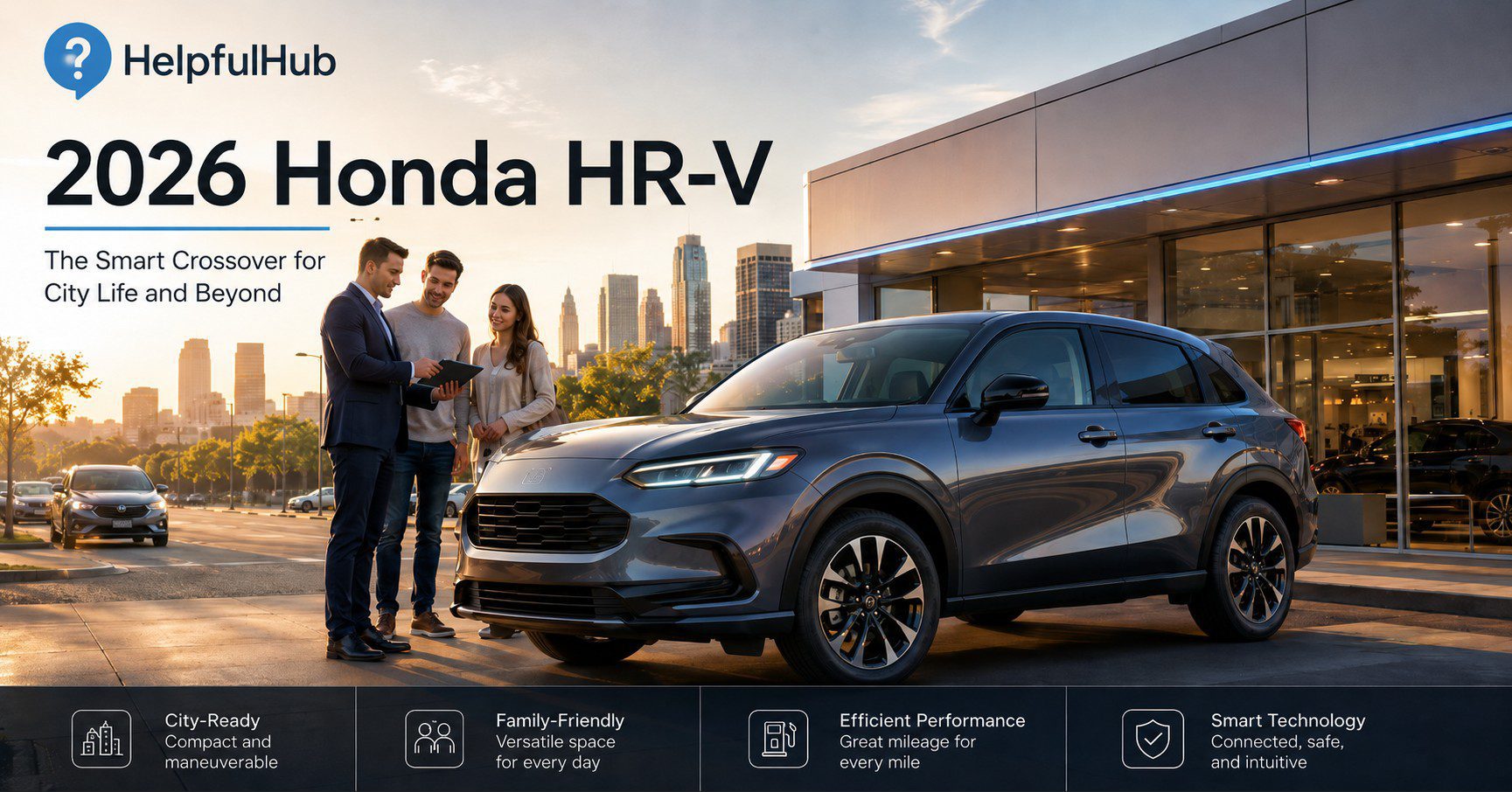
2026 Honda HR-V: Features, Trims, AWD, Price, and Buyer Guide
This guide explains the HR-V for compact crossover buyers, first-time SUV shoppers, students, young professionals, city drivers, and small families. We will look at trims, AWD, technology, city driving, commuter usability, ownership cost, financing, insurance, and how to compare a new HR-V with a used one before visiting a Honda dealership.
Quick Answer
The 2026 Honda HR-V is a practical compact crossover for commuters, city drivers, small families, and first-time SUV buyers who want a simple five-passenger SUV with available AWD and familiar Honda usability. Buyers should compare LX, Sport, and EX-L trims based on comfort, technology, AWD needs, driver-assistance features, insurance, financing, and long-term ownership cost. AWD can make sense in snowbelt states or areas with rough-weather driving, but it should be chosen because of real driving needs, not just because it sounds better. Before buying, verify current pricing, destination charge, availability, dealer fees, accessories, financing offers, and trim details with Honda or your local dealer.
2026 Honda HR-V: What US Buyers Should Know
The 2026 Honda HR-V sits in a popular part of the US market: the small crossover space. Many buyers like this category because it offers a higher seating position than many sedans, easier cargo loading than a small car, and a footprint that still works well in city parking lots, apartment garages, college campuses, and suburban driveways.
Honda lists the HR-V as a five-passenger crossover with LX, Sport, and EX-L trims. It uses a 2.0-liter DOHC i-VTEC 4-cylinder engine, a continuously variable transmission, and available Real Time AWD with Intelligent Control System. Honda also lists a 3-mode drive system with ECON, Normal, and Snow modes, along with Hill Descent Control and Hill Start Assist.
For shoppers comparing the Honda 2026 lineup, the HR-V is the smaller, more city-friendly SUV choice. It is different from the larger Honda Pilot three-row SUV guide and different from the hybrid-focused Honda CR-V hybrid SUV guide. The HR-V is best understood as a practical compact crossover for everyday driving.
2026 Honda HR-V Key Buyer Details at a Glance
| Buyer Detail | What to Know | Why It Matters |
|---|---|---|
| Vehicle type | Compact crossover / subcompact SUV-style model | Easy size for commuting, city driving, and small-family use |
| Seating | Five-passenger layout | Works for singles, couples, small families, and carpool needs |
| Engine | 2.0-liter DOHC i-VTEC 4-cylinder engine | Simple gas-powered setup for everyday driving |
| Output | Honda lists 158 horsepower and 138 lb-ft of torque | Best judged during a test drive, especially with passengers or cargo |
| Transmission | Continuously variable transmission | Designed for smooth daily driving rather than sporty shifting |
| AWD | Available Real Time AWD | Worth considering for snow, hills, wet roads, and rough-weather states |
| Trims | LX, Sport, and EX-L | Compare comfort, tech, wheels, seating materials, and driver-assist features |
Is the 2026 Honda HR-V Redesigned or Updated?
Buyers should be careful with wording around any new model year. Unless Honda clearly calls a vehicle all-new or fully redesigned, it is safer to describe it as the current HR-V model year rather than claiming a complete redesign. For the 2026 HR-V, shoppers should check Honda’s official pages and local dealer inventory for the latest trim and feature details.
That matters because car shoppers often see confusing wording online. Some articles may use terms like refresh, redesign, carryover, or update without proving what changed. A smart buyer should focus less on labels and more on what the actual vehicle includes: the engine, drivetrain, safety features, interior technology, seat comfort, cargo space, pricing, and dealer availability.
If you are comparing several Honda models, use the HR-V as the practical small crossover choice. For broader brand context, the Honda in USA guide can help explain Honda’s American market presence, while this article stays focused on the HR-V as a buying decision.
Quick Comparison: LX, Sport, EX-L, FWD, and AWD
The main shopping decision is not just “Should I buy an HR-V?” It is “Which HR-V should I buy, and do I need AWD?” The LX can make sense for buyers who want the lowest starting point. The Sport adds a more aggressive look and useful comfort upgrades. The EX-L is aimed at buyers who want more premium interior details and technology.
Honda lists available Real Time AWD on the trims. That gives buyers flexibility, but it also means the best value depends on where and how you drive. A buyer in Florida or Southern California may not need AWD the same way a buyer in Michigan, Colorado, Pennsylvania, Vermont, or upstate New York might.
FWD vs AWD HR-V Buyer Comparison
| Choice | Best For | What to Consider |
|---|---|---|
| FWD | City drivers, mild-weather commuters, buyers focused on lower cost | Usually the simpler choice if you rarely face snow, steep driveways, or rough weather |
| AWD | Snowbelt states, frequent rain, hilly areas, rough-weather commuting | Can improve confidence, but compare price, fuel economy, and your real driving needs |
| Snow mode | Winter driving support | Helpful in slick conditions, but it does not replace winter tires or careful driving |
| Hill Descent Control | Downhill control on steep grades | Useful for certain terrain, but most urban buyers may use it rarely |
| Test drive check | Every buyer | Drive the exact drivetrain and trim you plan to buy before signing |
Exterior Design and Compact SUV Practicality
The HR-V’s exterior appeal comes from its small-SUV shape. It gives buyers a crossover look without forcing them into a large vehicle. That can be a major advantage in tight apartment parking, downtown streets, school pickup lanes, grocery store lots, and narrow suburban driveways.
Compact crossovers are popular because they sit between sedans and larger SUVs. They feel more flexible than many small cars, but they do not carry the size penalty of a midsize or three-row SUV. The HR-V is especially relevant for shoppers who want a daily driver first and a light weekend vehicle second.
When you inspect the exterior, do not only focus on color and wheels. Check mirror visibility, door opening angles, rear hatch height, roofline shape, parking visibility, and how easy it is to load bags into the cargo area. Small details can matter more than styling after six months of ownership.
Interior Technology and Display Features
The 2026 HR-V interior should be evaluated around comfort, visibility, controls, storage, and everyday technology. A good compact SUV cabin should feel simple to use while driving. It should not require too much menu digging for normal tasks like changing audio, adjusting climate controls, connecting a phone, or backing into a parking space.
Honda lists a 9-inch color touchscreen for the 2026 HR-V. That matters because many buyers rely on maps, music, messages, and calls every day. The screen is only part of the experience, though. During your test drive, check the responsiveness, menu layout, volume control, visibility in sunlight, and how well your phone connects.
Seat comfort is another major point. A student may use the HR-V mostly around campus, while a commuter may spend an hour or more per day in traffic. A small family may care more about rear-seat access, child-seat space, and how easily bags fit behind the second row.
Apple CarPlay, Android Auto, HondaLink, and Wireless Charging
Phone integration is one of the most important everyday features for modern US buyers. Honda lists wireless Apple CarPlay and wireless Android Auto compatibility for the 2026 HR-V. That can reduce cable clutter and make the SUV feel more modern during daily commuting.
Honda also highlights HondaLink and wireless phone charging availability or standard details depending on the feature and trim information. Buyers should confirm exactly which features are included on the specific vehicle they are considering. Sometimes a feature appears in marketing, but the exact availability can depend on trim, package, region, or dealer inventory.
Before buying, pair your phone at the dealership. Open your map app, test audio, make a call, check wireless charging with your case on, and confirm that the USB ports fit your needs. These small tests can prevent frustration after purchase.
Engine, CVT, FWD, AWD, and Snow Mode Explained
The 2026 Honda HR-V is listed with a 2.0-liter DOHC i-VTEC 4-cylinder engine producing 158 horsepower and 138 lb-ft of torque. It is paired with a continuously variable transmission. In simple terms, this setup is built for normal driving, traffic, errands, school runs, highway commuting, and everyday crossover use.
A CVT does not shift like a traditional automatic transmission. Instead, it changes ratios smoothly to match driving conditions. Some buyers like that smooth feel, while others prefer a more traditional stepped shifting sensation. That is why a test drive matters, especially if you are coming from an older sedan, truck, or SUV.
Available Real Time AWD can help the HR-V respond to changing traction needs. Honda’s system can send torque to the rear wheels when needed. However, AWD is not magic. It does not make a vehicle stop faster on ice, and it should not replace good tires, safe speed, or winter driving judgment.
Snow mode is useful for drivers in cold-weather regions. It can help tune the vehicle’s response for slick conditions. If you live in a snowbelt state, compare AWD with proper tires, insurance cost, and the total monthly payment before making your final decision.
Trim Overview: LX, Sport, and EX-L
The three-trim structure makes the HR-V easier to shop than vehicles with too many confusing packages. LX is the entry point. Sport is the visual and comfort upgrade. EX-L is the more premium choice with higher-end cabin details and more convenience features.
At the time of writing, Honda listed starting MSRPs for the 2026 HR-V trims on its official trim comparison page. However, destination charges, dealer fees, accessories, taxes, registration, and local market conditions can change the final out-the-door price. Always ask for a written quote before comparing offers.
2026 Honda HR-V Trim Buyer Guide
| Trim | Buyer Profile | What to Check |
|---|---|---|
| LX | Budget-focused buyers who want the HR-V basics | Confirm included tech, seat comfort, audio needs, and whether FWD is enough |
| Sport | Buyers who want a sportier look and added comfort features | Compare wheel design, heated front seats, blind spot information, and AWD pricing |
| EX-L | Buyers who want more comfort, leather-trimmed seating, and premium features | Check monthly payment difference, parking sensors, moonroof, audio, and long-term value |
| FWD versions | Drivers in mild climates or buyers watching total cost | Compare fuel economy, price, and your actual weather needs |
| AWD versions | Drivers in snow, rain, hills, or rougher conditions | Compare added cost and whether you also need better seasonal tires |
Daily Commuting and City Driving
For many buyers, the HR-V will spend most of its life in traffic, parking lots, school lanes, and suburban roads. That is where a compact crossover can make sense. It offers a higher seating position than many sedans without feeling too large for daily use.
City drivers should pay attention to visibility, turning feel, brake response, and how easy it is to judge the corners of the vehicle. If you parallel park often, check camera clarity and parking sensor availability. If you drive in stop-and-go traffic, make sure the seat, steering wheel, and infotainment controls feel comfortable after more than a short test loop.
Commuters should also compare the HR-V with a sedan such as the 2026 Honda Accord. A sedan may feel smoother or more spacious in some driving situations, while the HR-V may offer easier cargo loading and a more SUV-like seating position.
Commuter, City Driver, and Small-Family Use Case Table
| Use Case | Why the HR-V May Fit | What to Test |
|---|---|---|
| Daily commuter | Compact size, useful tech, and easy cabin controls | Seat comfort, road noise, screen visibility, and CVT feel |
| City driver | Small SUV footprint helps with parking and tight streets | Rear visibility, turning radius feel, camera quality, and blind spots |
| Student or young professional | Practical size for campus, apartments, errands, and weekend plans | Insurance quote, monthly payment, phone connection, and cargo flexibility |
| Small family | Five-passenger layout and crossover cargo access | Child-seat fit, stroller space, rear doors, and rear-seat comfort |
| Weekend user | Enough flexibility for groceries, gear, luggage, and short trips | Cargo floor, hatch opening, passenger comfort, and AWD needs |
Small-Family Use, Cargo Space, and Weekend Practicality
The HR-V can work well for small families, but buyers should be realistic. It is not a replacement for a larger three-row SUV. If you regularly carry several passengers, bulky sports equipment, large strollers, pets, and luggage at the same time, compare it with larger Honda SUVs before deciding.
For everyday use, the HR-V’s appeal is flexibility. A compact crossover can handle grocery runs, school bags, gym gear, small road trips, and occasional home improvement errands better than many small sedans. The rear hatch shape can also make loading easier than reaching into a sedan trunk.
Bring real items to the dealership if possible. A stroller, child seat, work bag, sports bag, or suitcase can reveal more than a brochure. Also check whether rear passengers have enough space behind your normal driving position.
Safety and Driver Assistance Considerations
Honda lists Honda Sensing safety and driver-assistive technologies for the 2026 HR-V. These features can support daily driving by helping with warnings and driver assistance. However, buyers should remember that these systems assist the driver; they do not replace attention, safe speed, or good judgment.
Honda highlights features such as Collision Mitigation Braking System, Road Departure Mitigation, Adaptive Cruise Control with Low-Speed Follow, Lane Keeping Assist, Forward Collision Warning, Lane Departure Warning, Traffic Jam Assist, and Traffic Sign Recognition. Availability and details should be checked on the exact trim you plan to buy.
Blind spot information with cross traffic monitor is especially useful for urban and suburban drivers, but Honda notes that blind spot information is standard on Sport and EX-L trims. If this feature matters to you, do not assume every HR-V on the lot includes it.
Ownership Cost, Insurance, and Maintenance
The purchase price is only one part of the HR-V decision. A smart buyer also compares insurance, fuel, maintenance, taxes, registration, financing, accessories, and long-term depreciation. This is where some buyers make mistakes: they focus on the monthly payment but ignore the full cost of ownership.
Because the HR-V is a smaller gas-powered crossover, it may appeal to buyers who want a practical vehicle without moving into a larger SUV. Still, insurance can vary widely based on age, location, driving record, credit-based insurance factors where allowed, trim, coverage level, and deductible.
Maintenance expectations should include oil changes, tire rotations, brake inspections, filters, fluids, wipers, tires, and normal wear items. If you choose AWD, ask whether any drivetrain maintenance expectations differ over time. Also compare tire replacement costs by wheel size.
Ownership Cost Checklist
| Cost Area | What to Ask | Why It Matters |
|---|---|---|
| Insurance | Get quotes for LX, Sport, EX-L, FWD, and AWD if possible | Trim and location can change your real monthly cost |
| Fuel | Compare official fuel economy ratings and your commute pattern | City-heavy driving may feel different from highway commuting |
| Maintenance | Ask about service intervals and common wear items | Routine care affects long-term ownership cost |
| Tires | Check replacement pricing for the wheel size you choose | Larger wheels can sometimes cost more to replace |
| Accessories | Review cargo trays, mats, protection film, and dealer add-ons | Extras can raise the out-the-door price quickly |
| Financing | Compare APR, term length, down payment, and total interest | A low monthly payment can still become expensive over time |
Financing, Leasing, and Trade-In Tips
Financing can make the HR-V affordable month to month, but the loan term matters. A longer loan can lower the payment while increasing total interest. Before signing, compare the out-the-door price, APR, loan length, down payment, trade-in value, and any dealer add-ons.
Use a payment tool before you visit the dealership. The HelpfulHub car payment calculator can help estimate your monthly HR-V payment with different down payments and loan terms. This helps you walk into the dealership with a realistic budget.
Leasing may fit drivers who want a newer vehicle every few years and drive predictable mileage. However, lease terms can include mileage limits, wear charges, and end-of-lease decisions. Financing may fit buyers who want to keep the HR-V longer and build ownership equity over time.
For trade-ins, get more than one value estimate before negotiating. A dealer may offer convenience, but outside offers can help you understand your car’s market value. Keep the trade-in discussion separate from the new HR-V price until you understand both numbers.
New 2026 HR-V vs Used HR-V: What Buyers Should Consider
A new HR-V gives buyers the latest model-year features, full new-vehicle ownership experience, and the ability to choose trim, color, drivetrain, and accessories if inventory allows. A used HR-V or certified pre-owned HR-V may cost less upfront, but condition, mileage, service history, warranty coverage, and financing terms matter.
Do not assume used is always cheaper long term. A lower purchase price can be offset by higher interest rates, older tires, upcoming maintenance, less warranty coverage, or features you wish you had. On the other hand, a lightly used HR-V may make strong financial sense for budget-focused buyers.
HelpfulHub’s new vs used vehicle cost guide and buying new vs used car guide can help you compare long-term cost, not just the window sticker.
New 2026 HR-V vs Used HR-V Considerations
| Choice | Potential Advantage | Potential Concern |
|---|---|---|
| New 2026 HR-V | Latest model-year features, full new ownership experience, chosen trim if available | Higher upfront price, destination charge, dealer fees, and faster early depreciation |
| Certified pre-owned HR-V | May include added inspection and warranty benefits depending on program | Inventory, mileage, and feature availability can vary |
| Used HR-V | Lower purchase price may help budget-focused buyers | Condition, maintenance history, tires, brakes, and financing rate matter |
| Older HR-V generation | May cost less and still meet basic needs | May have different size, tech, safety, and driving feel |
| Lease return | Could offer predictable history and lower mileage | Inspect wear, service records, and remaining warranty carefully |
Compact SUV vs Sedan: Should You Choose the HR-V?
Some buyers automatically choose an SUV because crossovers are popular. However, a sedan may still be a better fit for certain drivers. The right choice depends on seating position, cargo needs, budget, fuel economy, insurance, parking, and how the vehicle feels on your normal roads.
The HR-V makes sense if you want easier cargo loading, a small SUV shape, available AWD, and a higher seating position. A sedan may make sense if you want a lower driving position, potentially more rear-seat stretch in some models, or a different highway feel.
If you are torn between a small crossover and a sedan, test drive both on the same day. Try the HR-V and a sedan route that includes parking, highway merging, rough pavement, and stop-and-go traffic. The difference is often clearer in real driving than in online research.
Competitor Shopping Context for Compact Crossover Buyers
The HR-V competes in a crowded compact crossover field. US shoppers commonly compare it with the Toyota Corolla Cross, Mazda CX-30, Subaru Crosstrek, Hyundai Kona, and Kia Seltos. Each model has a different personality, so avoid choosing only by brand name.
Compare size, seat comfort, cargo area, AWD availability, fuel economy ratings, safety technology, infotainment ease, insurance quote, financing terms, and dealer experience. Also compare real out-the-door pricing because discounts, fees, accessories, and inventory can change the final deal.
The HR-V may appeal most to buyers who already like Honda’s practical feel and want a compact crossover that is easy to drive. Still, competitors may offer different powertrain choices, styling, feature packaging, or pricing. A good buyer guide should help you create a shortlist, not force one answer for everyone.
Common Buyer Mistakes to Avoid
One common mistake is choosing AWD without thinking through actual needs. AWD can be useful, but it adds cost and may affect fuel economy. If you live in a mild-weather area and mostly drive on paved city roads, FWD may be enough.
Another mistake is focusing only on monthly payment. A payment can look affordable if the loan term is long, but the total interest may be much higher. Always compare the out-the-door price and total loan cost.
Some buyers also skip the insurance quote. This is risky for young drivers, first-time SUV buyers, and drivers moving from an older car to a new crossover. Insurance can change the real affordability of the vehicle.
Finally, do not assume every trim includes every feature you saw in photos or videos. Confirm the exact window sticker, feature list, accessories, and dealer add-ons for the vehicle you plan to buy.
Practical Expert Insight
The smartest way to shop the HR-V is to start with your real use case, not the trim ladder. If you commute in a mild-weather city, an FWD LX or Sport may be enough. If you face winter roads, steep hills, or frequent rain, AWD becomes more important, but it should be compared against tire choice, monthly payment, and long-term cost.
For many buyers, Sport may be the emotional middle ground because it adds style and comfort without moving all the way to the highest trim. However, EX-L can make sense if you care about a more premium cabin, parking support, audio, and comfort features. The key is to compare the monthly difference, not just the sticker difference.
Before visiting a dealership, write down your must-have features. Then test drive the exact trim and drivetrain you would buy. Check visibility, seat comfort, phone connection, cargo use, rear-seat access, and insurance cost. A 20-minute test drive with your real checklist is more valuable than hours of reading trim summaries.
FAQ
What is new in the 2026 Honda HR-V?
The safest answer is to check Honda’s current official HR-V trim and feature information before buying, because model-year details can change by trim and dealer inventory. Honda lists the 2026 HR-V with LX, Sport, and EX-L trims, a 2.0-liter DOHC i-VTEC 4-cylinder engine, CVT, available Real Time AWD, a 3-mode drive system, Honda Sensing, and modern phone connectivity features. Instead of focusing only on what changed, buyers should compare the exact vehicle on the lot for technology, AWD, safety features, seating, cargo space, pricing, fees, and financing terms.
Is the 2026 Honda HR-V redesigned?
Do not assume the 2026 Honda HR-V is fully redesigned unless Honda clearly confirms that wording. Many online pages use terms like updated, refreshed, or new without explaining the difference. For shoppers, the more important question is whether the current HR-V meets your needs. Compare the engine, CVT feel, available AWD, Snow mode, technology, seat comfort, cargo space, safety features, and trim pricing. If a dealer or article claims a major redesign, ask what specifically changed and verify it with official Honda information.
Is the 2026 Honda HR-V good for commuting?
The HR-V can be a strong commuter choice for buyers who want a compact crossover instead of a sedan. Its small-SUV size helps in traffic, parking lots, apartment garages, and city streets. The 9-inch touchscreen, wireless smartphone integration, available driver-assistance features, and practical cabin layout can also help daily usability. However, every commuter should test drive the exact trim. Pay attention to seat comfort, road noise, screen visibility, CVT feel, acceleration for highway merging, and fuel economy expectations for your actual route.
Is the 2026 Honda HR-V good for small families?
The HR-V can work for small families that need a practical five-passenger crossover for school runs, groceries, commuting, and weekend errands. It is easier to park than many larger SUVs and can offer more flexible cargo loading than a sedan. However, families should test real-life needs before buying. Bring a child seat, stroller, sports bag, or suitcase to the dealership if possible. Check rear-seat access, cargo height, visibility, and passenger comfort. If your family regularly carries lots of people and gear, compare larger Honda SUVs too.
Which 2026 Honda HR-V trim should buyers consider?
The best trim depends on budget and must-have features. LX may fit buyers who want the lowest starting point and a simple compact crossover. Sport may appeal to shoppers who want a more expressive look and comfort upgrades. EX-L may make sense for buyers who want more premium cabin details and convenience features. Do not choose only by trim name. Compare the window sticker, AWD pricing, insurance quote, monthly payment, phone features, seating materials, parking support, and the exact features on the vehicle you plan to buy.
Is AWD worth it on the 2026 Honda HR-V?
AWD may be worth considering if you live in a snowbelt state, drive through frequent rain, use hilly roads, or want extra confidence in rough-weather conditions. Honda lists available Real Time AWD with Intelligent Control System for the HR-V. Still, AWD is not necessary for every driver. It can add cost and may affect fuel economy, so buyers in mild climates should compare FWD carefully. Also remember that AWD helps with traction, but it does not replace safe driving, good tires, or proper braking distance.
What should buyers check before buying a 2026 Honda HR-V?
Before buying, verify current trim pricing, destination charge, dealer fees, taxes, accessories, and availability. Compare LX, Sport, and EX-L features on the exact window sticker. Decide whether FWD or AWD fits your real driving conditions. Test seat comfort, visibility, rear-seat access, cargo space, phone pairing, wireless charging, camera quality, and parking support. Get an insurance quote before signing. Also compare financing, lease terms, trade-in value, and total ownership cost, not just the monthly payment shown by the dealer.
Should buyers compare a new 2026 HR-V with a used HR-V?
Yes. A new 2026 HR-V may give you the latest model-year equipment, full new-vehicle ownership experience, and the ability to choose the trim and drivetrain if inventory allows. A used or certified pre-owned HR-V may lower the purchase price, but mileage, condition, service history, warranty coverage, tire wear, brake condition, and financing rate matter. Compare total cost over several years. Sometimes a new vehicle with a better rate can be competitive, while a well-kept used HR-V can be the smarter budget choice.
Final 2026 Honda HR-V Buyer Checklist
- Verify current trim pricing and availability with Honda or your local dealer.
- Compare LX, Sport, and EX-L features using the exact window sticker.
- Decide whether FWD or AWD makes more sense for your driving.
- Test drive the trim and drivetrain you plan to buy.
- Check seat comfort, driving position, visibility, and road noise.
- Check cargo space for commuting, family, school, work, or weekend needs.
- Compare compact SUV practicality against sedan comfort and cost.
- Estimate insurance before buying, especially if you are a young driver or first-time SUV buyer.
- Compare financing and lease offers from more than one source.
- Calculate the monthly payment and total loan cost before signing.
- Compare a new 2026 HR-V with a certified pre-owned or used HR-V.
- Review maintenance expectations, tire cost, and accessory pricing.
- Avoid choosing AWD only because it sounds better.
- Use the HelpfulHub car payment calculator when comparing affordability.
Conclusion
The 2026 Honda HR-V is worth considering if you want a practical compact crossover for commuting, city driving, small-family use, and everyday errands. It offers a small-SUV footprint, five-passenger usability, available AWD, familiar Honda technology, and a trim structure that is easy to compare.
The best choice depends on your real driving life. Compare LX, Sport, and EX-L trims, then decide whether FWD or AWD fits your climate, roads, and budget. Check total ownership cost, not just the monthly payment. Also compare insurance, maintenance, cargo needs, phone features, comfort, and long-term usability.
Before you buy, test drive the exact HR-V you are considering and compare it with at least one competitor or used HR-V option. A careful shopping process will help you choose the right 2026 Honda HR-V for your commute, family needs, budget, and long-term ownership plan.